
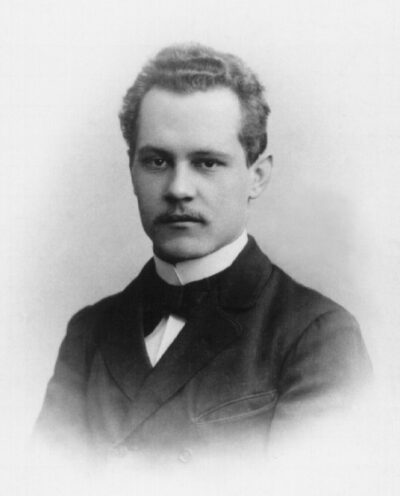
Arnold Sommerfeld
Arnold Sommerfeld was a German physicist. Born December 5, 1868, in Königsberg. Died April 26, 1951, in Munich. Positions held include Geheimrat and president (1919–1920). Known for fine-structure constant, Bohr-Sommerfeld atom model and Sommerfeld number. Educated at University of Königsberg and Altstadt Gymnasium. Awards include Max Planck Medal, Lorentz Medal and Oersted Medal.
Facts
50 facts · 2 confirmed by two sources · 17 cited · 31 from one source
Where this comes from
Papalocal keeps its own record. It started from these sources; what each one said is kept here as it was copied, so a change on their side never changes this page by itself. Tap one to read its version.
What Wikidata says · copied November 16, 2026 · revision 2563984568
- Described as
- German physicist (1868-1951)
- Other names
- Arnold Johannes Wilhelm Sommerfeld
- Born
- December 5, 1868 · 8 references
- Died
- April 26, 1951 · 8 references
- Born in
- Königsberg · 3 references
- Died in
- Munich · 4 references
- Buried in
- Nordfriedhof · 1 reference
- Cause of death
- traffic collision
- Name at birth
- Arnold Johannes Wilhelm Sommerfeld · 1 reference
- Citizen of
- Germany
- Occupation
- theoretical physicist; mathematician; university teacher; physicist · 1 reference
- Positions held
- Geheimrat · 1 reference; president (1919–1920) · 1 reference
- Worked for
- LMU Munich (1906–1947) · 1 reference; RWTH Aachen University (1900–1906) · 1 reference; University of Göttingen (1893–1897) · 1 reference; Clausthal University of Technology (1897–1900) · 2 references
- Education
- University of Königsberg (1886–1891) · 1 reference; Altstadt Gymnasium (1875–1886) · 1 reference
- Member of
- Royal Society of London (1926–); National Academy of Sciences (1929–); Bavarian Academy of Sciences and Humanities; American Academy of Arts and Sciences; Hungarian Academy of Sciences; Russian Academy of Sciences (1925–) · 1 reference; Royal Prussian Academy of Sciences; Burschenschaft Germania Königsberg · 1 reference; Göttingen Academy of Sciences and Humanities in Lower Saxony; Accademia Nazionale dei Lincei (1929–) · 1 reference
- Known for
- fine-structure constant; Bohr-Sommerfeld atom model; Sommerfeld number; Orr–Sommerfeld equation; Sommerfeld identity; Sommerfeld radiation condition; Sommerfeld–Kossel displacement law; Lectures on Theoretical Physics
- Awards
- Max Planck Medal (1931) · 1 reference; Lorentz Medal (1939) · 1 reference; Oersted Medal (1949) · 1 reference; Bavarian Maximilian Order for Science and Art (1931); Matteucci Medal (1924) · 1 reference; Foreign Member of the Royal Society (1926) · 1 reference; honorary doctor of the University of Calcutta · 1 reference
- Field
- theoretical physics; mathematical physics; spectroscopy
- Spouse
- Johanna Sommerfeld · 1 reference
- Father
- Franz Sommerfeld · 1 reference
- Wikipedias with a page
- 78
Wikidata item Q77078 (wikidata.org/wiki/Q77078), public domain (CC0). Copied November 16, 2026.
What Wikipedia says · copied November 16, 2026 · revision 1373972793
Arnold Johannes Wilhelm Sommerfeld (German: [ˈaʁnɔlt ˈzɔmɐˌfɛlt]; 5 December 1868 – 26 April 1951) was a German theoretical physicist who pioneered developments in both atomic and quantum physics, and also educated and mentored many students for the new era of theoretical physics.
Sommerfeld served as doctoral advisor and postdoctoral advisor to seven Nobel Prize winners and supervised at least 30 other famous physicists and chemists.
Sommerfeld introduced the second quantum number, azimuthal quantum number, and the third quantum number, magnetic quantum number. He also introduced the fine-structure constant and pioneered X-ray wave theory.
- Born, in its opening lines
- December 5, 1868
- Died, in its opening lines
- April 26, 1951
From the Wikipedia article “Arnold Sommerfeld” (en.wikipedia.org/wiki/Arnold_Sommerfeld), by its contributors, under CC BY-SA 4.0 (creativecommons.org/licenses/by-sa/4.0/). Copied November 16, 2026; not changed.
Confirmed Two sources agree. Cited One source, and it names where it got it. One source One source, without a reference of its own. Sources disagree The sources disagree. We show the best-supported value and keep theirs below.
