
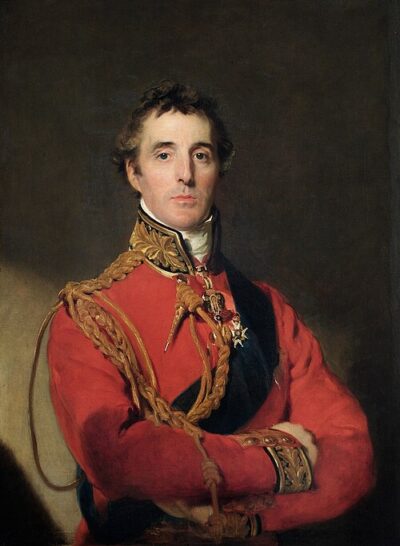
Arthur Wellesley, 1st Duke of Wellington
Arthur Wellesley, 1st Duke of Wellington was a British Field Marshal, Prime Minister of the United Kingdom, 1828–1830, 1834. Born May 1, 1769, in Dublin. Died September 14, 1852, in Walmer Castle. Positions held include Prime Minister of the United Kingdom (2 times) (1828–1834), member of the 4th Parliament of the United Kingdom and Home Secretary (1834). Educated at Eton College and Beverley Grammar School. Awards include Knight of the Order of the Holy Spirit, Knight of the Order of Saint Michael and Knight of the Order of the Golden Fleece.
Facts
69 facts · 2 confirmed by two sources · 20 cited · 47 from one source
Where this comes from
Papalocal keeps its own record. It started from these sources; what each one said is kept here as it was copied, so a change on their side never changes this page by itself. Tap one to read its version.
What Wikidata says · copied November 16, 2026 · revision 2568005891
- Described as
- British Field Marshal, Prime Minister of the United Kingdom, 1828–1830, 1834 (1769-1852)
- Other names
- Iron Duke, His Grace the Duker of Wellington, Arthur Wesley, Duke of Wellington, 1st Duke of Wellington Arthur Wellesley, Wellington, Nosey, Arthur, Duke of Wellington Wellesley, Duke of Wellington, Great Duke, Duke of Wellington Arthur Wellesley, 1st duke of Wellington, marquess of Douro, marquess of Wellington, earl of Wellington, Viscount Wellington of Talavera and of Wellington, Baron Douro or Wellesley Arthur Wellesley, Field Marshal Arthur Wellesley, 1st Duke of Wellington
- Born
- May 1, 1769 · 9 references
- Died
- September 14, 1852 · 9 references
- Born in
- Dublin · 3 references
- Died in
- Walmer Castle
- Buried in
- St Paul's Cathedral
- Cause of death
- stroke
- Name at birth
- Arthur Colley Wellesley
- Citizen of
- Kingdom of Ireland (–1800); United Kingdom of Great Britain and Ireland (1801–); Kingdom of Portugal
- Occupation
- politician · 3 references; diplomat; military officer · 1 reference; head of government · 1 reference; Generalfeldmarschall · 1 reference
- Positions held
- Prime Minister of the United Kingdom (2 times) (1828–1834); member of the 4th Parliament of the United Kingdom; Home Secretary (1834); Secretary of State for Foreign and Commonwealth Affairs (1834–1835); Member of Parliament in the Parliament of Ireland; Leader of the House of Lords (3 times) (1828–1846); Secretary of State for War and the Colonies; Member of the Privy Council of Ireland; Member of the Privy Council of the United Kingdom; ambassador of the United Kingdom to France (1814–1815) · 1 reference; Constable of the Tower (1826–1852); member of the 3rd Parliament of the United Kingdom; member of the 2nd Parliament of the United Kingdom; Chancellor of the University of Oxford (1834–1852); Lord Lieutenant of Hampshire (1820–1852)
- Political party
- Tories (–1834); Conservative Party (1834–)
- Worked for
- University of Oxford; Foreign Office · 1 reference
- Education
- Eton College · 1 reference; Beverley Grammar School; Drogheda Grammar School
- Member of
- Royal Society of London; Academy of Science for Public Utility
- Awards
- Knight of the Order of the Holy Spirit (1815); Knight of the Order of Saint Michael; Knight of the Order of the Golden Fleece (1812); Fellow of the Royal Society; Grand Cross of the Military Order of Maria Theresa; Order of the Black Eagle; Knight Grand Cross of the Order of the Bath; Knight Grand Cross of the Military Order of William (1815) · 1 reference; Order of Saint Alexander Nevsky; Order of St. Andrew; Knight of the Garter (1814); Order of St Patrick; Royal Order of the Welfs; Order of Saint Ferdinand; Grand Cross of the Royal and Military Order of Saint Hermenegild (1817)
- Spouse
- Catherine Wellesley, Duchess of Wellington (1806–) · 2 references
- Children
- Arthur Wellesley, 2nd Duke of Wellington · 1 reference; Lord Charles Wellesley · 1 reference
- Father
- Garret Wesley, 1st Earl of Mornington · 1 reference
- Mother
- Anne Wellesley, Countess of Mornington · 1 reference
- Siblings
- Lady Anne Culling Smith · 1 reference; William Wellesley-Pole, 3rd Earl of Mornington · 1 reference; Henry Wellesley, 1st Baron Cowley · 1 reference; Richard Wellesley, 1st Marquess Wellesley · 1 reference; Gerald Valerian Wellesley · 1 reference
- Military branch
- British Army (1787–)
- Military rank
- field marshal (1813–); general field marshal (1818–)
- Lived in
- Dangan Castle
- Nickname
- Nosey · 1 reference
- Wikipedias with a page
- 103
Wikidata item Q131691 (wikidata.org/wiki/Q131691), public domain (CC0). Copied November 16, 2026.
What Wikipedia says · copied November 16, 2026 · revision 1384980652
Field Marshal Arthur Wellesley, 1st Duke of Wellington (né Wesley; 1 May 1769 – 14 September 1852), was a British Army officer and statesman. A leading figure in early-19th-century British politics, Wellesley served as Prime Minister of the United Kingdom and as Commander-in-Chief of the Forces.
Wellesley was born into the Wellesley family in Dublin, in the Kingdom of Ireland. He was commissioned as an ensign in the British Army in 1787, serving in Ireland as aide-de-camp to two successive lords lieutenant of Ireland. He was also elected as a member of Parliament in the Irish House of Commons. Rising to the rank of colonel by 1796, Wellesley served in the Flanders campaign before being sent to India, where he fought in the Fourth Anglo-Mysore War, ending the conflict with a victory at Seringapatam in 1799. He was appointed governor of Seringapatam and Mysore and, as a newly appointed major general, won a decisive victory over the Maratha Confederacy at the Battle of Assaye in 1803.
Rising to prominence as a general officer during the Peninsular War, Wellesley was promoted to field marshal after leading British-led forces to victory against the French army at the Battle of Vitoria in 1813. Following Napoleon's first exile in 1814, Wellesley served as the British ambassador to France and was made Duke of Wellington. During the Hundred Days campaign in 1815, Wellington commanded another British-led army which, together with a Prussian army under Field Marshal Gebhard von Blücher, defeated Napoleon I at the battle of Waterloo.
After the end of his active military career, Wellington returned to politics, becoming a prominent member of the British Tory party. He served as prime minister from 1828 to 1830, as well as on an interim basis for a little less than a month in 1834. Wellington oversaw the passage of the Roman Catholic Relief Act 1829 and opposed the Reform Act 1832. He continued to be one of the leading figures in the House of Lords until his retirement in 1846 and remained Commander-in-Chief of the Forces until his death in 1852.
- Born, in its opening lines
- May 1, 1769
- Died, in its opening lines
- September 14, 1852
From the Wikipedia article “Arthur Wellesley, 1st Duke of Wellington” (en.wikipedia.org/wiki/Arthur_Wellesley,_1st_Duke_of_Wellington), by its contributors, under CC BY-SA 4.0 (creativecommons.org/licenses/by-sa/4.0/). Copied November 16, 2026; not changed.
Confirmed Two sources agree. Cited One source, and it names where it got it. One source One source, without a reference of its own. Sources disagree The sources disagree. We show the best-supported value and keep theirs below.
