
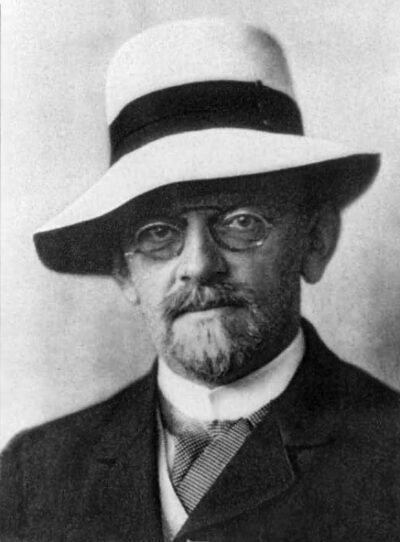
David Hilbert
David Hilbert was a German mathematician. Born January 23, 1862, in Kaliningrad. Died February 14, 1943, in Göttingen. Known for Geometry and the Imagination and Hilbert's basis theorem. Educated at University of Königsberg and Collegium Fridericianum. Awards include Pour le Mérite for Sciences and Arts order, Poncelet Prize and Cothenius Medal.
Facts
50 facts · 2 confirmed by two sources · 20 cited · 28 from one source
Where this comes from
Papalocal keeps its own record. It started from these sources; what each one said is kept here as it was copied, so a change on their side never changes this page by itself. Tap one to read its version.
What Wikidata says · copied November 16, 2026 · revision 2563977312
- Described as
- German mathematician (1862–1943)
- Other names
- Hilbert
- Born
- January 23, 1862 · 12 references
- Died
- February 14, 1943 · 13 references
- Born in
- Kaliningrad · 1 reference
- Died in
- Göttingen · 4 references
- Buried in
- Göttingen City Cemetery · 2 references
- Citizen of
- Kingdom of Prussia; German Empire; Weimar Republic; Nazi Germany
- Occupation
- mathematician · 2 references; university teacher; philosopher · 1 reference; physicist; logician; philosopher of mathematics
- Worked for
- University of Göttingen
- Education
- University of Königsberg (1880–1885) · 1 reference; Collegium Fridericianum (1870–1879) · 1 reference; Wilhelmsgymnasium (1879–1880) · 1 reference; Heidelberg University (1881) · 1 reference
- Member of
- Royal Society of London (1928–) · 1 reference; Saxon Academy of Sciences and Humanities (1929–) · 1 reference; German Academy of Sciences Leopoldina (1932–) · 1 reference; Bavarian Academy of Sciences and Humanities (1903–); Göttingen Academy of Sciences and Humanities in Lower Saxony (1895–) · 1 reference; Russian Academy of Sciences (1922–) · 2 references; Royal Swedish Academy of Sciences; Hungarian Academy of Sciences; Accademia Nazionale dei Lincei (1903–) · 1 reference; Royal Prussian Academy of Sciences (1913–) · 1 reference
- Known for
- Geometry and the Imagination; Hilbert's basis theorem
- Awards
- Pour le Mérite for Sciences and Arts order (1926); Poncelet Prize (1903); Cothenius Medal (1906); Bolyai Prize (1910); Lobachevsky Prize (1903) · 1 reference; Bavarian Maximilian Order for Science and Art (1907); Foreign Member of the Royal Society (1928) · 1 reference; Goethe Medal for Art and Science (1942)
- Field
- mathematical analysis; geometry; number theory; mathematics; Hilbert space · 1 reference; mathematical logic · 1 reference
- Spouse
- Käthe Hilbert · 1 reference
- Children
- Franz Hilbert · 1 reference
- Father
- Otto Hilbert
- Lived in
- Germany · 1 reference
- Wikipedias with a page
- 165
Wikidata item Q41585 (wikidata.org/wiki/Q41585), public domain (CC0). Copied November 16, 2026.
What Wikipedia says · copied November 16, 2026 · revision 1382016850
David Hilbert (; German: [ˈdaːvɪt ˈhɪlbɐt]; 23 January 1862 – 14 February 1943) was a German mathematician and philosopher of mathematics and one of the most influential mathematicians of all time.
Hilbert discovered and developed a broad range of fundamental ideas including invariant theory, the calculus of variations, commutative algebra, algebraic number theory, the foundations of geometry, spectral theory of operators and its application to integral equations, mathematical physics, and the foundations of mathematics (particularly proof theory). He adopted and defended Georg Cantor's set theory and transfinite numbers. In 1900, he presented a collection of problems that set a course for mathematical research of the 20th century.
Hilbert and his students contributed to establishing rigor and developed important tools used in modern mathematical physics. He was a co-founder of proof theory and mathematical logic.
- Born, in its opening lines
- January 23, 1862
- Died, in its opening lines
- February 14, 1943
From the Wikipedia article “David Hilbert” (en.wikipedia.org/wiki/David_Hilbert), by its contributors, under CC BY-SA 4.0 (creativecommons.org/licenses/by-sa/4.0/). Copied November 16, 2026; not changed.
Confirmed Two sources agree. Cited One source, and it names where it got it. One source One source, without a reference of its own. Sources disagree The sources disagree. We show the best-supported value and keep theirs below.
