
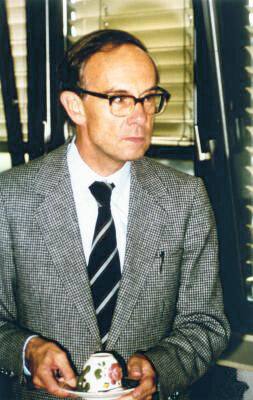
Friedrich Hirzebruch
Friedrich Hirzebruch was a German mathematician. Born October 17, 1927, in Hamm. Died May 27, 2012, in Bonn. Positions held include chairperson (1990–1994). Known for Hirzebruch signature theorem, Hirzebruch–Riemann–Roch theorem and Hirzebruch surface. Educated at University of Münster and ETH Zurich. Awards include Pour le Mérite for Sciences and Arts order, Knight Commander's Cross of the Order of Merit of the Federal Republic of Germany and Lomonosov Gold Medal.
Facts
56 facts · 2 confirmed by two sources · 33 cited · 21 from one source
Where this comes from
Papalocal keeps its own record. It started from these sources; what each one said is kept here as it was copied, so a change on their side never changes this page by itself. Tap one to read its version.
What Wikidata says · copied November 16, 2026 · revision 2569129400
- Described as
- German mathematician (1927–2012)
- Other names
- Friedrich Ernst Peter Hirzebruch, Fritz Hirzebruch
- Born
- October 17, 1927 · 7 references
- Died
- May 27, 2012 · 7 references
- Born in
- Hamm · 2 references
- Died in
- Bonn · 2 references
- Buried in
- Poppelsdorf Cemetery · 1 reference
- Name at birth
- Friedrich Ernst Peter Hirzebruch · 1 reference
- Citizen of
- Germany
- Occupation
- mathematician · 2 references; university teacher; professor of mathematics
- Positions held
- chairperson (1990–1994) · 1 reference
- Worked for
- University of Bonn (1956–1993) · 1 reference; University of Erlangen–Nuremberg (1951–1952) · 2 references; Institute for Advanced Study (1952–1954) · 2 references; University of Münster (1954–1955) · 1 reference; Princeton University (1955–1956) · 1 reference
- Education
- University of Münster (1945–1950) · 1 reference; ETH Zurich (1949–1950) · 1 reference
- Member of
- Royal Society of London (1994–) · 1 reference; German Academy of Sciences at Berlin; Saxon Academy of Sciences and Humanities (1993–) · 1 reference; German Academy of Sciences Leopoldina (1963–) · 1 reference; Austrian Academy of Sciences; French Academy of Sciences (1989–) · 1 reference; National Academy of Sciences (1986–); Berlin-Brandenburg Academy of Sciences and Humanities (1990–1992) · 1 reference; Heidelberg Academy of Sciences and Humanities (1966–) · 1 reference; Academy of Sciences and Literature Mainz (1972–) · 2 references
- Known for
- Hirzebruch signature theorem; Hirzebruch–Riemann–Roch theorem; Hirzebruch surface; Atiyah–Hirzebruch spectral sequence; Grothendieck–Hirzebruch–Riemann–Roch theorem; Inoue–Hirzebruch surface
- Awards
- Pour le Mérite for Sciences and Arts order (1991) · 1 reference; Knight Commander's Cross of the Order of Merit of the Federal Republic of Germany (1993) · 1 reference; Lomonosov Gold Medal (1996) · 1 reference; Alfried-Krupp Science Prize (2000) · 1 reference; Helmholtz Medal (2002) · 1 reference; Wolf Prize in Mathematics (1988) · 1 reference; Order of the Sacred Treasure; Cothenius Medal (1997) · 1 reference; Cantor medal (2004) · 1 reference; Lobachevsky Prize (1989) · 1 reference; Albert Einstein Medal (1999) · 1 reference; Foreign Member of the Royal Society (1994) · 1 reference; honorary doctorate from the University of Notre Dame (1989); doctor honoris causa of the University of Warwick (1980); honorary doctor of the University of Wuppertal (1987)
- Field
- mathematics · 1 reference; topology · 1 reference; complex manifold · 1 reference; algebraic geometry · 1 reference; number theory · 1 reference
- Father
- Fritz Hirzebruch · 1 reference
- Lived in
- Germany · 1 reference
- Wikipedias with a page
- 29
Wikidata item Q61753 (wikidata.org/wiki/Q61753), public domain (CC0). Copied November 16, 2026.
What Wikipedia says · copied November 16, 2026 · revision 1371996161
Friedrich Ernst Peter Hirzebruch ForMemRS (17 October 1927 – 27 May 2012) was a German mathematician, working in the fields of topology, complex manifolds and algebraic geometry, and a leading figure in his generation. He has been described as "the most important mathematician in Germany of the postwar period."
- Born, in its opening lines
- October 17, 1927
- Died, in its opening lines
- May 27, 2012
From the Wikipedia article “Friedrich Hirzebruch” (en.wikipedia.org/wiki/Friedrich_Hirzebruch), by its contributors, under CC BY-SA 4.0 (creativecommons.org/licenses/by-sa/4.0/). Copied November 16, 2026; not changed.
Confirmed Two sources agree. Cited One source, and it names where it got it. One source One source, without a reference of its own. Sources disagree The sources disagree. We show the best-supported value and keep theirs below.
