
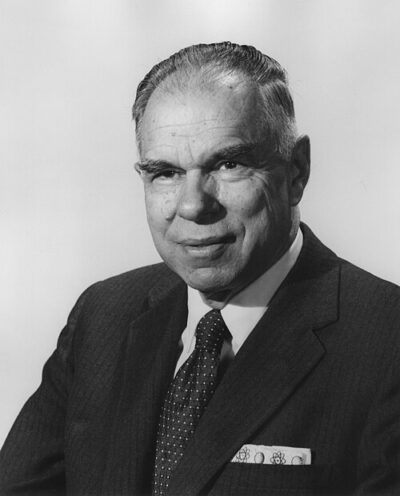
Glenn Theodore Seaborg
Glenn Theodore Seaborg was an American chemist. Born April 19, 1912, in Ishpeming. Died February 25, 1999, in Lafayette. Educated at University of California, Berkeley and University of California, Los Angeles. Awards include Nobel Prize in Chemistry, Priestley Medal and Perkin Medal.
Facts
46 facts · 2 confirmed by two sources · 17 cited · 27 from one source
Where this comes from
Papalocal keeps its own record. It started from these sources; what each one said is kept here as it was copied, so a change on their side never changes this page by itself. Tap one to read its version.
What Wikidata says · copied November 13, 2026 · revision 2568790402
- Described as
- American chemist (1912–1999)
- Other names
- G T Seaborg, G. T. Seaborg, Glenn Seaborg, Glenn T. Seaborg, G.T. Seaborg
- Born
- April 19, 1912 · 8 references
- Died
- February 25, 1999 · 9 references
- Born in
- Ishpeming · 1 reference
- Died in
- Lafayette
- Buried in
- Sunset View Cemetery · 1 reference
- Cause of death
- stroke
- Name at birth
- Glen Theodore Seaborg
- Citizen of
- United States
- Occupation
- chemist · 2 references; university teacher · 1 reference; nuclear physicist · 1 reference
- Worked for
- Manhattan Project; United States Atomic Energy Commission; University of California, Berkeley
- Education
- University of California, Berkeley (–1937) · 1 reference; University of California, Los Angeles (1929–1937) · 1 reference; Jordan High School (–1929) · 1 reference
- Member of
- Royal Society of London (1985–); German Academy of Sciences Leopoldina · 1 reference; Royal Swedish Academy of Sciences; National Academy of Sciences (1948–); Academy of Sciences of the USSR; Royal Swedish Academy of Engineering Sciences; American Academy of Arts and Sciences; Russian Academy of Sciences; American Philosophical Society (1952–) · 1 reference; American Association for the Advancement of Science · 1 reference
- Awards
- Nobel Prize in Chemistry (1951) · 2 references; Priestley Medal (1979) · 1 reference; Perkin Medal (1957) · 1 reference; John Scott Award (1952) · 1 reference; Franklin Medal (1963); ACS Award in Pure Chemistry (1947); Enrico Fermi Award (1959) · 1 reference; Swedish American of the Year (1962) · 1 reference; Legion of Honour (1973); National Inventors Hall of Fame (2005); Clark Kerr Medal (1986); Vannevar Bush Award (1988); National Medal of Science (1991); Royal Order of the Polar Star (1992); American Institute of Chemists Gold Medal (1973)
- Field
- nuclear chemistry
- Spouse
- Helen L. Seaborg (1942–1999)
- Children
- David Seaborg
- Lived in
- United States
- Wikipedias with a page
- 78
Wikidata item Q48973 (wikidata.org/wiki/Q48973), public domain (CC0). Copied November 13, 2026.
What Wikipedia says · copied November 13, 2026 · revision 1383665089
Glenn Theodore Seaborg ( SEE-borg; April 19, 1912 – February 25, 1999) was an American chemist whose involvement in the synthesis, discovery and investigation of ten transuranium elements earned him a share of the 1951 Nobel Prize in Chemistry. His work in this area also led to his development of the actinide concept and the arrangement of the actinide series in the periodic table of the elements.
Seaborg spent most of his career as an educator and research scientist at the University of California, Berkeley, serving as a professor, and, between 1958 and 1961, as the university's second chancellor. He advised ten US presidents—from Harry S. Truman to Bill Clinton—on nuclear policy and was Chairman of the United States Atomic Energy Commission from 1961 to 1971, where he pushed for commercial nuclear energy and the peaceful applications of nuclear science. Throughout his career, Seaborg worked for arms control. He was a signatory to the Franck Report and contributed to the Limited Test Ban Treaty, the Nuclear Non-Proliferation Treaty and the Comprehensive Test Ban Treaty. He was a well-known advocate of science education and federal funding for pure research. Toward the end of the Eisenhower administration, he was the principal author of the Seaborg Report on academic science, and, as a member of President Ronald Reagan's National Commission on Excellence in Education, he was a key contributor to its 1983 report "A Nation at Risk".
Seaborg was the principal or co-discoverer of ten elements: plutonium, americium, curium, berkelium, californium, einsteinium, fermium, mendelevium, nobelium and element 106, then called unnilhexium, which while he was still living, was named seaborgium in his honor. He said about this naming, "This is the greatest honor ever bestowed upon me—even better, I think, than winning the Nobel Prize. Future students of chemistry, in learning about the periodic table, may have reason to ask why the element was named for me, and thereby learn more about my work." He also discovered more than 100 isotopes of transuranium elements and is credited with important contributions to the chemistry of plutonium, originally as part of the Manhattan Project where he developed the extraction process used to isolate the plutonium fuel for the implosion-type atomic bomb. Early in his career, he was a pioneer in nuclear medicine and discovered isotopes of elements with important applications in the diagnosis and treatment of diseases, including iodine-131, which is used in the treatment of thyroid disease. In addition to his theoretical work in the development of the actinide concept, which placed the actinide series beneath the lanthanide series on the periodic table, he postulated the existence of super-heavy elements in the transactinide and superactinide series.
After sharing the 1951 Nobel Prize in Chemistry with Edwin McMillan, he received approximately 50 honorary doctorates and numerous other awards and honors. The list of things named after Seaborg ranges from the chemical element seaborgium to the asteroid 4856 Seaborg. He was the author of numerous books and 500 journal articles, often in collaboration with others. He was once listed in the Guinness Book of World Records as the person with the longest entry in Who's Who in America.
- Born, in its opening lines
- April 19, 1912
- Died, in its opening lines
- February 25, 1999
From the Wikipedia article “Glenn T. Seaborg” (en.wikipedia.org/wiki/Glenn_T._Seaborg), by its contributors, under CC BY-SA 4.0 (creativecommons.org/licenses/by-sa/4.0/). Copied November 13, 2026; not changed.
Confirmed Two sources agree. Cited One source, and it names where it got it. One source One source, without a reference of its own. Sources disagree The sources disagree. We show the best-supported value and keep theirs below.
