
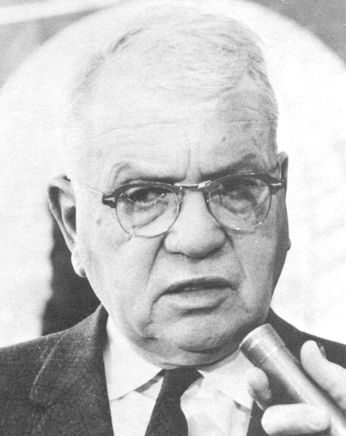
Harold Urey
Harold Urey was an American physical chemist. Born April 29, 1893, in Walkerton. Died January 5, 1981, in La Jolla. Educated at Earlham College and University of Montana. Awards include Nobel Prize in Chemistry, Franklin Medal and Medal for Merit.
Facts
52 facts · 2 confirmed by two sources · 21 cited · 29 from one source
Where this comes from
Papalocal keeps its own record. It started from these sources; what each one said is kept here as it was copied, so a change on their side never changes this page by itself. Tap one to read its version.
What Wikidata says · copied November 13, 2026 · revision 2563200251
- Described as
- American physical chemist (1893-1981)
- Other names
- Harold C. Urey, Harold Clayton Urey
- Born
- April 29, 1893 · 10 references
- Died
- January 5, 1981 · 8 references
- Born in
- Walkerton · 1 reference
- Died in
- La Jolla · 2 references
- Buried in
- Fairfield Cemetery · 1 reference
- Citizen of
- United States
- Occupation
- astronomer; chemist · 1 reference; physical chemist; physicist; university teacher; writer · 1 reference; zoologist · 1 reference
- Worked for
- University of Chicago; University of Copenhagen; Johns Hopkins University; Columbia University; University of California, San Diego · 1 reference; Lunar and Planetary Institute (1969–) · 1 reference
- Education
- Earlham College; University of Montana; University of California, Berkeley; Columbia University
- Member of
- Royal Society of London (1947–); Royal Swedish Academy of Sciences; American Academy of Arts and Sciences; Indian National Science Academy; American Philosophical Society (1935–) · 1 reference; American Astronomical Society · 1 reference; American Association for the Advancement of Science · 1 reference; American Physical Society · 1 reference; Century Association · 1 reference; National Academy of Sciences
- Awards
- Nobel Prize in Chemistry (1934) · 2 references; Franklin Medal (1943); Medal for Merit; J. Lawrence Smith Medal (1962); Gold Medal of the Royal Astronomical Society (1966); Priestley Medal (1973) · 1 reference; Arthur L. Day Medal (1969) · 1 reference; Willard Gibbs Award (1934) · 1 reference; National Medal of Science (1964); V. M. Goldschmidt Award (1975) · 1 reference; Fellow of the American Physical Society; Davy Medal (1940) · 1 reference; Liversidge Award (1946) · 1 reference; Guthrie Lecture (1957) · 1 reference; Foreign Member of the Royal Society (1947) · 1 reference
- Field
- physical chemistry; physics
- Spouse
- Frieda Urey (1926–1981)
- Children
- Elizabeth Baranger · 1 reference
- Wikipedias with a page
- 77
Wikidata item Q179777 (wikidata.org/wiki/Q179777), public domain (CC0). Copied November 13, 2026.
What Wikipedia says · copied November 13, 2026 · revision 1385188130
Harold Clayton Urey ( YOOR-ee; April 29, 1893 – January 5, 1981) was an American physical chemist who conducted pioneering work on isotopes. He earned the 1934 Nobel Prize in Chemistry "for his discovery of heavy hydrogen." He played a significant role in the development of the atom bomb, as well as contributing to theories on the development of organic life from non-living matter.
Born in Walkerton, Indiana, Urey studied thermodynamics under Gilbert N. Lewis at the University of California, Berkeley. After he received his PhD in 1923, he was awarded a fellowship by the American-Scandinavian Foundation to study at the Niels Bohr Institute in Copenhagen. He was a research associate at Johns Hopkins University from 1924 to 1929, before becoming an associate professor of chemistry at Columbia University. In 1931, he began work with the separation of isotopes that resulted in the discovery of deuterium.
During World War II, Urey turned his knowledge of isotope separation to the problem of uranium enrichment. He headed the group located at Columbia University that developed isotope separation using gaseous diffusion. The method was successfully developed, becoming the sole method used in the early post-war period. After the war, Urey became professor of chemistry at the Institute for Nuclear Studies, and later Ryerson professor of chemistry at the University of Chicago.
Urey speculated the early terrestrial atmosphere was composed of ammonia, methane, and hydrogen. One of his Chicago graduate students was Stanley L. Miller, who showed in the Miller–Urey experiment that if such a mixture were exposed to electric sparks and water, it can interact to produce amino acids, which are among the molecular building blocks of life. Work with isotopes of oxygen led to pioneering the new field of paleoclimatic research. In 1958, he accepted a post as a professor at large at the new University of California, San Diego (UCSD), where he helped create the science faculty. He was one of the founding members of UCSD's school of chemistry created in 1960. He became increasingly interested in space science, and when Apollo 11 returned Moon rock samples from the Moon, Urey examined them at the Lunar Receiving Laboratory. Lunar astronaut Harrison Schmitt said Urey approached him as a volunteer for a one-way mission to the Moon, stating "I will go, and I don't care if I don't come back."
- Born, in its opening lines
- April 29, 1893
- Died, in its opening lines
- January 5, 1981
From the Wikipedia article “Harold Urey” (en.wikipedia.org/wiki/Harold_Urey), by its contributors, under CC BY-SA 4.0 (creativecommons.org/licenses/by-sa/4.0/). Copied November 13, 2026; not changed.
Confirmed Two sources agree. Cited One source, and it names where it got it. One source One source, without a reference of its own. Sources disagree The sources disagree. We show the best-supported value and keep theirs below.
