
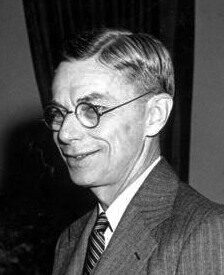
James Bryant Conant
James Bryant Conant was an American chemist. Born March 26, 1893, in Dorchester. Died February 11, 1978, in Hanover. Positions held include High Commissioner (1953–1955), United States Ambassador to Germany (1955–1957) and President of Harvard University (1933–1953). Educated at Harvard College. Awards include Commander of the Order of the British Empire, Presidential Medal of Freedom and Grand Cross 1st class of the Order of Merit of the Federal Republic of Germany.
Facts
44 facts · 2 confirmed by two sources · 16 cited · 26 from one source
Where this comes from
Papalocal keeps its own record. It started from these sources; what each one said is kept here as it was copied, so a change on their side never changes this page by itself. Tap one to read its version.
What Wikidata says · copied November 15, 2026 · revision 2568899161
- Described as
- American chemist (1893–1978)
- Other names
- James B. Conant, James Conant
- Born
- March 26, 1893 · 6 references
- Died
- February 11, 1978 · 6 references
- Born in
- Dorchester
- Died in
- Hanover
- Buried in
- Mount Auburn Cemetery
- Citizen of
- United States
- Occupation
- chemist · 1 reference; diplomat · 1 reference; university teacher; politician; ambassador · 1 reference
- Positions held
- High Commissioner (1953–1955); United States Ambassador to Germany (1955–1957); President of Harvard University (1933–1953)
- Worked for
- Harvard University · 1 reference
- Education
- Harvard College (–1916) · 1 reference
- Member of
- Royal Society of London (1941–); German Academy of Sciences Leopoldina; National Academy of Sciences; American Academy of Arts and Sciences; Phi Beta Kappa Society; Accademia Nazionale delle Scienze detta dei XL; American Philosophical Society (1935–)
- Awards
- Commander of the Order of the British Empire; Presidential Medal of Freedom (1963) · 1 reference; Grand Cross 1st class of the Order of Merit of the Federal Republic of Germany; Fellow of the Royal Institute of Chemistry; Commander of the Legion of Honour; doctor honoris causa of Keiō University; Fellow of the American Academy of Arts and Sciences; Fellow of the American Association for the Advancement of Science; William H. Nichols Medal (1932) · 1 reference; American Institute of Chemists Gold Medal (1934) · 1 reference; Foreign Member of the Royal Society (1941) · 1 reference; Priestley Medal (1944) · 2 references; doctor honoris causa from the University of Alger (1944) · 1 reference; doctor honoris causa from the University of Lyon (1947) · 1 reference; Honorary Fellow of the Royal Society Te Apārangi (1953–) · 1 reference
- Field
- chemistry
- Children
- Theodore Richards Conant · 1 reference
- Father
- James Scott Conant · 1 reference
- Mother
- Jennett Orr Bryant · 1 reference
- Siblings
- Marjorie Conant Bush-Brown
- Military rank
- Major · 1 reference
- Wikipedias with a page
- 30
Wikidata item Q49355 (wikidata.org/wiki/Q49355), public domain (CC0). Copied November 15, 2026.
What Wikipedia says · copied November 15, 2026 · revision 1384467803
James Bryant Conant (; March 26, 1893 – February 11, 1978) was an American chemist, a president of Harvard University, and the first U.S. ambassador to West Germany.
During World War I, he served in the U.S. Army, where he worked on the development of poison gases, especially lewisite. He became an assistant professor of chemistry at Harvard University in 1919 and the Sheldon Emery Professor of Organic Chemistry in 1929. He researched the physical structures of natural products, particularly chlorophyll, and he was one of the first to explore the sometimes complex relationship between chemical equilibrium and the reaction rate of chemical processes. He studied the biochemistry of oxyhemoglobin providing insight into the disease methemoglobinemia, helped to explain the structure of chlorophyll, and contributed important insights that underlie modern theories of acid-base chemistry.
In 1933, Conant became the president of Harvard University with a reformist agenda that included dispensing with a number of customs, including class rankings and the requirement for Latin classes. He abolished athletic scholarships, and instituted an "up or out" policy, under which untenured faculty who were not promoted were terminated. His egalitarian vision of education required a diversified student body, and he promoted the adoption of the Scholastic Aptitude Test (SAT) and co-educational classes. During his presidency, women were admitted to Harvard Medical School and Harvard Law School for the first time.
Conant was appointed to the National Defense Research Committee (NDRC) in 1940, becoming its chairman in 1941. In this capacity, he oversaw vital wartime research projects, including the development of synthetic rubber and the Manhattan Project, which developed the first atomic bombs. On July 16, 1945, he was among the dignitaries present at the Alamogordo Bombing and Gunnery Range for the Trinity nuclear test, the first detonation of an atomic bomb, and was part of the Interim Committee that advised President Harry S. Truman to use atomic bombs on Japan. After the war, he served on the Joint Research and Development Board (JRDC) that was established to coordinate burgeoning defense research, and on the influential General Advisory Committee (GAC) of the Atomic Energy Commission (AEC); in the latter capacity he advised the president against starting a development program for the hydrogen bomb.
In his later years at Harvard, Conant taught undergraduate courses on the history and philosophy of science, and wrote books explaining the scientific method to laymen. In 1953, he retired as president of Harvard University and became the United States High Commissioner for Germany, overseeing the restoration of German sovereignty after World War II, and then was Ambassador to West Germany until 1957. On returning to the United States, Conant criticized the education system in The American High School Today (1959), Slums and Suburbs (1961), and The Education of American Teachers (1963). Between 1965 and 1969, Conant authored his autobiography, My Several Lives (1970). He became increasingly infirm, had a series of strokes in 1977, and died in a nursing home in Hanover, New Hampshire, the following year.
- Born, in its opening lines
- March 26, 1893
- Died, in its opening lines
- February 11, 1978
From the Wikipedia article “James B. Conant” (en.wikipedia.org/wiki/James_B._Conant), by its contributors, under CC BY-SA 4.0 (creativecommons.org/licenses/by-sa/4.0/). Copied November 15, 2026; not changed.
Confirmed Two sources agree. Cited One source, and it names where it got it. One source One source, without a reference of its own. Sources disagree The sources disagree. We show the best-supported value and keep theirs below.
