
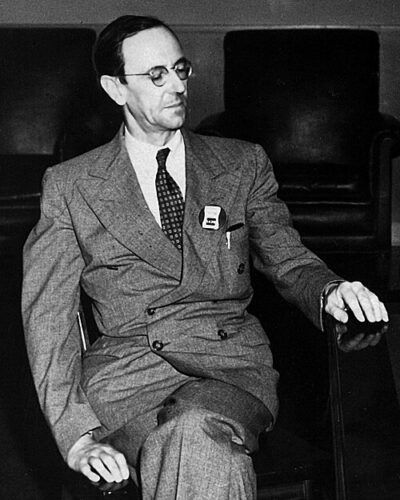
James Chadwick
James Chadwick was an English physicist (1891-1974), who discovered the neutron in 1932. Born October 20, 1891, in Bollington. Died July 24, 1974, in Cambridge. Positions held include Master of Gonville and Caius College, Cambridge (1948–1958). Educated at University of Manchester and Gonville and Caius College. Awards include Pour le Mérite for Sciences and Arts order, Fellow of the Royal Society and Copley Medal.
Facts
43 facts · 2 confirmed by two sources · 17 cited · 24 from one source
Where this comes from
Papalocal keeps its own record. It started from these sources; what each one said is kept here as it was copied, so a change on their side never changes this page by itself. Tap one to read its version.
What Wikidata says · copied November 16, 2026 · revision 2568809026
- Described as
- English physicist (1891-1974), who discovered the neutron in 1932
- Other names
- Sir James Chadwick
- Born
- October 20, 1891 · 11 references
- Died
- July 24, 1974 · 9 references
- Born in
- Bollington · 1 reference
- Died in
- Cambridge · 1 reference
- Citizen of
- United Kingdom
- Occupation
- nuclear physicist; university teacher · 1 reference; physicist · 2 references
- Positions held
- Master of Gonville and Caius College, Cambridge (1948–1958)
- Worked for
- University of Manchester; University of Liverpool; Victoria University of Manchester · 1 reference
- Education
- University of Manchester (1908–); Gonville and Caius College; University of Cambridge (1919–); Victoria University of Manchester · 1 reference
- Member of
- Royal Society of London; Saxon Academy of Sciences and Humanities (1932–); Pontifical Academy of Sciences · 1 reference; Royal Netherlands Academy of Arts and Sciences (1946–); American Philosophical Society (1948–) · 1 reference; American Physical Society · 1 reference
- Awards
- Pour le Mérite for Sciences and Arts order; Fellow of the Royal Society (1927); Copley Medal (1950) · 1 reference; Nobel Prize in Physics (1935) · 2 references; Hughes Medal (1932); Faraday Medal (1950); Franklin Medal (1951); Melchett Medal (1946); Companion of Honour (1970); Knight Bachelor (1945); Royal Society Bakerian Medal (1933) · 1 reference; Guthrie Medal and Prize (1967) · 1 reference; Medal of Freedom
- Field
- physics · 1 reference; neutron · 1 reference; nuclear bomb · 1 reference; radioactivity · 1 reference
- Spouse
- Aileen Maud Stewart-Brown (1925–)
- Children
- Joanna Stewart Chadwick · 1 reference; Judith Chadwick · 1 reference
- Father
- J. J. Chadwick · 1 reference
- Wikipedias with a page
- 99
Wikidata item Q80884 (wikidata.org/wiki/Q80884), public domain (CC0). Copied November 16, 2026.
What Wikipedia says · copied November 16, 2026 · revision 1385311881
Sir James Chadwick (20 October 1891 – 24 July 1974) was a British experimental physicist who received the Nobel Prize in Physics in 1935 for his discovery of the neutron. In 1941, he wrote the final draft of the MAUD Report, which inspired the U.S. government to begin serious atomic bomb research efforts. He was the head of the British team that worked on the Manhattan Project during World War II. He was knighted in Britain in 1945 for his achievements in nuclear physics.
Chadwick graduated from the Victoria University of Manchester in 1911, where he studied under Ernest Rutherford (known as the "father of nuclear physics"). At Manchester, he continued to study under Rutherford until he was awarded his MSc in 1913. The same year, Chadwick was awarded an 1851 Research Fellowship from the Royal Commission for the Exhibition of 1851. He elected to study beta radiation under Hans Geiger in Berlin. Using Geiger's recently developed Geiger counter, Chadwick was able to demonstrate that beta radiation produced a continuous spectrum, and not discrete lines as had been thought. Still in Germany when World War I broke out in Europe, he spent the next four years in the Ruhleben internment camp.
After the war, Chadwick followed Rutherford to the Cavendish Laboratory at the University of Cambridge, where Chadwick earned his Doctor of Philosophy degree under Rutherford's supervision from Gonville and Caius College, Cambridge, in June 1921. He was Rutherford's assistant director of research in the Cavendish Laboratory for over a decade at a time when it was one of the world's foremost centres for the study of physics, attracting students like John Cockcroft, Norman Feather, and Mark Oliphant. Chadwick followed his discovery of the neutron by measuring its mass. He anticipated that neutrons would become a major weapon in the fight against cancer. Chadwick left the Cavendish Laboratory in 1935 to become a professor of physics at the University of Liverpool, where he overhauled an antiquated laboratory and, by installing a cyclotron, made it an important centre for the study of nuclear physics.
- Born, in its opening lines
- October 20, 1891
- Died, in its opening lines
- July 24, 1974
From the Wikipedia article “James Chadwick” (en.wikipedia.org/wiki/James_Chadwick), by its contributors, under CC BY-SA 4.0 (creativecommons.org/licenses/by-sa/4.0/). Copied November 16, 2026; not changed.
Confirmed Two sources agree. Cited One source, and it names where it got it. One source One source, without a reference of its own. Sources disagree The sources disagree. We show the best-supported value and keep theirs below.
