
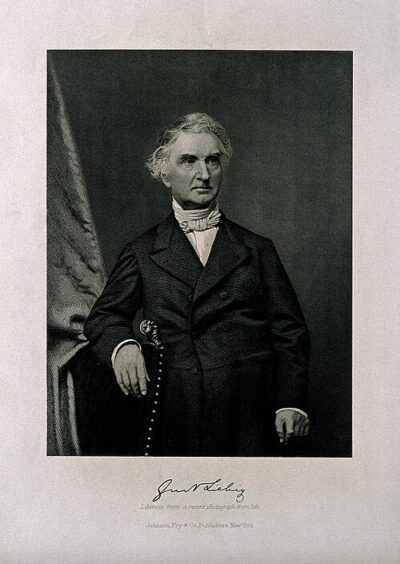
Justus von Liebig
Justus von Liebig was a German chemist. Born May 12, 1803, in Darmstadt. Died April 18, 1873, in Munich. Educated at University of Erlangen–Nuremberg and University of Bonn. Awards include Pour le Mérite for Sciences and Arts order, honorary citizen of Munich and Copley Medal.
Facts
45 facts · 2 confirmed by two sources · 13 cited · 30 from one source
Where this comes from
Papalocal keeps its own record. It started from these sources; what each one said is kept here as it was copied, so a change on their side never changes this page by itself. Tap one to read its version.
What Wikidata says · copied November 16, 2026 · revision 2569093275
- Described as
- German chemist (1803–1873)
- Other names
- Justus Freiherr von Liebig, Baron von Liebig, Justus, Baron von Liebig, Liebig
- Born
- May 12, 1803 · 10 references
- Died
- April 18, 1873 · 12 references
- Born in
- Darmstadt · 4 references
- Died in
- Munich · 4 references
- Buried in
- Alter Südfriedhof · 1 reference
- Citizen of
- Grand Duchy of Hesse; German Empire
- Occupation
- chemist · 1 reference; inventor; university teacher; agronomist; writer · 1 reference
- Worked for
- LMU Munich; University of Giessen; Heidelberg University · 1 reference
- Education
- University of Erlangen–Nuremberg; University of Bonn (1819–) · 1 reference
- Member of
- Royal Society of London (1840–); German Academy of Sciences Leopoldina; Royal Swedish Academy of Sciences; Bavarian Academy of Sciences and Humanities; Göttingen Academy of Sciences and Humanities in Lower Saxony; Saint Petersburg Academy of Sciences; Hungarian Academy of Sciences; American Academy of Arts and Sciences; Royal Netherlands Academy of Arts and Sciences; Russian Academy of Sciences
- Awards
- Pour le Mérite for Sciences and Arts order; honorary citizen of Munich; Copley Medal (1840) · 1 reference; Bavarian Maximilian Order for Science and Art (1853); Albert Medal (1869) · 1 reference; Foreign Member of the Royal Society (1840) · 1 reference; Fellow of the American Academy of Arts and Sciences; honorary member of the Physics Association (Frankfurt am Main, Germany) (1839)
- Field
- chemistry · 1 reference
- Spouse
- Henriette von Liebig · 1 reference
- Children
- Johanna Liebig · 1 reference; Georg von Liebig · 1 reference; Hermann von Liebig · 1 reference; Agnes Carrière; Marie Reichau · 1 reference
- Father
- Johann Georg Liebig · 1 reference
- Religion
- Lutheranism
- Lived in
- Grand Duchy of Hesse · 1 reference
- Wikipedias with a page
- 86
Wikidata item Q16571 (wikidata.org/wiki/Q16571), public domain (CC0). Copied November 16, 2026.
What Wikipedia says · copied November 16, 2026 · revision 1372035406
Justus Freiherr von Liebig (12 May 1803 – 18 April 1873) was a German scientist who made major contributions to the theory, practice, and pedagogy of chemistry, as well as to agricultural and biological chemistry; he is considered one of the principal founders of organic chemistry. As a professor at the University of Giessen, he devised the modern laboratory-oriented teaching method, and for such innovations, he is regarded as one of the most outstanding chemistry teachers of all time. He has been described as the "father of the fertilizer industry" for his emphasis on nitrogen and minerals as essential plant nutrients, and his popularization of the law of the minimum, which states that plant growth is limited by the scarcest nutrient resource, rather than the total amount of resources available. He also developed a manufacturing process for beef extracts, and with his consent a company, called Liebig Extract of Meat Company, was founded to exploit the concept; it later introduced the Oxo brand beef bouillon cube. He popularized an earlier invention for condensing vapors, which came to be known as the Liebig condenser.
- Born, in its opening lines
- May 12, 1803
- Died, in its opening lines
- April 18, 1873
From the Wikipedia article “Justus von Liebig” (en.wikipedia.org/wiki/Justus_von_Liebig), by its contributors, under CC BY-SA 4.0 (creativecommons.org/licenses/by-sa/4.0/). Copied November 16, 2026; not changed.
Confirmed Two sources agree. Cited One source, and it names where it got it. One source One source, without a reference of its own. Sources disagree The sources disagree. We show the best-supported value and keep theirs below.
