
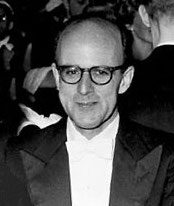
Max Perutz
Max Perutz was an Austrian-born British molecular biologist. Born May 19, 1914, in Vienna. Died February 6, 2002, in Cambridge. Known for Is Science Necessary? Essays on Science and Scientists. Educated at Peterhouse and University of Vienna. Awards include Commander of the Order of the British Empire, Copley Medal and Pour le Mérite for Sciences and Arts order.
Facts
52 facts · 2 confirmed by two sources · 17 cited · 33 from one source
Where this comes from
Papalocal keeps its own record. It started from these sources; what each one said is kept here as it was copied, so a change on their side never changes this page by itself. Tap one to read its version.
What Wikidata says · copied November 16, 2026 · revision 2569140028
- Described as
- Austrian-born British molecular biologist (1914-2002)
- Other names
- Max Ferdinand Perutz, Max F. Perutz
- Born
- May 19, 1914 · 8 references
- Died
- February 6, 2002 · 7 references
- Born in
- Vienna · 2 references
- Died in
- Cambridge · 1 reference
- Buried in
- Ascension Parish Burial Ground · 1 reference
- Cause of death
- cancer
- Citizen of
- United Kingdom (1941–) · 1 reference; Austria; United Kingdom of Great Britain and Ireland (–1927)
- Occupation
- molecular biologist; chemist · 1 reference; university teacher; crystallographer; biophysicist; biochemist · 1 reference
- Worked for
- University of Cambridge; University of York
- Education
- Peterhouse; University of Vienna; University of Cambridge; Theresianum
- Member of
- Royal Society of London (1954–); German Academy of Sciences at Berlin; German Academy of Sciences Leopoldina · 1 reference; Pontifical Academy of Sciences (1981–) · 1 reference; Bavarian Academy of Sciences and Humanities; French Academy of Sciences; American Academy of Arts and Sciences; European Molecular Biology Organization; Accademia Nazionale delle Scienze detta dei XL; Royal Netherlands Academy of Arts and Sciences · 1 reference
- Known for
- Is Science Necessary? Essays on Science and Scientists
- Awards
- Commander of the Order of the British Empire; Copley Medal (1979) · 1 reference; Pour le Mérite for Sciences and Arts order; Royal Medal (1971); Nobel Prize in Chemistry (1962) · 2 references; Otto Warburg Medal (1993) · 1 reference; Wilhelm Exner Medal (1967) · 1 reference; Sir Hans Krebs Medal (1968); honorary doctor of the University of Vienna · 1 reference; Croonian Medal and Lecture (1968); honorary doctorate of Salzburg University; Fellow of the American Academy of Arts and Sciences; Austrian Decoration for Science and Art (1967); Honorary member of the British Biophysical Society; honorary doctorate from University of Paris-XI (1993) · 1 reference
- Field
- biochemistry; molecular biology · 1 reference; chemistry · 1 reference
- Children
- Robin Perutz · 1 reference; Vivien Perutz · 1 reference
- Wikipedias with a page
- 63
Wikidata item Q78480 (wikidata.org/wiki/Q78480), public domain (CC0). Copied November 16, 2026.
What Wikipedia says · copied November 16, 2026 · revision 1384939776
Max Ferdinand Perutz (19 May 1914 – 6 February 2002) was an Austrian-born British molecular biologist, who shared the 1962 Nobel Prize for Chemistry with John Kendrew, for their studies of the structures of haemoglobin and myoglobin. He went on to win the Royal Medal of the Royal Society in 1971 and the Copley Medal in 1979. At Cambridge he founded and chaired (1962–79) The MRC Laboratory of Molecular Biology (LMB), fourteen of whose scientists have won Nobel Prizes.
- Born, in its opening lines
- May 19, 1914
- Died, in its opening lines
- February 6, 2002
From the Wikipedia article “Max Perutz” (en.wikipedia.org/wiki/Max_Perutz), by its contributors, under CC BY-SA 4.0 (creativecommons.org/licenses/by-sa/4.0/). Copied November 16, 2026; not changed.
Confirmed Two sources agree. Cited One source, and it names where it got it. One source One source, without a reference of its own. Sources disagree The sources disagree. We show the best-supported value and keep theirs below.
