
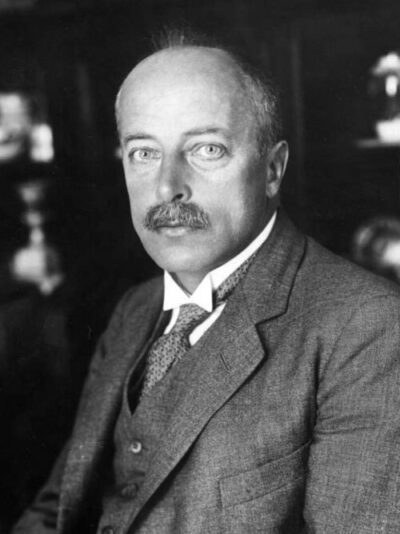
Max von Laue
Max von Laue was a German physicist, Nobel laureate and anti-Nazi. Born October 9, 1879, in Koblenz-Pfaffendorf. Died April 24, 1960, in West Berlin. Known for X-ray and Laue equations. Educated at University of Göttingen and LMU Munich. Awards include Pour le Mérite for Sciences and Arts order, Knight Commander's Cross of the Order of Merit of the Federal Republic of Germany and Ernst Reuter Medal.
Facts
56 facts · 2 confirmed by two sources · 16 cited · 38 from one source
Where this comes from
Papalocal keeps its own record. It started from these sources; what each one said is kept here as it was copied, so a change on their side never changes this page by itself. Tap one to read its version.
What Wikidata says · copied November 16, 2026 · revision 2567482015
- Described as
- German physicist, Nobel laureate and anti-Nazi (1879–1960)
- Other names
- Max Theodor Felix von Laue, Max Felix Theodor von Laue, Max Laue
- Born
- October 9, 1879 · 12 references
- Died
- April 24, 1960 · 6 references
- Born in
- Koblenz-Pfaffendorf · 2 references
- Died in
- West Berlin · 1 reference
- Buried in
- Göttingen City Cemetery · 1 reference
- Cause of death
- traffic collision
- Citizen of
- Germany
- Occupation
- physicist · 1 reference; university teacher; crystallographer; mathematician · 1 reference
- Worked for
- LMU Munich; Humboldt-Universität zu Berlin; Goethe University Frankfurt · 1 reference; University of Zurich · 1 reference; Physikalisch-Technische Bundesanstalt
- Education
- University of Göttingen; LMU Munich; Humboldt-Universität zu Berlin; University of Zurich · 1 reference; University of Strasbourg · 1 reference
- Member of
- Royal Society of London (1949–); Royal Prussian Academy of Sciences; German Academy of Sciences at Berlin; Pontifical Academy of Sciences · 1 reference; Academy of Sciences of the USSR; Royal Swedish Academy of Sciences; Göttingen Eighteen; American Academy of Arts and Sciences; German Academy of Sciences Leopoldina; American Physical Society · 1 reference
- Known for
- X-ray · 1 reference; Laue equations
- Awards
- Pour le Mérite for Sciences and Arts order (1952); Knight Commander's Cross of the Order of Merit of the Federal Republic of Germany; Ernst Reuter Medal (1959) · 1 reference; Nobel Prize in Physics (1914) · 2 references; Max Planck Medal (1932); Helmholtz Medal (1959); Matteucci Medal (1914); X-ray badge (1952); Adolf-von-Baeyer Gold Medal (1921); Fellow of the American Physical Society; Foreign Member of the Royal Society (1949) · 1 reference; Pour le Mérite · 1 reference; honorary member of the German Mineralogical Society (1924) · 2 references; honorary member of the Physics Association (Frankfurt am Main, Germany) (1924)
- Field
- physics · 2 references; crystallography; X-ray · 1 reference; theory of relativity · 1 reference; superconductivity · 1 reference
- Spouse
- Magda von Laue · 1 reference
- Children
- Theodore Hermann Von Laue · 1 reference
- Father
- Julius von Laue · 1 reference
- Lived in
- Germany · 1 reference
- Wikipedias with a page
- 93
Wikidata item Q57067 (wikidata.org/wiki/Q57067), public domain (CC0). Copied November 16, 2026.
What Wikipedia says · copied November 16, 2026 · revision 1381585190
Max Theodor Felix von Laue (German: [maks fɔn ˈlaʊ̯ə] ; 9 October 1879 – 24 April 1960) was a German physicist who received the Nobel Prize in Physics in 1914 "for his discovery of the diffraction of X-rays by crystals."
In addition to his scientific endeavors with contributions in optics, crystallography, quantum theory, superconductivity, and the theory of relativity, Laue had a number of administrative positions which advanced and guided German scientific research and development during four decades. A strong objector to Nazism, he was instrumental in re-establishing and organizing German science after World War II.
- Born, in its opening lines
- October 9, 1879
- Died, in its opening lines
- April 24, 1960
From the Wikipedia article “Max von Laue” (en.wikipedia.org/wiki/Max_von_Laue), by its contributors, under CC BY-SA 4.0 (creativecommons.org/licenses/by-sa/4.0/). Copied November 16, 2026; not changed.
Confirmed Two sources agree. Cited One source, and it names where it got it. One source One source, without a reference of its own. Sources disagree The sources disagree. We show the best-supported value and keep theirs below.
