
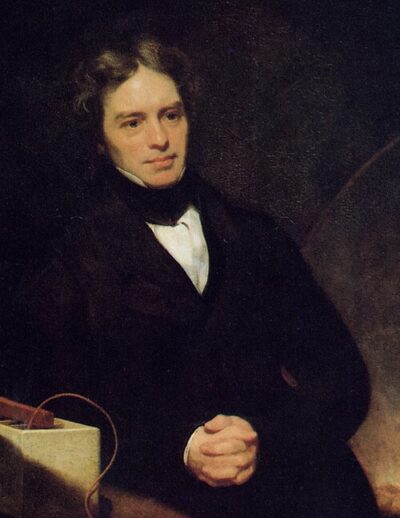
Michael Faraday
Michael Faraday was a British scientist. Born September 22, 1791, in Newington Butts. Died August 25, 1867, in Hampton Castle. Awards include Pour le Mérite for Sciences and Arts order, Fellow of the Royal Society and Copley Medal (2 times).
Facts
43 facts · 2 confirmed by two sources · 23 cited · 18 from one source
Where this comes from
Papalocal keeps its own record. It started from these sources; what each one said is kept here as it was copied, so a change on their side never changes this page by itself. Tap one to read its version.
What Wikidata says · copied November 16, 2026 · revision 2568285580
- Described as
- British scientist (1791–1867)
- Other names
- Faraday
- Born
- September 22, 1791 · 17 references
- Died
- August 25, 1867 · 16 references
- Born in
- Newington Butts · 2 references
- Died in
- Hampton Castle · 4 references
- Buried in
- Highgate Cemetery · 2 references
- Citizen of
- United Kingdom of Great Britain and Ireland; Kingdom of Great Britain
- Occupation
- physicist · 1 reference; chemist · 1 reference; inventor; writer · 1 reference; university teacher · 1 reference
- Worked for
- Royal Institution (1813–1858) · 2 references; George Riebau (1804–1812) · 1 reference
- Member of
- Royal Society of London (1824–) · 1 reference; Royal Prussian Academy of Sciences; German Academy of Sciences Leopoldina; Royal Swedish Academy of Sciences; French Academy of Sciences; Saint Petersburg Academy of Sciences; Hungarian Academy of Sciences; American Academy of Arts and Sciences; Royal Netherlands Academy of Arts and Sciences; American Philosophical Society · 1 reference
- Awards
- Pour le Mérite for Sciences and Arts order; Fellow of the Royal Society (1824) · 1 reference; Copley Medal (2 times) (1832, 1838) · 1 reference; Royal Medal (1835) · 1 reference; Rumford Medal (1846) · 1 reference; Albert Medal (1866) · 1 reference; Royal Society Bakerian Medal (1857) · 5 references; Fellow of the American Academy of Arts and Sciences (1832) · 1 reference; honorary member of the Physics Association (Frankfurt am Main, Germany) (1839)
- Field
- physics; chemistry; electromagnetism · 1 reference; discoveries and inventions · 1 reference
- Spouse
- Sarah Barnard (1821–) · 2 references
- Father
- James Faraday · 2 references
- Mother
- Margaret Hastwell · 1 reference
- Siblings
- Robert Faraday
- Religion
- Christianity · 1 reference; Glasite · 1 reference
- Wikipedias with a page
- 181
Wikidata item Q8750 (wikidata.org/wiki/Q8750), public domain (CC0). Copied November 16, 2026.
What Wikipedia says · copied November 16, 2026 · revision 1385648956
Michael Faraday (22 September 1791 – 25 August 1867) was an English chemist and physicist who contributed vastly to the study of electrochemistry and electromagnetism. His main discoveries include the principles underlying electromagnetic induction, diamagnetism, and electrolysis. Despite receiving little formal education, as an autodidact Faraday became one of the most influential scientists in history. It was by his research on the magnetic field around a conductor carrying a direct current that Faraday established the concept of the electromagnetic field in physics. Faraday also established that magnetism could affect rays of light and that there was an underlying relationship between the two phenomena. He similarly discovered the principles of electromagnetic induction, diamagnetism, and the laws of electrolysis. His inventions of electromagnetic rotary devices formed the foundation of electric motor technology, and it was largely due to his efforts that electricity became practical for use in technology. The SI unit of capacitance, the farad, is named after him.
As a chemist, Faraday discovered benzene and tetrachloroethylene, investigated the clathrate hydrate of chlorine, invented an early form of the Bunsen burner and the system of oxidation numbers, and popularised terminology such as "anode", "cathode", "electrode" and "ion". Faraday ultimately became the first and foremost Fullerian Professor of Chemistry at the Royal Institution, a lifetime position.
Faraday was an experimentalist who conveyed his ideas in clear and simple language, and thought and sensed the physical world in a visual manner, rather than in words or symbols. His mathematical abilities did not extend as far as trigonometry and were limited to the simplest algebra. Physicist and mathematician James Clerk Maxwell took the work of Faraday and others and summarised it in a set of equations which is accepted as the basis of all modern theories of electromagnetic phenomena. On Faraday's uses of lines of force, Maxwell wrote that they show Faraday "to have been in reality a mathematician of a very high order – one from whom the mathematicians of the future may derive valuable and fertile methods."
Faraday devoted considerable time and energy to public service. He worked on optimising lighthouses and protecting ships from corrosion. With Charles Lyell, he produced a forensic investigation on a colliery explosion at Haswell, County Durham, indicating for the first time that coal dust contributed to the severity of the explosion, and demonstrating how ventilation could have prevented it. Faraday also investigated industrial pollution at Swansea, air pollution at the Royal Mint, and wrote to The Times on the foul condition of the River Thames during the Great Stink. He refused to work on developing chemical weapons for use in the Crimean War, citing ethical reservations. He declined to have his lectures published, preferring people to recreate the experiments for themselves, to better experience the discovery, and told a publisher: "I have always loved science more than money and because my occupation is almost entirely personal I cannot afford to get rich."
Albert Einstein kept a portrait of Faraday on his study wall, alongside those of Isaac Newton and Maxwell. Physicist Ernest Rutherford stated, "When we consider the magnitude and extent of his discoveries and their influence on the progress of science and of industry, there is no honour too great to pay to the memory of Faraday, one of the greatest scientific discoverers of all time." He founded the Royal Institution's Friday Evening Discourses and was the main popularizer of its Christmas Lecture Series.
- Born, in its opening lines
- September 22, 1791
- Died, in its opening lines
- August 25, 1867
From the Wikipedia article “Michael Faraday” (en.wikipedia.org/wiki/Michael_Faraday), by its contributors, under CC BY-SA 4.0 (creativecommons.org/licenses/by-sa/4.0/). Copied November 16, 2026; not changed.
Confirmed Two sources agree. Cited One source, and it names where it got it. One source One source, without a reference of its own. Sources disagree The sources disagree. We show the best-supported value and keep theirs below.
