
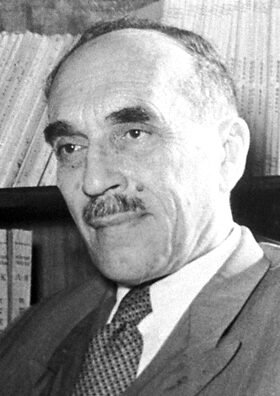
Nikolay Semyonov
Nikolay Semyonov was a Soviet physical chemist. Born April 3, 1896, in Saratov. Died September 25, 1986, in Moscow. Positions held include deputy of the Supreme Soviet of the Soviet Union. Educated at Imperial St. Petersburg University and Samara Real School. Awards include Stalin Prize, 2nd degree (2 times), Order of Lenin (9 times) and Hero of Socialist Labour (2 times).
Facts
53 facts · 1 confirmed by two sources · 6 cited · 45 from one source · 1 where the sources disagree
What’s different
- Born: we show April 3, 1896 (Sources disagree). Wikipedia says April 15, 1896
Where this comes from
Papalocal keeps its own record. It started from these sources; what each one said is kept here as it was copied, so a change on their side never changes this page by itself. Tap one to read its version.
What Wikidata says · copied November 16, 2026 · revision 2568988626
- Described as
- Soviet physical chemist (1896-1986)
- Other names
- Nikolay Nikolayevich Semyonov, Nikolay Nikolaevich Semenov, Nikolai Nikolaevich Semenov
- Born
- April 3, 1896 · 1 reference
- Died
- September 25, 1986 · 4 references
- Born in
- Saratov · 1 reference
- Died in
- Moscow · 1 reference
- Buried in
- Novodevichy Cemetery
- Citizen of
- Russian Empire; Soviet Union
- Occupation
- physicist; chemist · 1 reference; professor · 1 reference; politician
- Positions held
- deputy of the Supreme Soviet of the Soviet Union
- Political party
- Communist Party of the Soviet Union (1947–)
- Worked for
- Tomsk State University · 1 reference; Tomsk Polytechnic University; Ioffe Institute (1920–) · 1 reference; Semenov Institute of Chemical Physics (1931–1986) · 1 reference; Lomonosov Moscow State University (1944–); Moscow Institute of Physics and Technology; Peter the Great Saint Petersburg State Polytechnical University (1928–); Znanie (1960–1963)
- Education
- Imperial St. Petersburg University (1913–1917); Samara Real School (–1913)
- Member of
- Royal Society of London (1958–); German Academy of Sciences at Berlin (1966–); German Academy of Sciences Leopoldina (1955–); French Academy of Sciences (1978–); National Academy of Sciences (1963–); Academy of Sciences of the USSR (1929–) · 1 reference; Hungarian Academy of Sciences (1961–); New York Academy of Sciences (1962–); Romanian Academy (1965–); Bulgarian Academy of Sciences (1969–)
- Awards
- Stalin Prize, 2nd degree (2 times) (1941, 1949); Order of Lenin (9 times) (1945, 1949, 1953, 1954, 1956, 1966, 1971, 1976, 1981); Hero of Socialist Labour (2 times) (1966, 1976); Order of the October Revolution (1986); Nobel Prize in Chemistry (1956) · 2 references; Order of the Red Banner of Labour (1946); Lomonosov Gold Medal (1969); Lenin Prize (1976) · 1 reference; Jubilee Medal "In Commemoration of the 100th Anniversary of the Birth of Vladimir Ilyich Lenin"; Foreign Member of the Royal Society (1958) · 1 reference; Medal "For Valiant Labour in the Great Patriotic War 1941–1945" · 1 reference; Jubilee Medal "Thirty Years of Victory in the Great Patriotic War 1941–1945" · 1 reference; Jubilee Medal "50 Years of the Armed Forces of the USSR" · 1 reference; Medal "In Commemoration of the 800th Anniversary of Moscow" · 1 reference; State Stalin Prize, 1st degree (1941) · 1 reference
- Field
- chemical physics
- Spouse
- Maria Liverovskaya (1921–)
- Lived in
- Saint Petersburg (1920–); Tomsk (–1920) · 1 reference; Moscow
- Wikipedias with a page
- 67
Wikidata item Q48990 (wikidata.org/wiki/Q48990), public domain (CC0). Copied November 16, 2026.
What Wikipedia says · copied November 16, 2026 · revision 1384741430
Nikolay Nikolayevich Semyonov , sometimes Semenov, Semionov or Semenoff (Russian: Никола́й Никола́евич Семёнов; 15 April [O.S. 3 April] 1896 – 25 September 1986) was a Soviet physicist and chemist. Semyonov was awarded the 1956 Nobel Prize in Chemistry for his work on the mechanism of chemical transformation. He made a significant contribution to the development of chemical kinetics.
He was the first Soviet Nobel prize winner and the only Soviet Nobel laureate in Chemistry (1956). Semenov was an academician of the Academy of Sciences of the Soviet Union (1932, corresponding member since 1929). He had been awarded the title of Hero of Socialist Labour twice (1966 and 1976).
- Born, in its opening lines
- April 15, 1896
- Died, in its opening lines
- September 25, 1986
From the Wikipedia article “Nikolay Semyonov” (en.wikipedia.org/wiki/Nikolay_Semyonov), by its contributors, under CC BY-SA 4.0 (creativecommons.org/licenses/by-sa/4.0/). Copied November 16, 2026; not changed.
Confirmed Two sources agree. Cited One source, and it names where it got it. One source One source, without a reference of its own. Sources disagree The sources disagree. We show the best-supported value and keep theirs below.
