
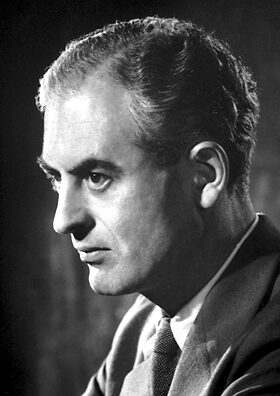
Peter Medawar
Peter Medawar was an English-brazilian biologist. Born February 28, 1915, in Petrópolis. Died October 2, 1987, in London. Educated at Magdalen College and Marlborough College. Awards include Fellow of the Royal Society, Nobel Prize in Physiology or Medicine and Commander of the Order of the British Empire.
Facts
41 facts · 2 confirmed by two sources · 17 cited · 22 from one source
Where this comes from
Papalocal keeps its own record. It started from these sources; what each one said is kept here as it was copied, so a change on their side never changes this page by itself. Tap one to read its version.
What Wikidata says · copied November 13, 2026 · revision 2563198865
- Described as
- English-brazilian biologist (1915–1987)
- Other names
- Sir Peter Brian Medawar, P.B. Medawar, P. B. Medawar, Sir Peter Medawar
- Born
- February 28, 1915 · 8 references
- Died
- October 2, 1987 · 8 references
- Born in
- Petrópolis · 2 references
- Died in
- London · 1 reference
- Buried in
- St. Andrew's Churchyard, Alfriston · 1 reference
- Citizen of
- United Kingdom; United States · 1 reference
- Occupation
- physician; immunologist; zoologist · 1 reference; autobiographer; professor; physiologist · 1 reference; researcher; anatomist · 1 reference
- Worked for
- University College London; Magdalen College; University of Birmingham
- Education
- Magdalen College; Marlborough College; University of Oxford
- Member of
- Royal Society of London; American Academy of Arts and Sciences; American Philosophical Society (1961–) · 1 reference; National Academy of Sciences (1965–)
- Awards
- Fellow of the Royal Society; Nobel Prize in Physiology or Medicine (1960) · 2 references; Commander of the Order of the British Empire; Copley Medal (1969) · 1 reference; Royal Medal (1959) · 1 reference; Kalinga Prize (1985) · 1 reference; EMBO Membership; Croonian Medal and Lecture (1958); Michael Faraday Prize (1987) · 1 reference; Knight Bachelor (1965) · 1 reference; Order of Merit (1981) · 1 reference; Honorary Fellow of the Royal College of Surgeons (1967) · 1 reference
- Field
- zoology
- Spouse
- Jean Medawar (1937–) · 1 reference
- Children
- Caroline Medawar Garland · 1 reference
- Religion
- atheism
- Wikipedias with a page
- 63
Wikidata item Q214209 (wikidata.org/wiki/Q214209), public domain (CC0). Copied November 13, 2026.
What Wikipedia says · copied November 13, 2026 · revision 1383324356
Sir Peter Brian Medawar (; 28 February 1915 – 2 October 1987) was a Brazilian-born biologist and writer of Lebanese-British descent who, from a succession of research and teaching posts (Oxford through the Royal Institution), and senior U.K. biomedical leadership positions (MRC and RPMC), contributed seminal discoveries in immunology, including one honoured by a Nobel Prize to him and Australian Mac Burnet in 1960. Medawar's works on the discovery of acquired immune tolerance, and on graft rejection, have been fundamental to the medical practice of tissue and organ transplants. For his scientific work, he has been termed the "father of transplantation". He is remembered, as well, for his wit, both in person and in his popular writings. Richard Dawkins referred to him as "the wittiest of all scientific writers"; Stephen Jay Gould as "the cleverest man I have ever known".
Medawar was the youngest child of a Lebanese father and a British mother, and a Brazilian and British citizen by birth. He prepared for university admission at a public secondary school, Marlborough College, about which he had ill feelings generally, but was positive with regard to his biology teacher, Ashley Gordon Lowndes. He then pursued his university training in zoology under John Young at Magdalen College, Oxford; after a scholarship and fellowship there, he went on to hold named professorial positions in zoology at the University of Birmingham and University College London. Until he was partially disabled by a cerebral infarction, he was Director of the National Institute for Medical Research (at Mill Hill).
With his Oxford, then Birmingham trainees, doctoral student Leslie Brent and postdoctoral fellow Rupert E. Billingham, he demonstrated the principle of acquired immunological tolerance (the phenomenon of unresponsiveness of the immune system to certain molecules), which was theoretically predicted by Mac Burnet. The understanding of immunological tolerance became the foundation of tissue and organ transplantation. He and Burnet shared the 1960 Nobel Prize in Physiology or Medicine "for discovery of acquired immunological tolerance".
- Born, in its opening lines
- February 28, 1915
- Died, in its opening lines
- October 2, 1987
From the Wikipedia article “Peter Medawar” (en.wikipedia.org/wiki/Peter_Medawar), by its contributors, under CC BY-SA 4.0 (creativecommons.org/licenses/by-sa/4.0/). Copied November 13, 2026; not changed.
Confirmed Two sources agree. Cited One source, and it names where it got it. One source One source, without a reference of its own. Sources disagree The sources disagree. We show the best-supported value and keep theirs below.
