
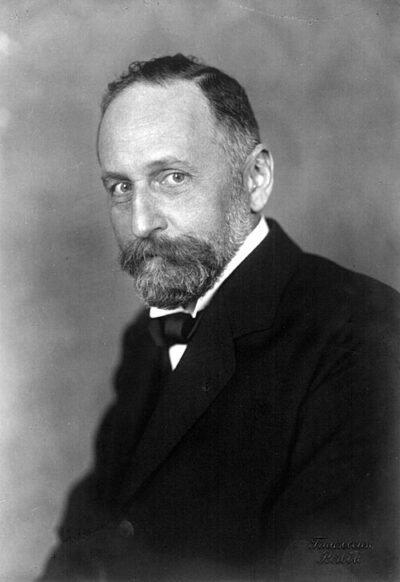
Richard Willstätter
Richard Willstätter was a German chemist. Born August 13, 1872, in Karlsruhe. Died August 3, 1942, in Muralto. Educated at LMU Munich. Awards include Faraday Lectureship Prize, Pour le Mérite for Sciences and Arts order and Nobel Prize in Chemistry.
Facts
47 facts · 2 confirmed by two sources · 14 cited · 31 from one source
Where this comes from
Papalocal keeps its own record. It started from these sources; what each one said is kept here as it was copied, so a change on their side never changes this page by itself. Tap one to read its version.
What Wikidata says · copied November 16, 2026 · revision 2569098712
- Described as
- German chemist (1872–1942)
- Other names
- Richard Willstaetter, Richard Willstatter
- Born
- August 13, 1872 · 9 references
- Died
- August 3, 1942 · 8 references
- Born in
- Karlsruhe · 3 references
- Died in
- Muralto · 3 references
- Buried in
- Muralto Cemetery · 1 reference
- Cause of death
- myocardial infarction
- Name at birth
- Richard Martin Willstätter
- Citizen of
- German Empire; Weimar Republic; Nazi Germany
- Occupation
- university teacher · 1 reference; chemist · 1 reference
- Worked for
- LMU Munich; ETH Zurich; Humboldt-Universität zu Berlin; Kaiser Wilhelm Society; University of Zurich · 1 reference
- Education
- LMU Munich
- Member of
- Royal Society of London; German Academy of Sciences Leopoldina (1919–) · 1 reference; Bavarian Academy of Sciences and Humanities; Royal Swedish Academy of Sciences; American Academy of Arts and Sciences; Accademia Nazionale dei Lincei (1922–) · 1 reference; Russian Academy of Sciences (1923–) · 1 reference; Royal Prussian Academy of Sciences; National Academy of Sciences (1926–); Academy of Sciences of Turin (1910–) · 1 reference
- Awards
- Faraday Lectureship Prize (1927); Pour le Mérite for Sciences and Arts order (1924); Nobel Prize in Chemistry (1915) · 2 references; Willard Gibbs Award (1933) · 1 reference; Bavarian Maximilian Order for Science and Art (1925); Adolf-von-Baeyer Gold Medal (1914) · 1 reference; honorary doctor of the University of Manchester; Davy Medal (1932) · 1 reference; honorary doctor of ETH Zürich; Foreign Member of the Royal Society (1928) · 1 reference; honorary doctorate of the Johann Wolfgang Goethe University Frankfurt; honorary doctor of the University of Halle-Wittenberg; Bressa Prize (1907) · 1 reference; Goethe Medal for Art and Science (1932); honorary member of the Physics Association (Frankfurt am Main, Germany) (1910)
- Field
- physical chemistry
- Spouse
- Sophie Leser
- Children
- Margarete Willstätter · 1 reference
- Lived in
- Germany · 1 reference
- Wikipedias with a page
- 68
Wikidata item Q77072 (wikidata.org/wiki/Q77072), public domain (CC0). Copied November 16, 2026.
What Wikipedia says · copied November 16, 2026 · revision 1371989555
Richard Martin Willstätter FRS(For) HFRSE (German pronunciation: [ˈʁɪçaʁt ˈvɪlˌʃtɛtɐ] , 13 August 1872 – 3 August 1942) was a German organic chemist whose study of the structure of plant pigments, chlorophyll included, won him the 1915 Nobel Prize for Chemistry.
- Born, in its opening lines
- August 13, 1872
- Died, in its opening lines
- August 3, 1942
From the Wikipedia article “Richard Willstätter” (en.wikipedia.org/wiki/Richard_Willstätter), by its contributors, under CC BY-SA 4.0 (creativecommons.org/licenses/by-sa/4.0/). Copied November 16, 2026; not changed.
Confirmed Two sources agree. Cited One source, and it names where it got it. One source One source, without a reference of its own. Sources disagree The sources disagree. We show the best-supported value and keep theirs below.
