
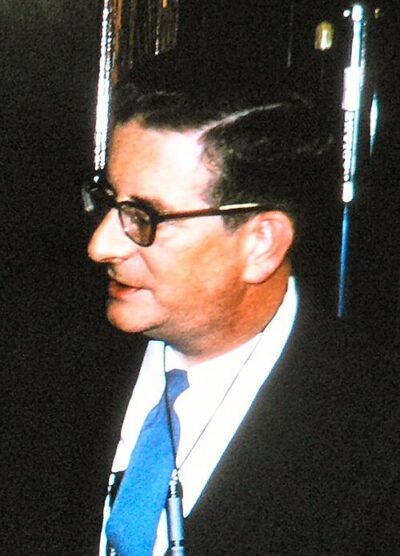
Robert Burns Woodward
Robert Burns Woodward was an American chemist. Born April 10, 1917, in Boston. Died July 8, 1979, in Cambridge. Educated at Massachusetts Institute of Technology and Quincy High School. Awards include Centenary Prize, Foreign Member of the Royal Society and William H. Nichols Medal.
Facts
37 facts · 2 confirmed by two sources · 16 cited · 19 from one source
Where this comes from
Papalocal keeps its own record. It started from these sources; what each one said is kept here as it was copied, so a change on their side never changes this page by itself. Tap one to read its version.
What Wikidata says · copied November 13, 2026 · revision 2567338422
- Described as
- American chemist
- Other names
- Robert B. Woodward
- Born
- April 10, 1917 · 10 references
- Died
- July 8, 1979 · 9 references
- Born in
- Boston · 1 reference
- Died in
- Cambridge · 1 reference
- Buried in
- Mount Auburn Cemetery · 1 reference
- Cause of death
- myocardial infarction
- Citizen of
- United States
- Occupation
- chemist · 1 reference; university teacher
- Worked for
- Harvard University
- Education
- Massachusetts Institute of Technology; Quincy High School · 1 reference
- Member of
- Royal Society of London (1956–); German Academy of Sciences Leopoldina · 1 reference; American Academy of Arts and Sciences; Academy of Sciences of the USSR (1976–); American Philosophical Society (1962–) · 1 reference; National Academy of Sciences (1953–); Accademia Nazionale dei Lincei (1968–) · 1 reference
- Awards
- Centenary Prize (1951); Foreign Member of the Royal Society (1956) · 1 reference; William H. Nichols Medal (1956) · 1 reference; ACS Award for Creative Work in Synthetic Organic Chemistry, (1957); Remsen Award (1958) · 1 reference; Davy Medal (1959) · 1 reference; Roger Adams Award in Organic Chemistry (1961) · 1 reference; National Medal of Science (1964); Robert Robinson Award (1964) · 1 reference; Nobel Prize in Chemistry (1965) · 2 references; Willard Gibbs Award (1967) · 1 reference; Lavoisier Medal (1968); AMA Scientific Achievement Award (1971); Arthur C. Cope Award (1973); doctor honoris causa from the Pierre and Marie Curie University (1975) · 1 reference
- Field
- organic chemistry
- Spouse
- Eudoxia Woodward (1946–) · 1 reference
- Father
- Arthur Chester Woodward · 1 reference
- Wikipedias with a page
- 68
Wikidata item Q232316 (wikidata.org/wiki/Q232316), public domain (CC0). Copied November 13, 2026.
What Wikipedia says · copied November 13, 2026 · revision 1380903235
Robert Burns Woodward (April 10, 1917 – July 8, 1979) was an American organic chemist, who is considered by many to be the preeminent synthetic organic chemist of the twentieth century.
Through his career, he made many key contributions to the subject, especially in the synthesis of complex natural products and the determination of their molecular structure. He worked closely with Roald Hoffmann on theoretical studies of chemical reactions, and also with Albert Eschenmoser. He received the Nobel Prize in Chemistry in 1965 “for his outstanding achievements in the art of organic synthesis.”
- Born, in its opening lines
- April 10, 1917
- Died, in its opening lines
- July 8, 1979
From the Wikipedia article “Robert Burns Woodward” (en.wikipedia.org/wiki/Robert_Burns_Woodward), by its contributors, under CC BY-SA 4.0 (creativecommons.org/licenses/by-sa/4.0/). Copied November 13, 2026; not changed.
Confirmed Two sources agree. Cited One source, and it names where it got it. One source One source, without a reference of its own. Sources disagree The sources disagree. We show the best-supported value and keep theirs below.
