
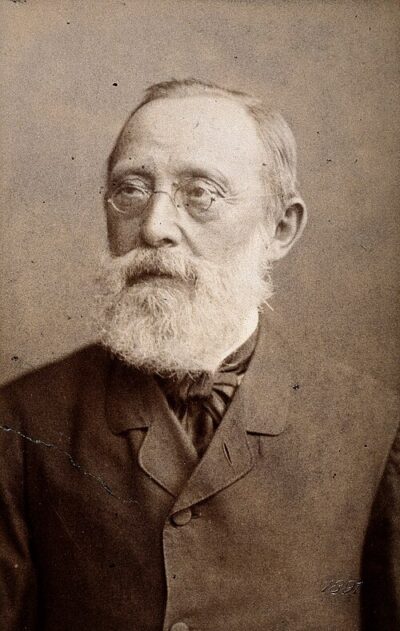
Rudolf Virchow
Rudolf Virchow was a German doctor, anthropologist, public health activist, pathologist, prehistorian, biologist and politician. Born October 13, 1821, in Świdwin. Died September 5, 1902, in Berlin. Positions held include member of the Reichstag of the German Empire. Educated at Humboldt-Universität zu Berlin and University of Würzburg. Awards include honorary citizen of Berlin, Copley Medal and Pour le Mérite for Sciences and Arts order.
Facts
52 facts · 2 confirmed by two sources · 12 cited · 38 from one source
Where this comes from
Papalocal keeps its own record. It started from these sources; what each one said is kept here as it was copied, so a change on their side never changes this page by itself. Tap one to read its version.
What Wikidata says · copied November 16, 2026 · revision 2565536664
- Described as
- German doctor, anthropologist, public health activist, pathologist, prehistorian, biologist and politician (1821-1902)
- Other names
- Rudolf Ludwig Carl Virchow, Rudolph Virchow, Rudolf Ludwig Karl Virchow, Teoría Celular
- Born
- October 13, 1821 · 12 references
- Died
- September 5, 1902 · 12 references
- Born in
- Świdwin · 2 references
- Died in
- Berlin · 3 references
- Buried in
- Alter St.-Matthäus-Kirchhof Berlin · 1 reference
- Cause of death
- heart failure
- Name at birth
- Rudolf Ludwig Karl Virchow
- Citizen of
- Kingdom of Prussia
- Occupation
- biologist; anthropologist · 2 references; paleontologist; archaeologist; prehistorian; politician · 2 references; physician · 2 references; university teacher · 1 reference
- Positions held
- member of the Reichstag of the German Empire
- Political party
- German Free-minded Party
- Worked for
- University of Würzburg; Humboldt-Universität zu Berlin; Charité
- Education
- Humboldt-Universität zu Berlin · 1 reference; University of Würzburg · 1 reference
- Member of
- Royal Prussian Academy of Sciences; German Academy of Sciences Leopoldina; Royal Swedish Academy of Sciences; Saint Petersburg Academy of Sciences; French Academy of Sciences; Hungarian Academy of Sciences; Hellenic Philological Society of Constantinople (1880–); Royal Society of London (1884–); American Academy of Arts and Sciences; Russian Academy of Sciences
- Awards
- honorary citizen of Berlin; Copley Medal (1892) · 1 reference; Pour le Mérite for Sciences and Arts order; Helmholtz Medal (1898); Cothenius Medal (1901); Croonian Medal and Lecture (1893); Order of Olga (1872); Foreign Member of the Royal Society (1884) · 1 reference; honorary member of the Physics Association (Frankfurt am Main, Germany) (1868)
- Field
- cell biology; medicine · 1 reference
- Spouse
- Ferdinande Amalie Rosalie Mayer
- Children
- Hans Virchow · 1 reference; Anna Emilie Adele Virchow; Ernst Oswald Ludwig Virchow; Werner Körte; Marie Rabl · 1 reference
- Father
- Karl Christian Siegfried Virchow
- Mother
- Johanna Maria Hesse
- Wikipedias with a page
- 78
Wikidata item Q76432 (wikidata.org/wiki/Q76432), public domain (CC0). Copied November 16, 2026.
What Wikipedia says · copied November 16, 2026 · revision 1385829314
Rudolf Ludwig Carl Virchow ( VEER-koh, FEER-khoh; German: [ˈʁuːdɔlf ˈvɪʁço, - ˈfɪʁço]; 13 October 1821 – 5 September 1902) was a German physician, anthropologist, pathologist, prehistorian, biologist, writer, editor, and politician. He is known as "the father of modern pathology" and as the founder of social medicine, and to his colleagues, the "Pope of medicine".
Virchow studied medicine at the Friedrich Wilhelm University under Johannes Peter Müller. While working at the Charité hospital, his investigation of the 1847–1848 typhus epidemic in Upper Silesia laid the foundation for public health in Germany, and paved the way for his political and social careers. From it, he coined a well known aphorism: "Medicine is a social science, and politics is nothing else but medicine on a large scale". His participation in the Revolution of 1848 led to his expulsion from Charité the next year. He then published a newspaper Die Medizinische Reform (The Medical Reform). He took the first Chair of Pathological Anatomy at the University of Würzburg in 1849. After seven years, in 1856, Charité reinstated him to its new Institute for Pathology. He co-founded the political party Deutsche Fortschrittspartei, and was elected to the Prussian House of Representatives and won a seat in the Reichstag. His opposition to Otto von Bismarck's financial policy resulted in a duel challenge by the latter. However, Virchow supported Bismarck in his anti-Catholic campaigns, which he named Kulturkampf ("culture struggle").
A prolific writer, he produced more than 2000 scientific writings. Cellular Pathology (1858), regarded as the root of modern pathology, introduced the third dictum in cell theory: Omnis cellula e cellula ("All cells come from cells"), although this concept is now widely recognized as being plagiarized from Robert Remak. He was a co-founder of Physikalisch-Medizinische Gesellschaft in 1849 and Deutsche Gesellschaft für Pathologie in 1897. He founded journals such as Archiv für Pathologische Anatomie und Physiologie und für Klinische Medicin (with Benno Reinhardt in 1847, later renamed Virchows Archiv), and Zeitschrift für Ethnologie (Journal of Ethnology). The latter is published by German Anthropological Association and the Berlin Society for Anthropology, Ethnology and Prehistory, the societies which he also founded.
Virchow was the first to describe and name diseases such as leukemia, chordoma, ochronosis, embolism, and thrombosis. He coined biological terms such as "neuroglia", "agenesis", "parenchyma", "osteoid", "amyloid degeneration", and "spina bifida"; terms such as Virchow's node, Virchow–Robin spaces, Virchow–Seckel syndrome, and Virchow's triad are named after him. His description of the life cycle of a roundworm Trichinella spiralis influenced the practice of meat inspection. He developed the first systematic method of autopsy, and introduced hair analysis in forensic investigation.
Opposing the germ theory of diseases, he rejected Ignaz Semmelweis's idea of disinfecting. He was critical of what he described as "Nordic mysticism" regarding the Aryan race. As an anti-Darwinist, he called Charles Darwin an "ignoramus" and his own student Ernst Haeckel a "fool". He described the original specimen of Neanderthal man as nothing but that of a deformed human.
- Born, in its opening lines
- October 13, 1821
- Died, in its opening lines
- September 5, 1902
From the Wikipedia article “Rudolf Virchow” (en.wikipedia.org/wiki/Rudolf_Virchow), by its contributors, under CC BY-SA 4.0 (creativecommons.org/licenses/by-sa/4.0/). Copied November 16, 2026; not changed.
Confirmed Two sources agree. Cited One source, and it names where it got it. One source One source, without a reference of its own. Sources disagree The sources disagree. We show the best-supported value and keep theirs below.
