
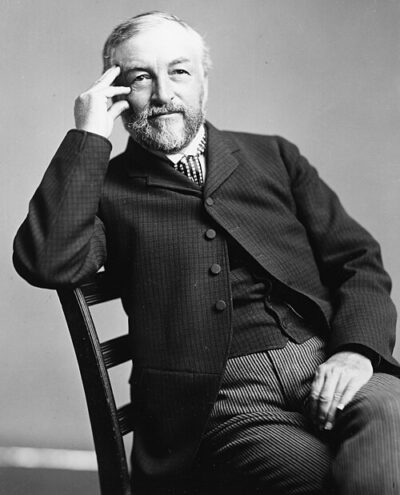
Samuel Langley
Samuel Langley was an American physicist, pioneer of aviation, and 3rd Secretary of the Smithsonian. Born August 22, 1834, in Roxbury. Died February 27, 1906, in Aiken. Positions held include Secretary of the Smithsonian (1887–). Educated at Boston English High School and Boston High School. Awards include Rumford Medal, Henry Draper Medal and Janssen Medal.
Facts
44 facts · 2 confirmed by two sources · 17 cited · 25 from one source
Where this comes from
Papalocal keeps its own record. It started from these sources; what each one said is kept here as it was copied, so a change on their side never changes this page by itself. Tap one to read its version.
What Wikidata says · copied November 13, 2026 · revision 2566443574
- Described as
- American physicist, pioneer of aviation, and 3rd Secretary of the Smithsonian (1834-1906)
- Other names
- Samuel Pierpont Langley
- Born
- August 22, 1834 · 6 references
- Died
- February 27, 1906 · 7 references
- Born in
- Roxbury · 1 reference
- Died in
- Aiken · 1 reference
- Buried in
- Forest Hills Cemetery · 1 reference
- Citizen of
- United States
- Occupation
- astronomer · 1 reference; aerospace engineer; astrophysicist; physicist · 1 reference; inventor; military flight engineer; aircraft pilot · 1 reference
- Positions held
- Secretary of the Smithsonian (1887–) · 1 reference
- Worked for
- Harvard University; United States Naval Academy; Allegheny Observatory; University of Pittsburgh; Smithsonian Institution
- Education
- Boston English High School; Boston High School
- Member of
- Royal Society of London (1895–); Royal Swedish Academy of Sciences; American Academy of Arts and Sciences; American Antiquarian Society; American Philosophical Society (1875–) · 1 reference; American Association for the Advancement of Science · 1 reference; National Academy of Sciences (1876–); Academy of Sciences of Turin (1900–) · 1 reference; Accademia Nazionale dei Lincei (1901–) · 1 reference
- Awards
- Rumford Medal (1886) · 1 reference; Henry Draper Medal (1886) · 1 reference; Janssen Medal (1893); Prix Jules Janssen (1898); National Aviation Hall of Fame (1963) · 1 reference; Rumford Prize (1886); Royal Medal; Foreign Member of the Royal Society (1895) · 1 reference; Honorary Fellow of the Royal Society Te Apārangi (1896–) · 1 reference
- Field
- astronomy; aviation · 2 references; physics · 1 reference
- Father
- Samuel Langley III · 1 reference
- Mother
- Mary Sumner Williams · 1 reference
- Wikipedias with a page
- 45
Wikidata item Q357961 (wikidata.org/wiki/Q357961), public domain (CC0). Copied November 13, 2026.
What Wikipedia says · copied November 13, 2026 · revision 1381757430
Samuel Pierpont Langley (August 22, 1834 – February 27, 1906) was an American aviation pioneer, astronomer and physicist who invented the bolometer. He was the third secretary of the Smithsonian Institution and a professor of astronomy at the University of Pittsburgh, where he was the director of the Allegheny Observatory.
- Born, in its opening lines
- August 22, 1834
- Died, in its opening lines
- February 27, 1906
From the Wikipedia article “Samuel Langley” (en.wikipedia.org/wiki/Samuel_Langley), by its contributors, under CC BY-SA 4.0 (creativecommons.org/licenses/by-sa/4.0/). Copied November 13, 2026; not changed.
Confirmed Two sources agree. Cited One source, and it names where it got it. One source One source, without a reference of its own. Sources disagree The sources disagree. We show the best-supported value and keep theirs below.
