
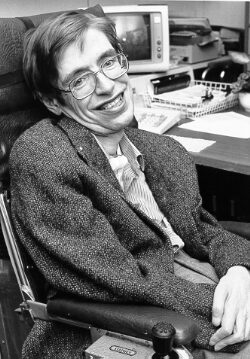
Stephen Hawking
Stephen Hawking was a British theoretical physicist, cosmologist and author. Born January 8, 1942, in Oxford. Died March 14, 2018, in Cambridge. Positions held include Lucasian Professor of Mathematics (1979–2009). Known for A Brief History of Time, Black Holes and Baby Universes and Other Essays and The Universe in a Nutshell. Educated at University College, Oxford and Trinity Hall. Awards include Albert Einstein Medal, Wolf Prize in Physics and Copley Medal.
Facts
72 facts · 2 confirmed by two sources · 47 cited · 23 from one source
Where this comes from
Papalocal keeps its own record. It started from these sources; what each one said is kept here as it was copied, so a change on their side never changes this page by itself. Tap one to read its version.
What Wikidata says · copied November 16, 2026 · revision 2568674684
- Described as
- British theoretical physicist, cosmologist and author (1942–2018)
- Other names
- Stephen William Hawking
- Born
- January 8, 1942 · 17 references
- Died
- March 14, 2018 · 13 references
- Born in
- Oxford · 2 references
- Died in
- Cambridge · 3 references
- Buried in
- Westminster Abbey · 1 reference
- Cause of death
- amyotrophic lateral sclerosis
- Citizen of
- United Kingdom · 2 references
- Occupation
- theoretical physicist; cosmologist; astrophysicist · 2 references; mathematician · 4 references; pedagogue; science writer; university teacher · 2 references; writer · 2 references
- Positions held
- Lucasian Professor of Mathematics (1979–2009) · 2 references
- Worked for
- Gonville and Caius College (1965–1969) · 1 reference; Faculty of Mathematics, University of Cambridge (1962–1965) · 1 reference; Perimeter Institute for Theoretical Physics (2008–2018) · 1 reference; University of Cambridge (–2018) · 2 references; California Institute of Technology (1970–1975) · 1 reference
- Education
- University College, Oxford (1959–1962); Trinity Hall (1962–1966) · 1 reference; St Albans School (1952–); University of Cambridge · 1 reference; St Albans High School for Girls; Byron House School
- Member of
- Royal Society of Arts (1974–); Pontifical Academy of Sciences (1986–) · 1 reference; American Philosophical Society (1984–) · 1 reference; National Academy of Sciences (1992–) · 2 references; Royal Society of London (1974–) · 2 references; American Academy of Arts and Sciences (1984–) · 1 reference; International Astronomical Union
- Teams
- University College Boat Club
- Known for
- A Brief History of Time · 1 reference; Black Holes and Baby Universes and Other Essays · 1 reference; The Universe in a Nutshell · 1 reference; On the Shoulders of Giants · 1 reference; God Created the Integers; The Dreams That Stuff Is Made of: The Most Astounding Papers of Quantum Physics and How They Shook the Scientific World; My Brief History
- Awards
- Albert Einstein Medal (1979) · 2 references; Wolf Prize in Physics (1988) · 1 reference; Copley Medal (2006) · 2 references; Presidential Medal of Freedom (2009) · 1 reference; Special Breakthrough Prize in Fundamental Physics (2013) · 2 references; Companion of Honour (1989) · 2 references; Eddington Medal (1975) · 1 reference; Gold Medal of the Royal Astronomical Society (1985) · 1 reference; Commander of the Order of the British Empire (1982) · 1 reference; Naylor Prize and Lectureship (1999) · 1 reference; Oskar Klein Medal (2003) · 1 reference; Hughes Medal (1976) · 1 reference; Royal Society Science Books Prize (2002) · 1 reference; Albert Medal (1999) · 2 references; Michelson–Morley Award (2003) · 1 reference
- Field
- general relativity; quantum gravity; theoretical physics · 1 reference; cosmology; applied mathematics · 1 reference; universe · 1 reference
- Spouse
- Jane Hawking (1965–1991) · 1 reference; Elaine Mason (1995–2006)
- Children
- Lucy Hawking · 1 reference; Robert Hawking · 1 reference; Timothy Hawking · 1 reference
- Father
- Frank Hawking · 1 reference
- Mother
- Isobel Eileen Hawking · 1 reference
- Lived in
- England
- Website
- https://hawking.org.uk
- Wikipedias with a page
- 203
Wikidata item Q17714 (wikidata.org/wiki/Q17714), public domain (CC0). Copied November 16, 2026.
What Wikipedia says · copied November 16, 2026 · revision 1385846442
Stephen William Hawking (8 January 1942 – 14 March 2018) was an English theoretical astrophysicist, cosmologist, and author who was director of research at the Centre for Theoretical Cosmology at the University of Cambridge. Between 1979 and 2009, he was the Lucasian Professor of Mathematics at Cambridge, widely viewed as one of the most prestigious academic posts in the world.
Hawking was born in Oxford into a family of physicians. In 1959, at the age of 17, he began his university education at University College, Oxford, where he received a first-class BA degree in physics. In 1962, he began his graduate work at Trinity Hall, Cambridge, where, in 1966, he obtained his PhD in applied mathematics and theoretical physics, specialising in general relativity and cosmology. In 1963, at age 21, Hawking was diagnosed with an early-onset slow-progressing form of motor neurone disease that gradually, over decades, paralysed him. After the loss of his speech, he communicated through a speech-generating device, initially through use of a handheld switch, and eventually by using a single cheek muscle.
Hawking's scientific works included a collaboration with Roger Penrose on gravitational singularity theorems in the framework of general relativity, and the theoretical prediction that black holes emit radiation, often called Hawking radiation. Initially, Hawking radiation was controversial. By the late 1970s, and following the publication of further research, the discovery was widely accepted as a major breakthrough in theoretical physics. Hawking was the first to set out a theory of cosmology explained by a union of the general theory of relativity and quantum mechanics. He supported the many-worlds interpretation of quantum mechanics. He also introduced the notion of a micro black hole.
Hawking achieved commercial success with several works of popular science in which he discussed his theories and cosmology in general. His book A Brief History of Time appeared on the Sunday Times bestseller list for a record-breaking 237 weeks. Hawking was a Fellow of the Royal Society, a lifetime member of the Pontifical Academy of Sciences, and a recipient of the Presidential Medal of Freedom, the highest civilian award in the United States. In 2002, Hawking was ranked number 25 in the BBC's poll of the 100 Greatest Britons. He died in 2018 at the age of 76, having lived more than 50 years following his diagnosis of motor neurone disease.
- Born, in its opening lines
- January 8, 1942
- Died, in its opening lines
- March 14, 2018
From the Wikipedia article “Stephen Hawking” (en.wikipedia.org/wiki/Stephen_Hawking), by its contributors, under CC BY-SA 4.0 (creativecommons.org/licenses/by-sa/4.0/). Copied November 16, 2026; not changed.
Confirmed Two sources agree. Cited One source, and it names where it got it. One source One source, without a reference of its own. Sources disagree The sources disagree. We show the best-supported value and keep theirs below.
