
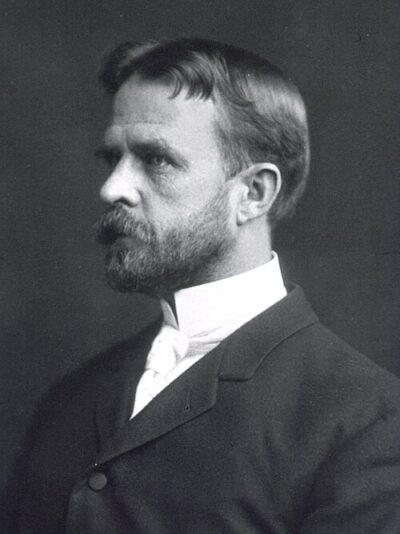
Thomas Hunt Morgan
Thomas Hunt Morgan was an American biologist and professor from Kentucky. Born September 25, 1866, in Lexington. Died December 4, 1945, in Pasadena. Educated at Johns Hopkins University and University of Kentucky. Awards include Nobel Prize in Physiology or Medicine, Copley Medal and Darwin Medal.
Facts
47 facts · 2 confirmed by two sources · 18 cited · 27 from one source
Where this comes from
Papalocal keeps its own record. It started from these sources; what each one said is kept here as it was copied, so a change on their side never changes this page by itself. Tap one to read its version.
What Wikidata says · copied November 13, 2026 · revision 2563063686
- Described as
- American biologist and professor from Kentucky (1866–1945)
- Other names
- Thomas H. Morgan, Thomas Morgan, T. H. Morgan, T. Kh. Morgan
- Born
- September 25, 1866 · 11 references
- Died
- December 4, 1945 · 12 references
- Born in
- Lexington · 2 references
- Died in
- Pasadena · 1 reference
- Buried in
- Mountain View Cemetery and Mausoleum · 2 references
- Cause of death
- myocardial infarction
- Citizen of
- United States
- Occupation
- evolutionary biologist; geneticist; zoologist · 1 reference; physician; university teacher; physiologist · 1 reference; biologist · 1 reference
- Worked for
- Bryn Mawr College (1891–1904) · 1 reference; California Institute of Technology (1928–); Columbia University (1904–1927)
- Education
- Johns Hopkins University (1886–1890); University of Kentucky (1883–1886); Columbia University · 1 reference
- Member of
- Royal Society of London (1919–) · 1 reference; Pontifical Academy of Sciences · 1 reference; Russian Academy of Sciences (1923–) · 1 reference; Royal Swedish Academy of Sciences; Lwów Scientific Society; American Academy of Arts and Sciences; Royal Prussian Academy of Sciences; Académie Nationale de Médecine; National Academy of Sciences (1909–); Göttingen Academy of Sciences and Humanities in Lower Saxony
- Awards
- Nobel Prize in Physiology or Medicine (1933) · 2 references; Copley Medal (1939) · 1 reference; Darwin Medal (1924) · 1 reference; Croonian Medal and Lecture (1922); Foreign Member of the Royal Society (1919) · 1 reference; Silliman Memorial Lectures (1924); doctor honoris causa from the University of Paris (1935) · 1 reference
- Field
- genetics
- Spouse
- Lilian Vaughan Morgan (1904–)
- Children
- Isabel Morgan
- Father
- Charlton Hunt Morgan
- Mother
- Ellen Key Howard
- Lived in
- Baltimore · 1 reference; Lexington · 1 reference; Bryn Mawr · 1 reference; New York City · 1 reference; Pasadena · 1 reference
- Wikipedias with a page
- 79
Wikidata item Q177681 (wikidata.org/wiki/Q177681), public domain (CC0). Copied November 13, 2026.
What Wikipedia says · copied November 13, 2026 · revision 1381402569
Thomas Hunt Morgan (September 25, 1866 – December 4, 1945) was an American evolutionary biologist, geneticist, and embryologist. In 1933, he won the Nobel Prize in Physiology or Medicine for discoveries on the role of chromosomes in heredity.
Morgan received his Ph.D. from Johns Hopkins University in zoology in 1890 and researched embryology during his tenure at Bryn Mawr. Following the rediscovery of Mendelian inheritance in 1900, Morgan began to study the genetic characteristics of the fruit fly Drosophila melanogaster. In his famous Fly Room at Columbia University's Schermerhorn Hall, Morgan demonstrated that genes are carried on chromosomes and are the mechanical basis of heredity. These discoveries formed the basis of the modern science of genetics.
During his distinguished career, Morgan wrote 22 books and 370 scientific papers. As a result of his work, Drosophila became a major model organism in contemporary genetics. The Division of Biology which he established at the California Institute of Technology has produced seven Nobel Prize winners.
- Born, in its opening lines
- September 25, 1866
- Died, in its opening lines
- December 4, 1945
From the Wikipedia article “Thomas Hunt Morgan” (en.wikipedia.org/wiki/Thomas_Hunt_Morgan), by its contributors, under CC BY-SA 4.0 (creativecommons.org/licenses/by-sa/4.0/). Copied November 13, 2026; not changed.
Confirmed Two sources agree. Cited One source, and it names where it got it. One source One source, without a reference of its own. Sources disagree The sources disagree. We show the best-supported value and keep theirs below.
