
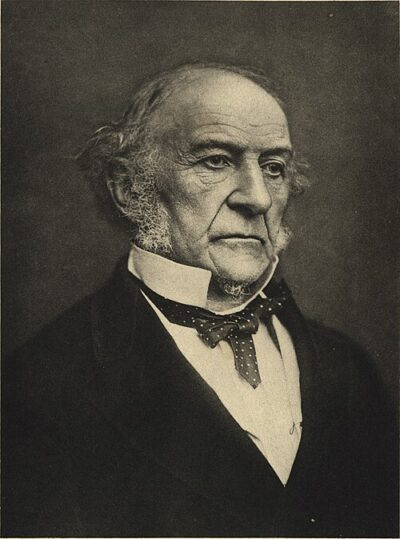
William Ewart Gladstone
William Ewart Gladstone was a British Liberal prime minister. Born December 29, 1809, in Liverpool. Died May 19, 1898, in Hawarden Castle. Positions held include Leader of the Opposition (3 times) (1866–1892), Chancellor of the Exchequer (4 times) (1852–1882) and Secretary of State for War and the Colonies. Educated at Christ Church and Eton College. Awards include Fellow of the Royal Society and Knight of the Legion of Honour.
Facts
59 facts · 2 confirmed by two sources · 28 cited · 29 from one source
Where this comes from
Papalocal keeps its own record. It started from these sources; what each one said is kept here as it was copied, so a change on their side never changes this page by itself. Tap one to read its version.
What Wikidata says · copied November 16, 2026 · revision 2567353432
- Described as
- British Liberal prime minister (1809–1898)
- Other names
- Gladstone, W. E. (William Ewart), William Gladstone, The Rt Hon William Ewart Gladstone, W. E. Gladstone, Gladstone
- Born
- December 29, 1809 · 12 references
- Died
- May 19, 1898 · 11 references
- Born in
- Liverpool · 1 reference
- Died in
- Hawarden Castle
- Buried in
- Westminster Abbey · 2 references
- Citizen of
- United Kingdom of Great Britain and Ireland; United Kingdom · 1 reference
- Occupation
- politician · 2 references; diplomat; statistician; writer · 1 reference; head of government · 1 reference
- Positions held
- Leader of the Opposition (3 times) (1866–1892); Chancellor of the Exchequer (4 times) (1852–1882); Secretary of State for War and the Colonies; President of the Board of Trade (1843–1845); Member of the Privy Council of the United Kingdom; Prime Minister of the United Kingdom (3 times) (1868–1894); member of the 25th Parliament of the United Kingdom (1892–1895) · 1 reference; member of the 24th Parliament of the United Kingdom (1886–1892) · 1 reference; member of the 23rd Parliament of the United Kingdom (1885–1886) · 1 reference; member of the 22nd Parliament of the United Kingdom (1880–1885) · 1 reference; member of the 21st Parliament of the United Kingdom (1874–1880) · 1 reference; member of the 20th Parliament of the United Kingdom (1868–1874) · 1 reference; member of the 19th Parliament of the United Kingdom (1865–1868) · 1 reference; member of the 18th Parliament of the United Kingdom (1859–1865) · 1 reference; member of the 17th Parliament of the United Kingdom (1857–1859) · 1 reference
- Political party
- Conservative Party (1834–1846); Tories (1828–1834); Liberal Party (1859–)
- Worked for
- University of Edinburgh
- Education
- Christ Church; Eton College (1821–1827) · 1 reference
- Member of
- Royal Society of London; Hungarian Academy of Sciences; Hellenic Philological Society of Constantinople (1862–); American Academy of Arts and Sciences; Accademia Nazionale dei Lincei (1876–) · 1 reference; American Antiquarian Society; Serbian Learned Society (1880–1892); Serbian Academy of Sciences and Arts (1892–1898); Historic Society of Lancashire and Cheshire; Accademia della Crusca
- Awards
- Fellow of the Royal Society (1881) · 1 reference; Knight of the Legion of Honour (1859) · 1 reference
- Field
- politics
- Spouse
- Catherine Gladstone (1839–) · 4 references
- Children
- William Henry Gladstone · 2 references; Mary Gladstone · 1 reference; Henry Gladstone, 1st Baron Gladstone of Hawarden · 1 reference; Herbert Gladstone, 1st Viscount Gladstone · 1 reference; Helen Gladstone · 1 reference; Agnes Gladstone · 1 reference; Stephen Edward Gladstone · 2 references; Catherine Jessy Gladstone · 2 references
- Father
- Sir John Gladstone, 1st Baronet · 2 references
- Mother
- Anne MacKenzie Robertson · 2 references
- Siblings
- John Gladstone
- Religion
- Anglicanism
- Wikipedias with a page
- 100
Wikidata item Q160852 (wikidata.org/wiki/Q160852), public domain (CC0). Copied November 16, 2026.
What Wikipedia says · copied November 16, 2026 · revision 1384534764
William Ewart Gladstone ( YOO-ərt GLAD-stən; 29 December 1809 – 19 May 1898) was a British statesman who served as Prime Minister of the United Kingdom for four non-consecutive terms between 1868 and 1894, the most of any British prime minister. He began in politics as a Conservative Member of Parliament (MP) for Newark and ended as the face of the Liberal Party. He also served four times as Chancellor of the Exchequer, five times as Leader of the House of Commons, and MP for over 60 years, from 1832 to 1846 and from 1847 to 1895, representing a total of five constituencies. His political career thus spanned nearly the entire Victorian era.
Gladstone was born in Liverpool to the prominent Scottish merchant and slaveholder Sir John Gladstone. A graduate of Eton and Oxford, Gladstone first entered the House of Commons in 1832 as a High Tory, a grouping that joined the Conservative Party under Sir Robert Peel in 1834. Gladstone served as a minister in both of Peel's governments, and in 1846 joined the breakaway Peelite faction that merged into the new Liberal Party in 1859. He was chancellor under Lord Aberdeen (1852–1855), Lord Palmerston (1859–1865) and Lord Russell (1865–1866). Gladstone's own political doctrine – which promoted equality of opportunity and the repeal of taxes and protectionist trade barriers – came to be known as Gladstonian liberalism.
In 1868, Gladstone became prime minister for the first time. His ministry passed many reforms, including the disestablishment of the Church of Ireland and the introduction of secret voting. After electoral defeat in 1874, Gladstone resigned as leader of the Liberal Party. From 1876 he began a comeback based on moral opposition to the Ottoman Empire's massacres of Bulgarians. Gladstone's Midlothian speaking campaign of 1879–1880 is considered the first modern political campaign in Britain, and his popularity among the working class earned him the sobriquet "The People's William". After the 1880 general election, Gladstone returned as party leader and formed his second ministry (1880–1885), which saw the passage of the Third Reform Act as well as crises in Ireland — where his government passed repressive measures but also improved the legal rights of tenant farmers — and Egypt, where public outrage at the death of General Gordon in the Siege of Khartoum forced him to resign.
Gladstone's brief 1886 premiership was dominated by his proposal of home rule for Ireland that was defeated in the House of Commons and caused Liberal Unionists to break from his party. This helped keep the Liberals out of office for 20 years, barring the minority cabinet Gladstone formed in 1892. This time, the Government of Ireland Bill 1893 passed through the Commons but was defeated by a wide margin in the House of Lords. Gladstone resigned in March 1894, aged 84, as the oldest ever prime minister. His successor, Lord Rosebery, was defeated in a landslide in the subsequent year's election. Gladstone left Parliament in 1895 and died three years later.
A powerful orator, Gladstone was called by some the "G.O.M." (to his supporters, the "Grand Old Man"; to his rivals, "God's Only Mistake"). Historians often rank Gladstone as one of the greatest prime ministers in British history. His devoutness, charitable work (particularly with fallen women) and nonfiction texts on subjects ranging from the Oxford Movement to classical civilisation have also attracted attention.
- Born, in its opening lines
- December 29, 1809
- Died, in its opening lines
- May 19, 1898
From the Wikipedia article “William Ewart Gladstone” (en.wikipedia.org/wiki/William_Ewart_Gladstone), by its contributors, under CC BY-SA 4.0 (creativecommons.org/licenses/by-sa/4.0/). Copied November 16, 2026; not changed.
Confirmed Two sources agree. Cited One source, and it names where it got it. One source One source, without a reference of its own. Sources disagree The sources disagree. We show the best-supported value and keep theirs below.
