
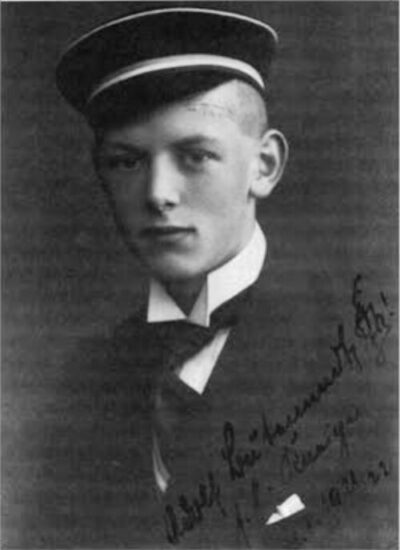
Adolf Butenandt
Adolf Butenandt was a German biochemist. Born March 24, 1903, in Lehe. Died January 18, 1995, in Munich. Educated at University of Marburg and University of Göttingen. Awards include Pour le Mérite for Sciences and Arts order, Bavarian Order of Merit and honorary citizen of Munich.
Facts
49 facts · 2 confirmed by two sources · 18 cited · 29 from one source
Where this comes from
Papalocal keeps its own record. It started from these sources; what each one said is kept here as it was copied, so a change on their side never changes this page by itself. Tap one to read its version.
What Wikidata says · copied November 16, 2026 · revision 2568844725
- Described as
- German biochemist (1903-1995)
- Other names
- Adolf Friedrich Johann Butenandt
- Born
- March 24, 1903 · 11 references
- Died
- January 18, 1995 · 11 references
- Born in
- Lehe · 2 references
- Died in
- Munich · 3 references
- Buried in
- Munich Waldfriedhof · 1 reference
- Citizen of
- Germany
- Occupation
- biochemist · 1 reference; chemist; politician; university teacher · 1 reference
- Political party
- Nazi Party (1936–) · 1 reference
- Worked for
- University of Tübingen; LMU Munich; Humboldt-Universität zu Berlin; Kaiser Wilhelm Society; University of Göttingen · 1 reference; Gdańsk University of Technology; University of Marburg · 1 reference
- Education
- University of Marburg; University of Göttingen
- Member of
- Royal Society of London (1968–); Royal Prussian Academy of Sciences; German Academy of Sciences at Berlin; German Academy of Sciences Leopoldina; French Academy of Sciences; Bavarian Academy of Sciences and Humanities; Turnerschaft Philippina-Saxonia · 1 reference; National Socialist Teachers League; German Labor Front; Luftfahrtforschungsansalt
- Awards
- Pour le Mérite for Sciences and Arts order (1962) · 1 reference; Bavarian Order of Merit; honorary citizen of Munich (1985); Great Golden Medal of Honour for Services to the Republic of Austria (1994) · 1 reference; Nobel Prize in Chemistry (1939) · 2 references; Carus medal (1943); Harnack medal (1973); Bavarian Maximilian Order for Science and Art (1981); Ernst Hellmut Vits Award (1970); August Wilhelm von Hofmann Medal (1942) · 1 reference; Emil Fischer Medal (1935) · 1 reference; Fresenius Prize (1935) · 1 reference; honorary doctor of the University of Vienna (1963) · 1 reference; Grand Cross 1st class of the Order of Merit of the Federal Republic of Germany (1985) · 1 reference; honorary doctorate of the University of Graz (1957) · 1 reference
- Field
- biochemistry; organic chemistry
- Spouse
- Erika Butenandt · 1 reference
- Children
- Otfrid Butenandt · 1 reference
- Wikipedias with a page
- 72
Wikidata item Q5327 (wikidata.org/wiki/Q5327), public domain (CC0). Copied November 16, 2026.
What Wikipedia says · copied November 16, 2026 · revision 1371961421
Adolf Friedrich Johann Butenandt (German pronunciation: [ˈaːdɔlf ˈbuːtənant] ; 24 March 1903, Lehe near Bremerhaven – 18 January 1995, Munich) was a German biochemist. He was awarded the Nobel Prize in Chemistry in 1939 for his "work on sex hormones." He initially rejected the award in accordance with government policy, but accepted it in 1949 after World War II. He was President of the Max Planck Society from 1960 to 1972. He was also the first, in 1959, to discover the structure of the sex pheromone of silkworms, which he named bombykol.
- Born, in its opening lines
- March 24, 1903
- Died, in its opening lines
- January 18, 1995
From the Wikipedia article “Adolf Butenandt” (en.wikipedia.org/wiki/Adolf_Butenandt), by its contributors, under CC BY-SA 4.0 (creativecommons.org/licenses/by-sa/4.0/). Copied November 16, 2026; not changed.
Confirmed Two sources agree. Cited One source, and it names where it got it. One source One source, without a reference of its own. Sources disagree The sources disagree. We show the best-supported value and keep theirs below.
