
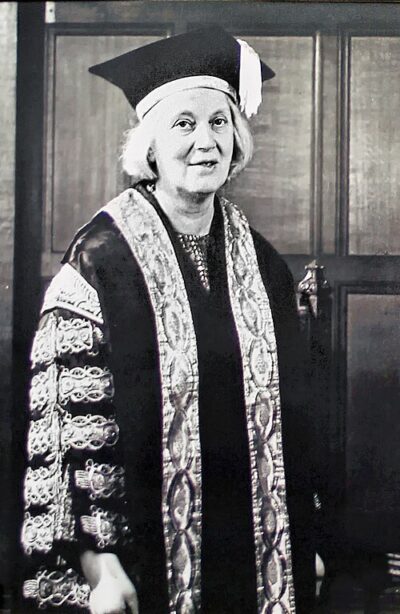
Dorothy Hodgkin
Dorothy Hodgkin was a British chemist. Born May 12, 1910, in Cairo. Died July 29, 1994, in Ilmington. Positions held include Chancellor of the University of Bristol (1970–1988). Educated at Somerville College and Newnham College. Awards include Fellow of the Royal Society, Nobel Prize in Chemistry and Order of Merit.
Facts
52 facts · 2 confirmed by two sources · 27 cited · 23 from one source
Where this comes from
Papalocal keeps its own record. It started from these sources; what each one said is kept here as it was copied, so a change on their side never changes this page by itself. Tap one to read its version.
What Wikidata says · copied November 16, 2026 · revision 2569200411
- Described as
- British chemist
- Other names
- Dorothy Crowfoot, Dorothy Mary Crowfoot, Dorothy Mary Hodgkin, Dorothy Mary Crowfoot Hodgkin, Dorothy Crowfoot Hodgkin
- Born
- May 12, 1910 · 11 references
- Died
- July 29, 1994 · 12 references
- Born in
- Cairo · 3 references
- Died in
- Ilmington · 1 reference
- Cause of death
- cerebral hemorrhage
- Citizen of
- United Kingdom · 1 reference; United Kingdom of Great Britain and Ireland (–1927)
- Occupation
- chemist · 1 reference; biochemist · 2 references; crystallographer · 1 reference; biophysicist; physicist · 1 reference
- Positions held
- Chancellor of the University of Bristol (1970–1988)
- Worked for
- University of Cambridge
- Education
- Somerville College · 1 reference; Newnham College; Sir John Leman High School · 1 reference; University of Oxford · 1 reference
- Member of
- Royal Society of London (1947–) · 1 reference; German Academy of Sciences Leopoldina · 1 reference; Academy of Sciences of the USSR (1976–) · 1 reference; American Academy of Arts and Sciences · 1 reference; Russian Academy of Sciences; Royal Netherlands Academy of Arts and Sciences; National Academy of Sciences (1971–); Manchester Literary and Philosophical Society
- Awards
- Fellow of the Royal Society (1947–); Nobel Prize in Chemistry (1964) · 2 references; Order of Merit (1965) · 1 reference; Copley Medal (1976) · 1 reference; Lomonosov Gold Medal (1986) · 1 reference; Royal Medal (1956); Lenin Peace Prize; Honorary doctor of the University of Zagreb; Royal Society Bakerian Medal (1972) · 1 reference; Fellow of the Royal Institute of Chemistry; Banting Medal (1972) · 1 reference; Fellow of the American Academy of Arts and Sciences; Honorary Fellow of the Royal Society of Chemistry; Austrian Decoration for Science and Art (1983); Baly Medal (1971)
- Field
- X-ray crystallography; biochemistry · 1 reference; chemistry · 1 reference; crystallography · 1 reference
- Spouse
- Thomas Lionel Hodgkin (1937–1982) · 2 references
- Father
- John Winter Crowfoot · 1 reference
- Mother
- Grace Mary Hood Crowfoot · 2 references
- Siblings
- Elizabeth Grace Crowfoot · 1 reference; Joan Crowfoot Payne · 1 reference; Diana Crowfoot · 1 reference
- Lived in
- Oxford · 1 reference
- Wikipedias with a page
- 107
Wikidata item Q7487 (wikidata.org/wiki/Q7487), public domain (CC0). Copied November 16, 2026.
What Wikipedia says · copied November 16, 2026 · revision 1384365938
Dorothy Mary Crowfoot Hodgkin (née Crowfoot; 12 May 1910 – 29 July 1994) was an English chemist who advanced the technique of X-ray crystallography to determine the structure of biomolecules, which became essential for structural biology. She received the 1964 Nobel Prize in Chemistry, and is the only British woman scientist to have been awarded a Nobel Prize.
Among her most influential discoveries are the confirmation of the structure of penicillin as previously surmised by Edward Abraham and Ernst Boris Chain; and mapping the structure of vitamin B12, for which in 1964 she became the third woman to win the Nobel Prize in Chemistry. Hodgkin also elucidated the structure of insulin in 1969 after 35 years of work.
Hodgkin used the name "Dorothy Crowfoot" until twelve years after marrying Thomas Lionel Hodgkin, when she began using "Dorothy Crowfoot Hodgkin". Hodgkin is referred to as "Dorothy Hodgkin" by the Royal Society (when referring to its sponsorship of the Dorothy Hodgkin fellowship), and by Somerville College. The National Archives of the United Kingdom refer to her as "Dorothy Mary Crowfoot Hodgkin". The case of her Nobel prize is inscribed 'Crowfoot Hodgkin'.
- Born, in its opening lines
- May 12, 1910
- Died, in its opening lines
- July 29, 1994
From the Wikipedia article “Dorothy Hodgkin” (en.wikipedia.org/wiki/Dorothy_Hodgkin), by its contributors, under CC BY-SA 4.0 (creativecommons.org/licenses/by-sa/4.0/). Copied November 16, 2026; not changed.
Confirmed Two sources agree. Cited One source, and it names where it got it. One source One source, without a reference of its own. Sources disagree The sources disagree. We show the best-supported value and keep theirs below.
