
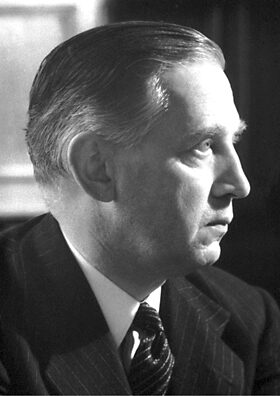
Edward Victor Appleton
Edward Victor Appleton was an English physicist. Born September 6, 1892, in Bradford. Died April 21, 1965, in Edinburgh. Educated at University of Edinburgh and St John's College. Awards include Fellow of the Royal Society, Knight Commander of the Order of the Bath and Knight Grand Cross of the Order of the British Empire.
Facts
41 facts · 2 confirmed by two sources · 12 cited · 27 from one source
Where this comes from
Papalocal keeps its own record. It started from these sources; what each one said is kept here as it was copied, so a change on their side never changes this page by itself. Tap one to read its version.
What Wikidata says · copied November 16, 2026 · revision 2563200796
- Described as
- English physicist (1892–1965)
- Other names
- Sir Edward Appleton, Sir Edward Victor Appleton
- Born
- September 6, 1892 · 13 references
- Died
- April 21, 1965 · 13 references
- Born in
- Bradford · 3 references
- Died in
- Edinburgh · 2 references
- Buried in
- Morningside Cemetery · 1 reference
- Citizen of
- United Kingdom
- Occupation
- physicist · 1 reference; astronomer; researcher; university teacher
- Worked for
- King's College London; University of London; University of Cambridge
- Education
- University of Edinburgh; St John's College; University of Cambridge · 1 reference
- Member of
- Royal Society of London; German Academy of Sciences at Berlin; Royal Swedish Academy of Sciences; American Academy of Arts and Sciences (1936–) · 1 reference; Pontifical Academy of Sciences · 1 reference; Royal Prussian Academy of Sciences; Indian National Science Academy
- Awards
- Fellow of the Royal Society; Knight Commander of the Order of the Bath; Knight Grand Cross of the Order of the British Empire; Royal Medal (1950); Nobel Prize in Physics (1947) · 2 references; IEEE Medal of Honor (1962) · 1 reference; Hughes Medal (1933); Faraday Medal (1946); King Haakon VII Freedom Cross; IEEE Morris N. Liebmann Memorial Award (1929) · 1 reference; Albert Medal (1950); honorary doctorate at the Laval University (1958) · 1 reference; Royal Society Bakerian Medal (1937) · 1 reference; Honorary Fellow of the Royal Society of Edinburgh; Chree Medal and Prize (1947) · 1 reference
- Field
- physics
- Spouse
- Helen Lennie Appleton
- Children
- Rosalind Appleton-Collins · 1 reference
- Wikipedias with a page
- 85
Wikidata item Q153194 (wikidata.org/wiki/Q153194), public domain (CC0). Copied November 16, 2026.
What Wikipedia says · copied November 16, 2026 · revision 1379531093
Sir Edward Victor Appleton (6 September 1892 – 21 April 1965) was a British physicist who received the Nobel Prize in Physics in 1947 for his contributions to the knowledge of the ionosphere, which led to the development of radar and shortwave radio.
A graduate of the University of Cambridge, Appleton was commissioned as a second lieutenant for the Royal Engineers in 1915. During the First World War, he was an instructor at the Royal Engineers Signals Depot in Fenny Stratford, and served briefly on the Western Front. He brought a captured German thermionic valve back with him. He became Wheatstone Professor of Physics at King's College London in 1924 and a fellow of the Royal Society in 1927. His primary research interests were how radio waves were created and propagated and unravelling the mystery of how they were reflected by the upper atmosphere.
Appleton returned to Cambridge in 1936 as Jacksonian Professor of Natural Philosophy and, when Ernest Rutherford died in October of that year, became acting director of the Cavendish Laboratory. In 1939, shortly before the outbreak of the Second World War, Appleton became the Secretary of the Department of Scientific and Industrial Research. In this role, he marshalled the scientific knowledge of Britain in service of the war effort. He was also closely involved with the development of radar, an outgrowth of his pre-war research into the ionosphere. He was also in charge of Tube Alloys, the British nuclear weapons project, which was merged into the American Manhattan Project in 1943.
From 1948 until his death in 1965, he was the Principal and Vice-Chancellor of the University of Edinburgh. As such, he oversaw its growth and was involved in the controversial redevelopment of the historic George Square.
- Born, in its opening lines
- September 6, 1892
- Died, in its opening lines
- April 21, 1965
From the Wikipedia article “Edward Victor Appleton” (en.wikipedia.org/wiki/Edward_Victor_Appleton), by its contributors, under CC BY-SA 4.0 (creativecommons.org/licenses/by-sa/4.0/). Copied November 16, 2026; not changed.
Confirmed Two sources agree. Cited One source, and it names where it got it. One source One source, without a reference of its own. Sources disagree The sources disagree. We show the best-supported value and keep theirs below.
