
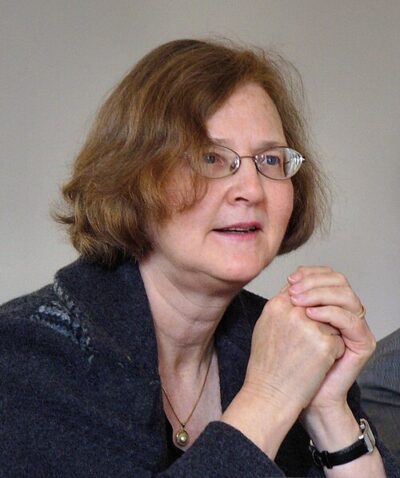
Elizabeth Blackburn
Elizabeth Blackburn is an Australian-American biological researcher. Born November 26, 1948, in Hobart. Positions held include President of the American Association for Cancer Research (2010–2011). Educated at University of Melbourne and Darwin College. Awards include Albert Lasker Award for Basic Medical Research, Nobel Prize in Physiology or Medicine and L'Oréal-UNESCO Award For Women in Science.
Facts
43 facts · 1 confirmed by two sources · 25 cited · 17 from one source
Where this comes from
Papalocal keeps its own record. It started from these sources; what each one said is kept here as it was copied, so a change on their side never changes this page by itself. Tap one to read its version.
What Wikidata says · copied November 13, 2026 · revision 2566536767
- Described as
- Australian-American biological researcher
- Other names
- Blackburn E, E Blackburn, Blackburn, E. H. Blackburn, Blackburn EH, E.H. Blackburn, E. Blackburn, Blackburn E. H., Blackburn E., E H Blackburn, Elizabeth H. Blackburn, Elizabeth Helen Blackburn
- Born
- November 26, 1948 · 5 references
- Born in
- Hobart · 1 reference
- Citizen of
- Australia; United States (2003–)
- Occupation
- biologist · 2 references; molecular biologist · 1 reference; biochemist · 1 reference; university teacher · 1 reference
- Positions held
- President of the American Association for Cancer Research (2010–2011) · 1 reference
- Worked for
- University of Oxford; University of California, San Francisco (1990–); University of California, Berkeley (1978–1990) · 1 reference; Salk Institute for Biological Studies · 1 reference
- Education
- University of Melbourne (–1972); Darwin College; University of Cambridge (–1975) · 1 reference; University High School; Janet Clarke Hall
- Member of
- National Academy of Sciences (1993–) · 1 reference; American Academy of Arts and Sciences (1991–) · 1 reference; Australian Academy of Science (2007–) · 1 reference; European Molecular Biology Organization (2010–) · 1 reference; National Academy of Medicine · 1 reference; Royal Society of London (1992–) · 1 reference
- Awards
- Albert Lasker Award for Basic Medical Research (2006) · 1 reference; Nobel Prize in Physiology or Medicine (2009) · 2 references; L'Oréal-UNESCO Award For Women in Science (2008) · 1 reference; Benjamin Franklin Medal (2005) · 1 reference; Harvey Prize (1999) · 1 reference; Canada Gairdner International Award (1998) · 1 reference; Paul Ehrlich and Ludwig Darmstaedter Prize (2009) · 1 reference; Louisa Gross Horwitz Prize (2007) · 1 reference; Victorian Honour Roll of Women (2010) · 1 reference; Albany Medical Center Prize (2008) · 1 reference; Alfred P. Sloan, Jr. Prize (2001) · 1 reference; Dr A.H. Heineken Prize for Medicine (2004) · 1 reference; Dickson Prize in Medicine (2000); Gruber Prize in Genetics (2006); Pearl Meister Greengard Prize (2008)
- Field
- biology · 1 reference; physiology · 1 reference; cytogenetics
- Website
- https://blackburnlab.ucsf.edu
- Wikipedias with a page
- 81
Wikidata item Q26321 (wikidata.org/wiki/Q26321), public domain (CC0). Copied November 13, 2026.
What Wikipedia says · copied November 13, 2026 · revision 1385276544
Elizabeth Helen Blackburn (born 26 November 1948) is an Australian–American Nobel laureate who is the former president of the Salk Institute for Biological Studies. In 1984, Blackburn co-discovered telomerase, the enzyme that replenishes the telomere, with Carol W. Greider. For this work, she was awarded the 2009 Nobel Prize in Physiology or Medicine, sharing it with Carol W. Greider and Jack W. Szostak, becoming the first Australian woman Nobel laureate.
She also worked in medical ethics, and was controversially dismissed from the Bush administration's President's Council on Bioethics. 170 scientists signed an open letter to the president in her support, maintaining that she was fired because of political opposition to her advice.
- Born, in its opening lines
- November 26, 1948
From the Wikipedia article “Elizabeth Blackburn” (en.wikipedia.org/wiki/Elizabeth_Blackburn), by its contributors, under CC BY-SA 4.0 (creativecommons.org/licenses/by-sa/4.0/). Copied November 13, 2026; not changed.
Confirmed Two sources agree. Cited One source, and it names where it got it. One source One source, without a reference of its own. Sources disagree The sources disagree. We show the best-supported value and keep theirs below.
