
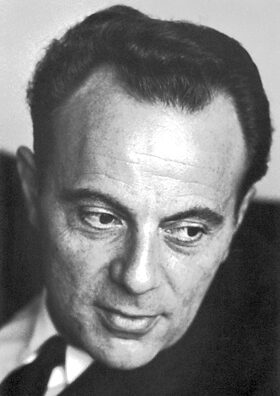
François Jacob
François Jacob was a French biologist and geneticist, winner of the Nobel Prize in 1965. Born June 17, 1920, in Nancy. Died April 20, 2013, in 14th arrondissement of Paris. Positions held include chancellor (2007–2011) and Member of the Académie française (1996–2013). Educated at Lycée Carnot and Paris Medical Faculty. Awards include Nobel Prize in Physiology or Medicine, Grand Prix Charles-Leopold Mayer and Grand Cross of the Legion of Honour.
Facts
46 facts · 1 confirmed by two sources · 16 cited · 28 from one source · 1 where the sources disagree
What’s different
- Died: we show April 20, 2013 (Sources disagree). Wikipedia says April 19, 2013
Where this comes from
Papalocal keeps its own record. It started from these sources; what each one said is kept here as it was copied, so a change on their side never changes this page by itself. Tap one to read its version.
What Wikidata says · copied November 16, 2026 · revision 2563197608
- Described as
- French biologist and geneticist, winner of the Nobel Prize in 1965
- Born
- June 17, 1920 · 16 references
- Died
- April 20, 2013 · 2 references
- Born in
- Nancy · 3 references
- Died in
- 14th arrondissement of Paris · 1 reference
- Buried in
- Montparnasse Cemetery
- Name at birth
- Franck François Louis Jacob · 1 reference
- Citizen of
- France
- Occupation
- biochemist; university teacher · 1 reference; geneticist · 1 reference; physiologist; autobiographer; professor · 1 reference; film producer · 1 reference; film editor · 1 reference
- Positions held
- chancellor (2007–2011); Member of the Académie française (1996–2013)
- Worked for
- Collège de France (1964–1991) · 1 reference
- Education
- Lycée Carnot; Paris Medical Faculty (–1947) · 2 references
- Member of
- Royal Society of London; Académie Française (1996–); French Academy of Sciences; National Academy of Sciences (1969–); Royal Danish Academy of Sciences and Letters; American Academy of Arts and Sciences; Hungarian Academy of Sciences; European Molecular Biology Organization; American Philosophical Society · 1 reference; International Academy of the History of Science
- Awards
- Nobel Prize in Physiology or Medicine (1965) · 2 references; Grand Prix Charles-Leopold Mayer (1962); Grand Cross of the Legion of Honour; Croix de guerre 1939–1945; Grand Officer of the National Order of Merit; Companion of the Liberation; Sir Hans Krebs Medal (1982); Leeuwenhoek Lecture (1977); honorary doctor of the University of Valencia (1993) · 1 reference; Foreign Member of the Royal Society (1973) · 1 reference; honorary doctor from the NOVA University Lisbon; honorary doctorate of the Autonomous University of Madrid; Arnold-Reymond prize (1974) · 1 reference; Mendel Medal (1962) · 1 reference
- Field
- microbiology
- Children
- Odile Jacob
- Wikipedias with a page
- 67
Wikidata item Q218311 (wikidata.org/wiki/Q218311), public domain (CC0). Copied November 16, 2026.
What Wikipedia says · copied November 16, 2026 · revision 1378725893
François Jacob (French: [ʒakɔb]; 17 June 1920 – 19 April 2013) was a French biologist. He shared the 1965 Nobel Prize in Physiology or Medicine with Jacques Monod and André Lwoff "for their discoveries concerning genetic control of enzyme and virus synthesis". He and Monod originated the idea that control of enzyme levels in all cells occurs through regulation of transcription. For his work in the French Resistance, he received the Cross of Liberation, the Légion d'honneur and Croix de guerre.
He wrote popular science, and in 1994 received the inaugural Lewis Thomas Prize.
- Born, in its opening lines
- June 17, 1920
- Died, in its opening lines
- April 19, 2013
From the Wikipedia article “François Jacob” (en.wikipedia.org/wiki/François_Jacob), by its contributors, under CC BY-SA 4.0 (creativecommons.org/licenses/by-sa/4.0/). Copied November 16, 2026; not changed.
Confirmed Two sources agree. Cited One source, and it names where it got it. One source One source, without a reference of its own. Sources disagree The sources disagree. We show the best-supported value and keep theirs below.
