
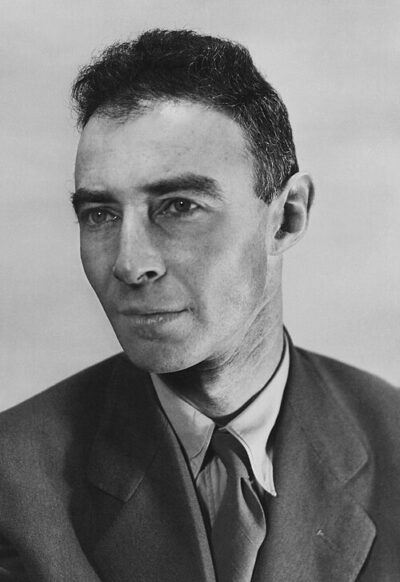
J. Robert Oppenheimer
J. Robert Oppenheimer was an American theoretical physicist. Born April 22, 1904, in Manhattan. Died February 18, 1967, in Princeton. Positions held include director (2 times) (1943–1966). Known for nuclear bomb. Educated at Harvard University and Cavendish Laboratory. Awards include Enrico Fermi Award, Knight of the Legion of Honour and Medal for Merit.
Facts
58 facts · 2 confirmed by two sources · 18 cited · 38 from one source
Where this comes from
Papalocal keeps its own record. It started from these sources; what each one said is kept here as it was copied, so a change on their side never changes this page by itself. Tap one to read its version.
What Wikidata says · copied November 13, 2026 · revision 2568739503
- Described as
- American theoretical physicist (1904–1967)
- Other names
- Julius Ropert Oppenheimer, Robert Oppenheimer, Oppenheimer, Julius Robert Oppenheimer
- Born
- April 22, 1904 · 13 references
- Died
- February 18, 1967 · 14 references
- Born in
- Manhattan · 1 reference
- Died in
- Princeton · 3 references
- Cause of death
- laryngeal cancer · 2 references
- Name at birth
- Julius Robert Oppenheimer
- Citizen of
- United States · 3 references
- Occupation
- theoretical physicist; engineer; nuclear physicist · 1 reference; art collector; university teacher · 1 reference; science administrator; physicist · 1 reference; scientist · 1 reference
- Positions held
- director (2 times) (1943–1966) · 1 reference
- Worked for
- University of California, Berkeley; University of Cambridge; California Institute of Technology · 1 reference; Manhattan Project · 1 reference; Institute for Advanced Study · 1 reference
- Education
- Harvard University · 1 reference; Cavendish Laboratory; Ethical Culture Fieldston School · 1 reference; Jesus College; Harvard College; University of Cambridge · 1 reference
- Member of
- Royal Society of London (1962–1967); American Philosophical Society (1945–); American Academy of Arts and Sciences; Phi Beta Kappa Society; National Academy of Sciences; Japan Academy (1950–) · 1 reference
- Known for
- nuclear bomb · 1 reference
- Awards
- Enrico Fermi Award (1963) · 2 references; Knight of the Legion of Honour (1958); Medal for Merit (1946) · 1 reference; Three Physicists Prize (1958) · 1 reference; Nessim-Habif Award (1962) · 1 reference; honorary doctorate from Princeton University; Richtmyer Memorial Lecture Award (1947) · 1 reference; Fellow of the American Physical Society; Foreign Member of the Royal Society (1962) · 2 references; honorary doctor of the University of Calcutta; Messenger Lectures (1945) · 1 reference; Officer of the Legion of Honour · 1 reference
- Field
- applied physics; theoretical physics; nuclear physics · 1 reference
- Spouse
- Katherine Oppenheimer (1940–1967) · 1 reference
- Children
- Peter Oppenheimer; Toni Oppenheimer
- Siblings
- Frank Oppenheimer · 1 reference
- Lived in
- Princeton · 1 reference; Los Alamos · 1 reference; Berkeley · 1 reference; New York City · 1 reference; Göttingen · 1 reference
- Wikipedias with a page
- 130
Wikidata item Q132537 (wikidata.org/wiki/Q132537), public domain (CC0). Copied November 13, 2026.
What Wikipedia says · copied November 13, 2026 · revision 1385033816
J. Robert Oppenheimer (born Julius Robert Oppenheimer ; April 22, 1904 – February 18, 1967) was an American theoretical physicist who served as the director of the Manhattan Project's Los Alamos Laboratory during World War II. He is often called the "Father of the Atomic Bomb" for his role in overseeing the development of the first nuclear weapons.
Born in New York City, Oppenheimer obtained a degree in chemistry from Harvard University in 1925 and a doctorate in physics from the University of Göttingen in Germany in 1927, studying under Max Born. After research at other institutions, he joined the physics faculty at the University of California, Berkeley, where he was made a full professor in 1936.
Oppenheimer made significant contributions to physics in the fields of quantum mechanics and nuclear physics, including the Born–Oppenheimer approximation for molecular wave functions; work on the theory of positrons, quantum electrodynamics, and quantum field theory; and the Oppenheimer–Phillips process in nuclear fusion. With his students, he also made major contributions to astrophysics, including the theory of cosmic ray showers, and the theory of neutron stars and black holes.
In 1941, Oppenheimer was briefed about nuclear weapon design by Australian physicist Mark Oliphant. In 1942, Oppenheimer was recruited to work on the Manhattan Project, and in 1943 was appointed director of the project's Los Alamos Laboratory in New Mexico, tasked with developing the first nuclear weapons. His leadership and scientific expertise were instrumental in the project's success, and on July 16, 1945, he was present at the first test of the atomic bomb, Trinity. In August, the weapons were used on Japan in the atomic bombings of Hiroshima and Nagasaki, to date the only uses of nuclear weapons in a conflict.
In 1947, Oppenheimer was appointed director of the Institute for Advanced Study in Princeton, New Jersey, and chairman of the General Advisory Committee of the new United States Atomic Energy Commission (AEC). He lobbied for international control of nuclear power and weapons in order to avert an arms race with the Soviet Union, and later opposed the development of the hydrogen bomb, partly on ethical grounds. During the Second Red Scare, his stances, together with his past associations with the Communist Party USA, led to an AEC security hearing in 1954 and the revocation of his security clearance. He continued to lecture, write, and work in physics, and in 1963 received the Enrico Fermi Award for contributions to theoretical physics. The 1954 decision was vacated in 2022.
- Born, in its opening lines
- April 22, 1904
- Died, in its opening lines
- February 18, 1967
From the Wikipedia article “J. Robert Oppenheimer” (en.wikipedia.org/wiki/J._Robert_Oppenheimer), by its contributors, under CC BY-SA 4.0 (creativecommons.org/licenses/by-sa/4.0/). Copied November 13, 2026; not changed.
Confirmed Two sources agree. Cited One source, and it names where it got it. One source One source, without a reference of its own. Sources disagree The sources disagree. We show the best-supported value and keep theirs below.
