
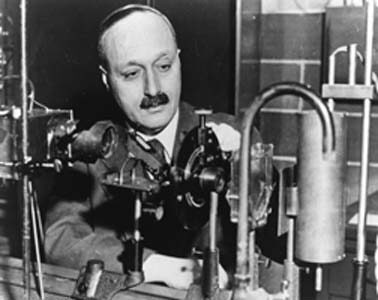
James Franck
James Franck was a German-American physicist. Born August 26, 1882, in Hamburg. Died May 21, 1964, in Göttingen. Educated at Heidelberg University and Humboldt-Universität zu Berlin. Awards include Nobel Prize in Physics, Max Planck Medal and Rumford Prize.
Facts
40 facts · 2 confirmed by two sources · 12 cited · 25 from one source · 1 where the sources disagree
What’s different
- Buried in: we show Oak Woods Cemetery (Sources disagree). Wikidata also lists Ohlsdorf Cemetery
Where this comes from
Papalocal keeps its own record. It started from these sources; what each one said is kept here as it was copied, so a change on their side never changes this page by itself. Tap one to read its version.
What Wikidata says · copied November 13, 2026 · revision 2568733748
- Described as
- German-American physicist (1882–1964)
- Born
- August 26, 1882 · 8 references
- Died
- May 21, 1964 · 8 references
- Born in
- Hamburg · 2 references
- Died in
- Göttingen · 2 references
- Buried in
- Ohlsdorf Cemetery; Oak Woods Cemetery · 1 reference
- Citizen of
- United States; Weimar Republic
- Occupation
- physicist · 1 reference; university teacher; chemist · 1 reference; professor · 1 reference
- Worked for
- Johns Hopkins University; University of Göttingen; University of Chicago; Humboldt-Universität zu Berlin · 1 reference
- Education
- Heidelberg University; Humboldt-Universität zu Berlin · 1 reference; Wilhelm-Gymnasium
- Member of
- Royal Society of London (1964–); German Academy of Sciences at Berlin; German Academy of Sciences Leopoldina · 1 reference; Göttingen Academy of Sciences and Humanities in Lower Saxony; Academy of Sciences of the USSR; American Academy of Arts and Sciences; Russian Academy of Sciences; Royal Prussian Academy of Sciences; American Philosophical Society (1937–) · 1 reference; American Association for the Advancement of Science · 1 reference
- Awards
- Nobel Prize in Physics (1925) · 2 references; Max Planck Medal (1951); Rumford Prize (1955) · 1 reference; Dannie Heineman Prize (1961); Foreign Member of the Royal Society (1964) · 1 reference; Iron Cross (1914), 1st class (1917) · 1 reference; Hanseatic Cross (Hamburg) (1916) · 1 reference; honorary member of the Physics Association (Frankfurt am Main, Germany) (1928) · 1 reference; Iron Cross (1914), 2nd class (1915) · 1 reference
- Field
- physics · 1 reference
- Spouse
- Hertha Sponer (1946–)
- Military branch
- Imperial German Army (1914–1918)
- Wikipedias with a page
- 88
Wikidata item Q57066 (wikidata.org/wiki/Q57066), public domain (CC0). Copied November 13, 2026.
What Wikipedia says · copied November 13, 2026 · revision 1381502123
James Franck (German: [ˈdʒɛɪ̯ms ˈfʁaŋk] ; 26 August 1882 – 21 May 1964) was a German–American physicist who shared the 1925 Nobel Prize in Physics with Gustav Hertz "for their discovery of the laws governing the impact of an electron upon an atom."
Franck completed his doctorate in 1906 and his habilitation in 1911 at the Frederick William University in Berlin, where he lectured and taught until 1918, having reached the position of professor extraordinarius. He served as a volunteer in the German Army during World War I. He was seriously injured in 1917 in a gas attack and was awarded the Iron Cross 1st Class.
Franck became the head of the physics division of the Kaiser Wilhelm Gesellschaft for Physical Chemistry. In 1920, Franck became professor ordinarius of experimental physics and Director of the Second Institute for Experimental Physics at the University of Göttingen. While there he worked on quantum physics with Max Born, who was Director of the Institute of Theoretical Physics. His work included the Franck–Hertz experiment, an important confirmation of the Bohr model of the atom. He promoted the careers of women in physics, notably Lise Meitner, Hertha Sponer, and Hilde Levi.
After the Nazi Party came to power in Germany in 1933, Franck resigned from his position at the University of Göttingen in protest against the dismissal of fellow colleagues. He assisted Frederick Lindemann in helping dismissed Jewish scientists find work overseas, before he left Germany in November. After a year at the Niels Bohr Institute in Denmark, he moved to the United States, where he worked at Johns Hopkins University in Baltimore and then the University of Chicago. During this period he became interested in photosynthesis.
Franck participated in the Manhattan Project during World War II as director of the chemistry division of the Metallurgical Laboratory. He was also the Chairman of the Committee on Political and Social Problems regarding the atomic bomb, which is best known for the compilation of the Franck Report, which recommended that the atomic bombs not be used on the Japanese cities without warning.
- Born, in its opening lines
- August 26, 1882
- Died, in its opening lines
- May 21, 1964
From the Wikipedia article “James Franck” (en.wikipedia.org/wiki/James_Franck), by its contributors, under CC BY-SA 4.0 (creativecommons.org/licenses/by-sa/4.0/). Copied November 13, 2026; not changed.
Confirmed Two sources agree. Cited One source, and it names where it got it. One source One source, without a reference of its own. Sources disagree The sources disagree. We show the best-supported value and keep theirs below.
