
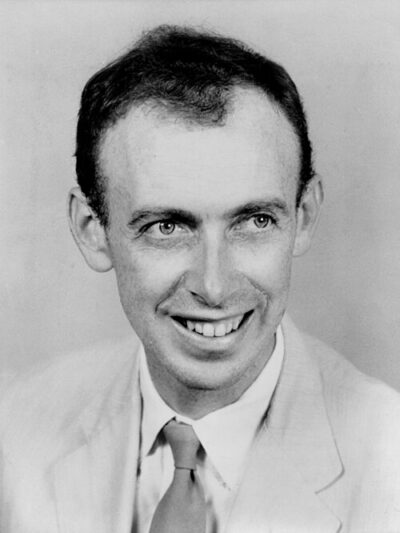
James Watson
James Watson was an American molecular biologist, geneticist, zoologist and Nobel Laureate. Born April 6, 1928, in Chicago. Died November 6, 2025, in East Northport. Known for The Double Helix and Molecular Biology of the Gene. Educated at Indiana University Bloomington and University of Chicago. Awards include Copley Medal, Presidential Medal of Freedom and Lomonosov Gold Medal.
Facts
57 facts · 2 confirmed by two sources · 51 cited · 4 from one source
Where this comes from
Papalocal keeps its own record. It started from these sources; what each one said is kept here as it was copied, so a change on their side never changes this page by itself. Tap one to read its version.
What Wikidata says · copied November 13, 2026 · revision 2566474315
- Described as
- American molecular biologist, geneticist, zoologist and Nobel Laureate (1928–2025)
- Other names
- James Dewey Watson, James D. Watson, Jim Watson, J. D. Watson
- Born
- April 6, 1928 · 8 references
- Died
- November 6, 2025 · 1 reference
- Born in
- Chicago · 3 references
- Died in
- East Northport · 1 reference
- Name at birth
- James Dewey Watson · 1 reference
- Citizen of
- United States · 2 references
- Occupation
- biologist · 2 references; geneticist · 1 reference; zoologist · 2 references; biochemist · 2 references; molecular biologist · 2 references; academic · 1 reference; university teacher · 2 references; chemist · 1 reference
- Worked for
- Harvard University · 2 references; University of Cambridge · 1 reference; Cold Spring Harbor Laboratory (1968–2007) · 3 references; United States National Institutes of Health · 1 reference; California Institute of Technology (1953–1955) · 1 reference
- Education
- Indiana University Bloomington (1948–1950) · 1 reference; University of Chicago (1943–1947) · 2 references; South Shore High School
- Member of
- Royal Society of London (1981–) · 1 reference; National Academy of Sciences (1962–) · 1 reference; National Academy of Sciences of Ukraine · 1 reference; American Academy of Arts and Sciences (1957–) · 1 reference; Russian Academy of Sciences (1988–) · 1 reference; European Molecular Biology Organization (1985–) · 1 reference; Academia Europaea (1998–) · 1 reference; Royal Irish Academy (2005–) · 1 reference; Academy of Sciences of the USSR (1988–); Royal Academy of Medicine of Catalonia (2005–) · 1 reference
- Known for
- The Double Helix · 2 references; Molecular Biology of the Gene · 1 reference
- Awards
- Copley Medal (1993) · 1 reference; Presidential Medal of Freedom (1977) · 1 reference; Lomonosov Gold Medal (1994) · 1 reference; Albert Lasker Award for Basic Medical Research (1960) · 1 reference; Canada Gairdner International Award (2002) · 1 reference; Honorary Knight Commander of the Order of the British Empire (2002) · 2 references; Nobel Prize in Physiology or Medicine (1962) · 3 references; Guggenheim Fellowship (2 times) (1965, 1983) · 1 reference; Philadelphia Liberty Medal (2000) · 1 reference; National Medal of Science (1997) · 1 reference; John J. Carty Award for the Advancement of Science (1971) · 1 reference; EMBO Membership (1985) · 1 reference; honorary doctor of the Autonomous University of Barcelona (2005) · 1 reference; Foreign Member of the Royal Society (1981) · 1 reference; Mendel Medal (2000) · 1 reference
- Field
- biochemistry · 1 reference; genetics · 1 reference; molecular biology · 1 reference; molecular genetics · 1 reference; DNA structure · 1 reference; molecular biochemistry · 1 reference
- Father
- James Dewey Watson · 1 reference
- Religion
- atheism
- Wikipedias with a page
- 110
Wikidata item Q83333 (wikidata.org/wiki/Q83333), public domain (CC0). Copied November 13, 2026.
What Wikipedia says · copied November 13, 2026 · revision 1384892858
James Dewey Watson (April 6, 1928 – November 6, 2025) was an American molecular biologist, geneticist, and zoologist. In 1953, James Watson and Francis Crick co-authored an academic paper on DNA entitled, "Molecular Structure of Nucleic Acids: A Structure for Deoxyribose Nucleic Acid". Published in the scientific journal Nature, the paper proposed the existence of the double helix structure of the DNA molecule, having built on research by Rosalind Franklin and Raymond Gosling. In 1962, the Nobel Prize in Physiology or Medicine was awarded to James Watson, Francis Crick, and Maurice Wilkins "for their discoveries concerning the molecular structure of nucleic acids and its significance for information transfer in living material".
James Watson graduated from the University of Chicago in 1947 and received his doctorate from Indiana University Bloomington in 1950. After a post-doctoral year at the University of Copenhagen with Herman Kalckar and Ole Maaløe, Watson worked at the University of Cambridge's Cavendish Laboratory in England, where he met his future collaborator Francis Crick. From 1956 to 1976, Watson was employed by the faculty of the Harvard University Biology Department, promoting research in molecular biology.
From 1968, Watson served as the director of the Cold Spring Harbor Laboratory (CSHL) in Laurel Hollow, New York, greatly expanding its level of funding and research. At CSHL, he shifted his research emphasis to the study of cancer, along with making it a world-leading research center in molecular biology. In 1994, Watson started as president and served for 10 years. He was then appointed chancellor, serving until his resignation in 2007 after making comments claiming that there is a genetic link between race and intelligence. In 2019, after the broadcast of a documentary where Watson reiterated these views on race and genetics, CSHL revoked his honorary titles and severed all ties with him.
Watson wrote many science books, including the textbook Molecular Biology of the Gene (1965) and his bestselling book The Double Helix (1968). He made derogatory comments about Rosalind Franklin, who had been responsible for gathering data that led to the discovery of the structure of DNA, and was criticized for misogyny. Between 1988 and 1992, Watson was associated with the National Institutes of Health, helping to establish the Human Genome Project, which completed the task of mapping the human genome in 2003.
- Born, in its opening lines
- April 6, 1928
- Died, in its opening lines
- November 6, 2025
From the Wikipedia article “James Watson” (en.wikipedia.org/wiki/James_Watson), by its contributors, under CC BY-SA 4.0 (creativecommons.org/licenses/by-sa/4.0/). Copied November 13, 2026; not changed.
Confirmed Two sources agree. Cited One source, and it names where it got it. One source One source, without a reference of its own. Sources disagree The sources disagree. We show the best-supported value and keep theirs below.
