
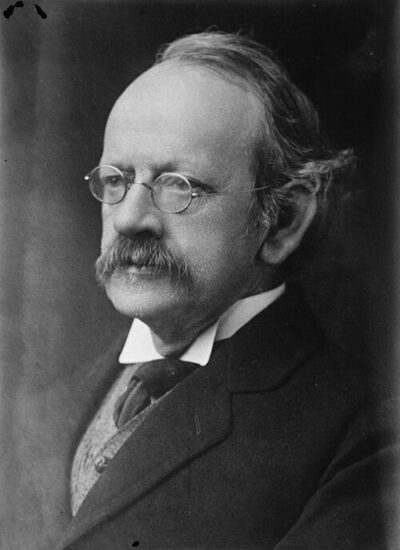
Joseph John Thomson
Joseph John Thomson was a British physicist. Born December 18, 1856, in Cheetham Hill. Died August 30, 1940, in Cambridge. Positions held include President of the Royal Society (1915–1920) and Master of Trinity College, Cambridge (1918–1940). Known for plum pudding model. Educated at University of Manchester and Trinity College. Awards include Nobel Prize in Physics, Fellow of the Royal Society and Copley Medal.
Facts
54 facts · 2 confirmed by two sources · 20 cited · 32 from one source
Where this comes from
Papalocal keeps its own record. It started from these sources; what each one said is kept here as it was copied, so a change on their side never changes this page by itself. Tap one to read its version.
What Wikidata says · copied November 16, 2026 · revision 2563199987
- Described as
- British physicist (1856-1940)
- Other names
- John Thompson, Sir Joseph Thomson, Sir Joseph John Thomson, J. J. Thomson
- Born
- December 18, 1856 · 10 references
- Died
- August 30, 1940 · 13 references
- Born in
- Cheetham Hill · 3 references
- Died in
- Cambridge · 3 references
- Buried in
- Westminster Abbey · 1 reference
- Name at birth
- Joseph John Thomson.
- Citizen of
- United Kingdom
- Occupation
- physicist · 1 reference; mathematician; university teacher
- Positions held
- President of the Royal Society (1915–1920); Master of Trinity College, Cambridge (1918–1940)
- Worked for
- University of Cambridge
- Education
- University of Manchester; Trinity College; Victoria University of Manchester; University of Cambridge · 1 reference
- Member of
- Royal Society of London (1884–); International Scientific Esperanto Association; Saint Petersburg Academy of Sciences; Academy of Sciences of the USSR; Royal Swedish Academy of Sciences; American Academy of Arts and Sciences; Russian Academy of Sciences; Royal Prussian Academy of Sciences; Accademia Nazionale delle Scienze detta dei XL; Bavarian Academy of Sciences and Humanities
- Known for
- plum pudding model
- Awards
- Nobel Prize in Physics (1906) · 2 references; Fellow of the Royal Society (1884) · 1 reference; Copley Medal (1914) · 1 reference; Royal Medal (1894); Elliott Cresson Medal (1910) · 1 reference; Hughes Medal (1902); Faraday Medal (1925); Hodgkins Medal (1902) · 1 reference; Albert Medal (1915) · 1 reference; Franklin Medal (1922); Adams Prize (1882); Royal Society Bakerian Medal (1913) · 3 references; Guthrie Lecture (1928) · 1 reference; Knight Bachelor (1908); Dalton Medal (1931)
- Field
- physics · 1 reference; experimental physics · 1 reference; electron · 1 reference; electrical conductance · 1 reference
- Spouse
- Rose Thomson · 1 reference
- Children
- George Paget Thomson · 1 reference; Joan Paget Thomson · 1 reference
- Father
- Joseph James Thomson
- Mother
- Emma Swindells
- Siblings
- Frederick Vernon Thomson · 1 reference
- Religion
- Anglicanism
- Wikipedias with a page
- 120
Wikidata item Q47285 (wikidata.org/wiki/Q47285), public domain (CC0). Copied November 16, 2026.
What Wikipedia says · copied November 16, 2026 · revision 1384570664
Sir Joseph John Thomson (18 December 1856 – 30 August 1940) was a British physicist. He received the 1906 Nobel Prize in Physics "in recognition of the great merits of his theoretical and experimental investigations on the conduction of electricity by gases." In 1897, he showed that cathode rays were composed of previously unknown negatively charged particles (now called electrons), which he calculated must have bodies much smaller than atoms and a very large charge-to-mass ratio. The electron was the first subatomic particle to be discovered.
Thomson is credited with finding the first evidence for isotopes of a stable (non-radioactive) element in 1912, as part of his exploration into the composition of canal rays (positive ions). His experiments to determine the nature of positively charged particles, with Francis William Aston, were the first use of mass spectrometry and led to the development of the mass spectrograph.
Thomson was an influential teacher, and seven of his students went on to win Nobel Prizes: Ernest Rutherford (Chemistry 1908), Lawrence Bragg (Physics 1915), Charles Barkla (Physics 1917), Francis William Aston (Chemistry 1922), Charles Thomson Rees Wilson (Physics 1927), Owen Richardson (Physics 1928) and Edward Victor Appleton (Physics 1947). His son, George Paget Thomson, shared the 1937 Nobel Prize in Physics with Clinton Davisson "for their experimental discovery of the diffraction of electrons by crystals".
- Born, in its opening lines
- December 18, 1856
- Died, in its opening lines
- August 30, 1940
From the Wikipedia article “J. J. Thomson” (en.wikipedia.org/wiki/J._J._Thomson), by its contributors, under CC BY-SA 4.0 (creativecommons.org/licenses/by-sa/4.0/). Copied November 16, 2026; not changed.
Confirmed Two sources agree. Cited One source, and it names where it got it. One source One source, without a reference of its own. Sources disagree The sources disagree. We show the best-supported value and keep theirs below.
