
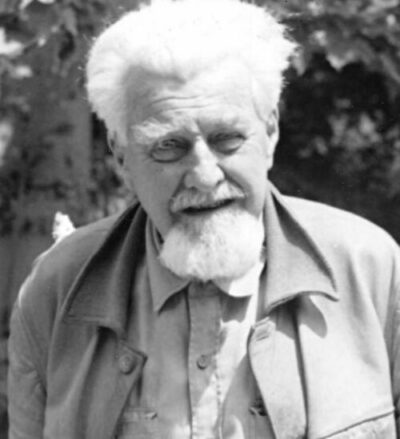
Konrad Lorenz
Konrad Lorenz was an Austrian zoologist, winner of the Nobel Prize in Physiology or Medicine in 1973. Born November 7, 1903, in Vienna. Died February 27, 1989, in Vienna. Positions held include psychologist. Known for On Aggression, Civilized Man's Eight Deadly Sins and Behind the Mirror: A Search for a Natural History of Human Knowledge. Educated at Columbia University and University of Vienna (2 times). Awards include Nobel Prize in Physiology or Medicine, Prix mondial Cino Del Duca and Great Cross with Star and Sash of the Order of Merit of the Federal Republic of Germany.
Facts
49 facts · 2 confirmed by two sources · 14 cited · 33 from one source
Where this comes from
Papalocal keeps its own record. It started from these sources; what each one said is kept here as it was copied, so a change on their side never changes this page by itself. Tap one to read its version.
What Wikidata says · copied November 16, 2026 · revision 2569140062
- Described as
- Austrian zoologist, winner of the Nobel Prize in Physiology or Medicine in 1973 (1903–1989)
- Other names
- Konrad Zacharias Lorenz, Konrad Z. Lorenz
- Born
- November 7, 1903 · 15 references
- Died
- February 27, 1989 · 13 references
- Born in
- Vienna · 4 references
- Died in
- Vienna · 2 references
- Buried in
- Sankt Andrä-Wördern (1989)
- Cause of death
- kidney failure
- Citizen of
- Austria
- Occupation
- ethologist · 1 reference; zoologist · 2 references; university teacher · 1 reference; writer · 1 reference; physician · 2 references; philosopher · 1 reference; psychologist · 1 reference; naturalist
- Positions held
- psychologist
- Political party
- Nazi Party (1938–1944)
- Worked for
- University of Vienna; LMU Munich; University of Königsberg
- Education
- Columbia University (1922–1923); University of Vienna (2 times) (1923–1933)
- Member of
- Royal Society of London; German Academy of Sciences Leopoldina · 1 reference; Austrian Academy of Sciences; Royal Swedish Academy of Sciences; National Academy of Sciences (1966–) · 1 reference; American Academy of Arts and Sciences; Bavarian Academy of Sciences and Humanities; American Philosophical Society (1974–)
- Known for
- On Aggression; Civilized Man's Eight Deadly Sins; Behind the Mirror: A Search for a Natural History of Human Knowledge
- Awards
- Nobel Prize in Physiology or Medicine (1973) · 2 references; Prix mondial Cino Del Duca (1969) · 1 reference; Great Cross with Star and Sash of the Order of Merit of the Federal Republic of Germany; Pour le Mérite for Sciences and Arts order (1969); Kalinga Prize (1969) · 1 reference; Bavarian Maximilian Order for Science and Art (1984); Prize of the City of Vienna for Natural Sciences (1959); honorary citizen of Vienna (1983); Foreign Member of the Royal Society (1964) · 1 reference; Austrian Decoration for Science and Art (1964); Pour le Mérite · 1 reference
- Field
- ethology; philosophy
- Spouse
- Margarethe Gebhardt
- Father
- Adolf Lorenz · 1 reference
- Siblings
- Albert Lorenz · 1 reference
- Wikipedias with a page
- 95
Wikidata item Q78496 (wikidata.org/wiki/Q78496), public domain (CC0). Copied November 16, 2026.
What Wikipedia says · copied November 16, 2026 · revision 1372396829
Konrad Zacharias Lorenz (Austrian German: [ˈkɔnraːd tsaxaˈriːas ˈloːrɛnts] ; 7 November 1903 – 27 February 1989) was an Austrian zoologist, ethologist, and ornithologist. He shared the 1973 Nobel Prize in Physiology or Medicine with Nikolaas Tinbergen and Karl von Frisch. He is often regarded as one of the founders of modern ethology, the study of animal behavior. He developed an approach that began with an earlier generation, including his teacher Oskar Heinroth.
Lorenz studied instinctive behavior in animals, especially in greylag geese and jackdaws. Working with geese, he investigated the principle of imprinting, the process by which some nidifugous birds (i.e. birds that leave their nest early) bond instinctively with the first moving object that they see within the first hours of hatching. Although Lorenz did not discover the topic, he became widely known for his descriptions of imprinting as an instinctive bond. In 1936, he met Tinbergen, and the two collaborated in developing ethology as a separate sub-discipline of biology. A Review of General Psychology survey, published in 2002, ranked Lorenz the 65th most cited scholar of the 20th century in the technical psychology journals, introductory psychology textbooks, and survey responses.
Lorenz's work was interrupted by the onset of World War II, and in 1941 he was recruited into the German Army as a medic. In 1944, he was sent to the Eastern Front, where he was captured by the Soviet Red Army and spent four years as a German prisoner of war in Soviet Armenia. After the war, he regretted his membership in the Nazi Party.
Lorenz wrote numerous books, some of which, such as King Solomon's Ring, On Aggression, and Man Meets Dog, became popular reading. His last work Here I Am – Where Are You? is a summary of his life's work and focuses on his famous studies of greylag geese.
- Born, in its opening lines
- November 7, 1903
- Died, in its opening lines
- February 27, 1989
From the Wikipedia article “Konrad Lorenz” (en.wikipedia.org/wiki/Konrad_Lorenz), by its contributors, under CC BY-SA 4.0 (creativecommons.org/licenses/by-sa/4.0/). Copied November 16, 2026; not changed.
Confirmed Two sources agree. Cited One source, and it names where it got it. One source One source, without a reference of its own. Sources disagree The sources disagree. We show the best-supported value and keep theirs below.
