
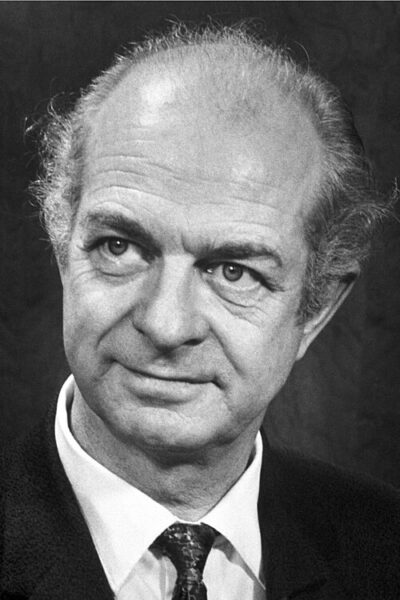
Linus Pauling
Linus Pauling was an American scientist. Born February 28, 1901, in Portland. Died August 19, 1994, in Big Sur. Positions held include professor (1969–1974). Educated at California Institute of Technology and Oregon State University. Awards include Guggenheim Fellowship (2 times), ACS Award in Pure Chemistry and Irving Langmuir Award in Chemical Physics.
Facts
58 facts · 2 confirmed by two sources · 42 cited · 14 from one source
Where this comes from
Papalocal keeps its own record. It started from these sources; what each one said is kept here as it was copied, so a change on their side never changes this page by itself. Tap one to read its version.
What Wikidata says · copied November 13, 2026 · revision 2568763671
- Described as
- American scientist (1901–1994)
- Other names
- Linus C. Pauling, Linus Carl Pauling
- Born
- February 28, 1901 · 14 references
- Died
- August 19, 1994 · 13 references
- Born in
- Portland · 2 references
- Died in
- Big Sur · 4 references
- Buried in
- Oswego Pioneer Cemetery · 1 reference
- Cause of death
- prostate cancer · 2 references
- Citizen of
- United States · 3 references
- Occupation
- chemist · 6 references; physicist · 3 references; Esperantist · 1 reference; university teacher · 1 reference; biochemist · 3 references; peace activist · 1 reference; crystallographer; biophysicist
- Positions held
- professor (1969–1974)
- Worked for
- California Institute of Technology (1927–1963) · 1 reference; Linus Pauling Institute · 1 reference; University of California, San Diego (1967–1969); Stanford University (1969–1975); Oregon State University · 1 reference
- Education
- California Institute of Technology (–1925) · 1 reference; Oregon State University (1917–1922)
- Member of
- Royal Society of London (1948–) · 1 reference; American Philosophical Society (1936–) · 1 reference; Bavarian Academy of Sciences and Humanities · 1 reference; National Academy of Sciences (1933–) · 1 reference; International Academy of Quantum Molecular Science · 1 reference; French Academy of Sciences · 1 reference; American Academy of Arts and Sciences · 1 reference; Academy of Sciences of the USSR (1958–) · 1 reference; Royal Society of Edinburgh · 1 reference; German Academy of Sciences Leopoldina · 1 reference
- Awards
- Guggenheim Fellowship (2 times) (1926, 1965) · 1 reference; ACS Award in Pure Chemistry (1931) · 1 reference; Irving Langmuir Award in Chemical Physics (1931) · 1 reference; William H. Nichols Medal (1941) · 1 reference; Silliman Memorial Lectures (1947) · 1 reference; Willard Gibbs Award (1946) · 1 reference; Davy Medal (1947) · 1 reference; Liversidge Award (1948) · 1 reference; Foreign Member of the Royal Society (1948) · 1 reference; doctor honoris causa from the University of Paris (1948) · 1 reference; Medal for Merit (1948) · 1 reference; honorary doctor of the University of Toulouse (1949) · 1 reference; Nobel Prize in Chemistry (1954) · 2 references; honorary doctorate of the University of Montpellier (1958) · 1 reference; Humanist of the Year (1961) · 1 reference
- Field
- quantum chemistry · 1 reference; biochemistry · 1 reference; physical chemistry · 1 reference
- Spouse
- Ava Helen Pauling · 2 references
- Children
- Peter Pauling
- Religion
- atheism
- Lived in
- Corvallis; Big Sur (–1994); Lake Oswego
- Website
- https://scarc.library.oregonstate.edu/digitalresources/pauling/
- Wikipedias with a page
- 112
Wikidata item Q48983 (wikidata.org/wiki/Q48983), public domain (CC0). Copied November 13, 2026.
What Wikipedia says · copied November 13, 2026 · revision 1384642385
Linus Carl Pauling ( PAW-ling; February 28, 1901 – August 19, 1994) was an American chemist and peace activist. He published more than 1,200 papers and books, of which about 850 dealt with scientific topics. Scientific American called him one of the 20 greatest scientists of all time. For his scientific work, Pauling was awarded the Nobel Prize in Chemistry in 1954. For his peace activism, he was awarded the Nobel Peace Prize in 1962. He is one of five people to have won more than one Nobel Prize. Of these, he is the only person to have been awarded two unshared Nobel Prizes, and one of two people to be awarded Nobel Prizes in different fields, the other being Marie Curie.
Pauling was one of the founders of the fields of quantum chemistry and molecular biology. His contributions to the theory of the chemical bond include the concept of orbital hybridisation and the first accurate scale of electronegativities of the elements. Pauling also worked on the structures of biological molecules, and showed the importance of the alpha helix and beta sheet in protein secondary structure. Pauling's approach combined methods and results from X-ray crystallography, molecular model building, and quantum chemistry. His discoveries inspired the work of James Watson, Francis Crick, Rosalind Franklin, and Maurice Wilkins on the structure of DNA, which in turn made it possible for geneticists to crack the DNA code of all organisms.
In his later years, he promoted nuclear disarmament, as well as orthomolecular medicine, megavitamin therapy, and dietary supplements, especially ascorbic acid (commonly known as Vitamin C). None of his ideas concerning the medical usefulness of large doses of vitamins have gained much acceptance in the mainstream scientific community. He was married to the American human rights activist Ava Helen Pauling.
- Born, in its opening lines
- February 28, 1901
- Died, in its opening lines
- August 19, 1994
From the Wikipedia article “Linus Pauling” (en.wikipedia.org/wiki/Linus_Pauling), by its contributors, under CC BY-SA 4.0 (creativecommons.org/licenses/by-sa/4.0/). Copied November 13, 2026; not changed.
Confirmed Two sources agree. Cited One source, and it names where it got it. One source One source, without a reference of its own. Sources disagree The sources disagree. We show the best-supported value and keep theirs below.
