
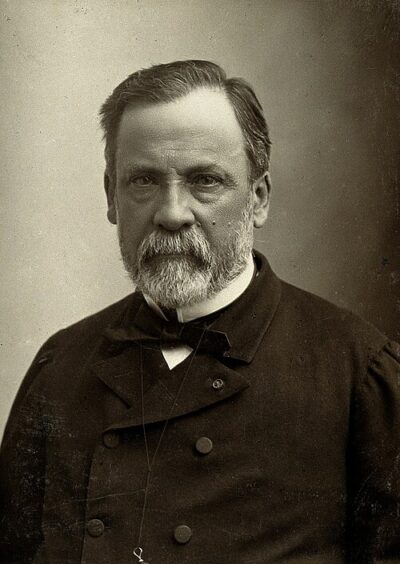
Louis Pasteur
Louis Pasteur was a French chemist and microbiologist. Born December 27, 1822, in Dole. Died September 28, 1895, in Castle of Villeneuve-l'Étang. Positions held include Member of the Académie française (1881–1895). Known for rabies vaccine and Pasteur Institute. Educated at École Normale Supérieure and Lycée Saint-Louis. Awards include Grand Cross of the Legion of Honour, Leeuwenhoek Medal and Copley Medal.
Facts
62 facts · 2 confirmed by two sources · 20 cited · 40 from one source
Where this comes from
Papalocal keeps its own record. It started from these sources; what each one said is kept here as it was copied, so a change on their side never changes this page by itself. Tap one to read its version.
What Wikidata says · copied November 16, 2026 · revision 2569730267
- Described as
- French chemist and microbiologist (1822–1895)
- Other names
- Pasteur
- Born
- December 27, 1822 · 19 references
- Died
- September 28, 1895 · 16 references
- Born in
- Dole · 3 references
- Died in
- Castle of Villeneuve-l'Étang · 2 references
- Buried in
- Notre-Dame de Paris (–1896) · 1 reference
- Cause of death
- cardiac arrest · 1 reference
- Citizen of
- France · 1 reference
- Occupation
- microbiologist · 2 references; chemist · 3 references; university teacher · 1 reference; biochemist · 1 reference; agronomist · 1 reference; biologist · 2 references; lithographer · 2 references; botanist
- Positions held
- Member of the Académie française (1881–1895) · 1 reference
- Worked for
- University of Strasbourg (1848–) · 1 reference; University of Lille (1854–1857) · 2 references; École Normale Supérieure (1857–) · 1 reference; École Centrale de Lille · 1 reference; Pasteur Institute · 1 reference
- Education
- École Normale Supérieure (1844–1845) · 1 reference; Lycée Saint-Louis · 1 reference; University of Paris · 1 reference; Conservatoire national des Arts et Métiers · 1 reference
- Member of
- Royal Society of London (1869–) · 1 reference; Société Philomathique de Paris · 1 reference; Lille Academy of Sciences (1854–) · 1 reference; Académie Française (1881–1895) · 2 references; American Philosophical Society · 1 reference; National Academy of Sciences (1883–) · 2 references; Saint Petersburg Academy of Sciences · 1 reference; Royal Swedish Academy of Sciences · 1 reference; Hungarian Academy of Sciences · 1 reference; Hellenic Philological Society of Constantinople (1881–) · 1 reference
- Known for
- rabies vaccine (1885); Pasteur Institute (1888)
- Awards
- Grand Cross of the Legion of Honour (1868) · 2 references; Leeuwenhoek Medal (1895) · 1 reference; Copley Medal (1874) · 4 references; Rumford Medal (1856) · 1 reference; Knight of the Order of Agricultural Merit (1883) · 1 reference; Order of Saint Anna, 1st class · 1 reference; National Inventors Hall of Fame (1978) · 2 references; Imperial Order of the Rose (1873) · 1 reference; Jecker Prize (1861) · 1 reference; Albert Medal (1882) · 1 reference; Concours général · 1 reference; Order of the Medjidie (1886) · 1 reference; Order of Saint Anna, 1st class with diamonds · 1 reference; Foreign Member of the Royal Society (1869) · 1 reference; Bressa Prize (1883) · 1 reference
- Field
- chemistry · 1 reference; microbiology · 1 reference
- Spouse
- Marie Pasteur (1849–) · 1 reference
- Children
- Marie-Louise Pasteur · 1 reference; Jean-Baptiste Pasteur; Jeanne Pasteur; Cécile Pasteur; Camille Pasteur
- Father
- Jean-Joseph Pasteur · 1 reference
- Religion
- Catholicism · 1 reference
- Wikipedias with a page
- 215
Wikidata item Q529 (wikidata.org/wiki/Q529), public domain (CC0). Copied November 16, 2026.
What Wikipedia says · copied November 16, 2026 · revision 1383911409
Louis Pasteur (; French: [lwi pastœʁ] ; 27 December 1822 – 28 September 1895) was a French chemist, pharmacist, and microbiologist renowned for his discoveries of the principles of vaccination, microbial fermentation, and pasteurization, the last of which was named after him. His research in chemistry led to remarkable breakthroughs in the understanding of the causes and prevention of diseases, which laid down the foundations of hygiene, public health and much of modern medicine. Pasteur's works are credited with saving millions of lives through the development of vaccines for rabies and anthrax. He is regarded as one of the founders of modern bacteriology and has been honored as the "father of bacteriology" and the "father of microbiology" (together with Robert Koch; the latter epithet also attributed to Antonie van Leeuwenhoek).
Pasteur was responsible for disproving the doctrine of spontaneous generation. Under the auspices of the French Academy of Sciences, his experiment demonstrated that in sterilized and sealed flasks, nothing ever developed; conversely, in sterilized but open flasks, microorganisms could grow. For this experiment, the academy awarded him the Alhumbert Prize carrying 2,500 francs in 1862.
Pasteur is also regarded as one of the fathers of the germ theory of diseases, which was a minor medical concept at the time. His many experiments showed that diseases could be prevented by killing or stopping germs, thereby directly supporting the germ theory and its application in clinical medicine. He is best known to the general public for his invention of the technique of treating milk and wine to stop bacterial contamination, a process now called pasteurization. Pasteur also made significant discoveries in chemistry, most notably on the molecular basis for the asymmetry of certain crystals and racemization. Early in his career, his investigation of sodium ammonium tartrate initiated the field of optical isomerism. This work had a profound effect on structural chemistry, with eventual implications for many areas including medicinal chemistry.
He was the director of the Pasteur Institute, established in 1887, until his death, and his body was interred in a vault beneath the institute. Although Pasteur made groundbreaking experiments, his reputation became associated with various controversies. Historical reassessment of his notebook revealed that he practiced deception to overcome his rivals.
- Born, in its opening lines
- December 27, 1822
- Died, in its opening lines
- September 28, 1895
From the Wikipedia article “Louis Pasteur” (en.wikipedia.org/wiki/Louis_Pasteur), by its contributors, under CC BY-SA 4.0 (creativecommons.org/licenses/by-sa/4.0/). Copied November 16, 2026; not changed.
Confirmed Two sources agree. Cited One source, and it names where it got it. One source One source, without a reference of its own. Sources disagree The sources disagree. We show the best-supported value and keep theirs below.
