
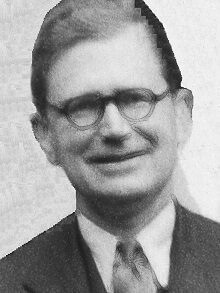
Nevill Francis Mott
Nevill Francis Mott was an English physicist, Nobel prize winner. Born September 30, 1905, in Leeds. Died August 8, 1996, in Milton Keynes. Positions held include Master of Gonville and Caius College, Cambridge (1959–1966). Educated at Clifton College and St John's College. Awards include Hughes Medal, doctor honoris causa from the University of Grenoble and Guthrie Lecture.
Facts
42 facts · 2 confirmed by two sources · 19 cited · 21 from one source
Where this comes from
Papalocal keeps its own record. It started from these sources; what each one said is kept here as it was copied, so a change on their side never changes this page by itself. Tap one to read its version.
What Wikidata says · copied November 16, 2026 · revision 2567361666
- Described as
- English physicist, Nobel prize winner
- Other names
- Sir Nevill Mott, Sir Nevill Francis Mott, Nevill Mott, N. F. Mott
- Born
- September 30, 1905 · 10 references
- Died
- August 8, 1996 · 11 references
- Born in
- Leeds · 1 reference
- Died in
- Milton Keynes · 1 reference
- Citizen of
- United Kingdom · 1 reference
- Occupation
- physicist · 1 reference; university teacher
- Positions held
- Master of Gonville and Caius College, Cambridge (1959–1966)
- Worked for
- University of Bristol
- Education
- Clifton College; St John's College; Giggleswick School; University of Cambridge · 1 reference
- Member of
- Royal Society of London; German Academy of Sciences Leopoldina (1964–) · 1 reference; American Academy of Arts and Sciences; National Academy of Sciences (1957–) · 1 reference; Göttingen Academy of Sciences and Humanities in Lower Saxony; Romanian Academy
- Awards
- Hughes Medal (1941); doctor honoris causa from the University of Grenoble (1949) · 1 reference; Guthrie Lecture (1951) · 1 reference; Royal Medal (1953); Royal Society Bakerian Medal (1953) · 1 reference; honorary doctor of the University of Poitiers (1954) · 1 reference; Three Physicists Prize (1956); doctor honoris causa from the University of Paris (1954); Copley Medal (1972) · 1 reference; Faraday Medal (1973); honorary doctorate from University of Bordeaux-I (1977) · 1 reference; Nobel Prize in Physics (1977) · 2 references; honorary doctorate from University of Rouen (1983) · 1 reference; Companion of Honour (1995); Honorary doctor of the University of Ottawa
- Field
- physics; solid-state physics · 1 reference; alloy · 1 reference; semiconductor · 1 reference; photographic emulsion · 1 reference
- Spouse
- Ruth Eleanor Horder
- Children
- Alice Mott
- Father
- Charles Francis Mott · 1 reference
- Wikipedias with a page
- 67
Wikidata item Q189485 (wikidata.org/wiki/Q189485), public domain (CC0). Copied November 16, 2026.
What Wikipedia says · copied November 16, 2026 · revision 1377953693
Sir Nevill Francis Mott (30 September 1905 – 8 August 1996) was a British theoretical physicist who won the Nobel Prize for Physics in 1977 for his work on the electronic structure of magnetic and disordered systems, especially amorphous semiconductors. The Prize was shared with Philip W. Anderson and John Van Vleck. The three had conducted loosely related research. Mott and Anderson clarified the reasons why magnetic or amorphous materials can sometimes be metallic and sometimes insulating.
- Born, in its opening lines
- September 30, 1905
- Died, in its opening lines
- August 8, 1996
From the Wikipedia article “Nevill Mott” (en.wikipedia.org/wiki/Nevill_Mott), by its contributors, under CC BY-SA 4.0 (creativecommons.org/licenses/by-sa/4.0/). Copied November 16, 2026; not changed.
Confirmed Two sources agree. Cited One source, and it names where it got it. One source One source, without a reference of its own. Sources disagree The sources disagree. We show the best-supported value and keep theirs below.
