
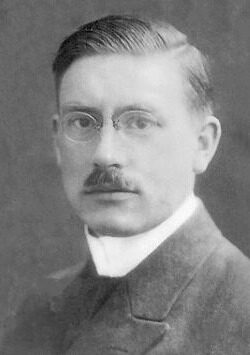
Peter Debye
Peter Debye was a Dutch-American physicist and physical chemist. Born March 24, 1884, in Maastricht. Died November 2, 1966, in Ithaca. Known for Debye length and Debye–Hückel equation. Educated at RWTH Aachen University and LMU Munich. Awards include Faraday Lectureship Prize, Nobel Prize in Chemistry and Max Planck Medal.
Facts
61 facts · 2 confirmed by two sources · 28 cited · 31 from one source
Where this comes from
Papalocal keeps its own record. It started from these sources; what each one said is kept here as it was copied, so a change on their side never changes this page by itself. Tap one to read its version.
What Wikidata says · copied November 13, 2026 · revision 2568851088
- Described as
- Dutch-American physicist and physical chemist (1884–1966)
- Other names
- Peter Joseph William Debye, Peter J. W. Debye, Petrus Josephus Wilhelmus Debije, Petrus Debye, P.J.W. Debije
- Born
- March 24, 1884 · 12 references
- Died
- November 2, 1966 · 14 references
- Born in
- Maastricht · 4 references
- Died in
- Ithaca · 4 references
- Buried in
- Pleasant Grove Cemetery · 1 reference
- Cause of death
- myocardial infarction · 1 reference
- Name at birth
- Petrus Josephus Wilhelmus Debije · 1 reference
- Citizen of
- Kingdom of the Netherlands · 1 reference; United States · 2 references
- Occupation
- chemist · 3 references; physicist · 1 reference; theoretical physicist; scientist · 1 reference; engineer; crystallographer; university teacher · 3 references; plasma physicist
- Worked for
- Leipzig University (1927–); University of Göttingen (1914–); University of Zurich (1920–); Cornell University (1940–); Utrecht University (1912–1914) · 1 reference; Humboldt-Universität zu Berlin (1934–); LMU Munich (1906–); ETH Zurich (1911–)
- Education
- RWTH Aachen University (1901–1905); LMU Munich (1906–); ETH Zurich
- Member of
- Royal Society of London (1933–); Royal Prussian Academy of Sciences; Saxon Academy of Sciences and Humanities (1928–); German Academy of Sciences Leopoldina (1932–); Heidelberg Academy of Sciences and Humanities (1959–) · 1 reference; Academy of Sciences of the USSR; Royal Netherlands Academy of Arts and Sciences; Hungarian Academy of Sciences; Pontifical Academy of Sciences · 1 reference; American Academy of Arts and Sciences (1927–)
- Known for
- Debye length; Debye–Hückel equation
- Awards
- Faraday Lectureship Prize (1933) · 1 reference; Nobel Prize in Chemistry (1936) · 2 references; Max Planck Medal (1950) · 1 reference; Willard Gibbs Award (1949); Franklin Medal (1937); Rumford Medal (1930) · 1 reference; Priestley Medal (1963) · 1 reference; Lorentz Medal (1935) · 1 reference; National Medal of Science (1965); Mendel Medal (1940) · 1 reference; Commander of the Order of Leopold II (1956) · 1 reference; Order of the Netherlands Lion; Fellow of the American Physical Society; Guthrie Lecture (1930) · 1 reference; Foreign Member of the Royal Society (1933) · 1 reference
- Field
- physics · 1 reference; physical chemistry; theoretical chemistry · 1 reference; X-ray · 1 reference
- Spouse
- Mathilde Alberer · 1 reference
- Religion
- Catholicism · 1 reference
- Wikipedias with a page
- 80
Wikidata item Q103835 (wikidata.org/wiki/Q103835), public domain (CC0). Copied November 13, 2026.
What Wikipedia says · copied November 13, 2026 · revision 1379013277
Peter Joseph William Debye ( dib-EYE; born Petrus Josephus Wilhelmus Debije, Dutch: [ˈpeːtrʏz dəˈbɛiə]; March 24, 1884 – November 2, 1966) was a Dutch-American physicist and physical chemist, and Nobel laureate in Chemistry.
- Born, in its opening lines
- March 24, 1884
- Died, in its opening lines
- November 2, 1966
From the Wikipedia article “Peter Debye” (en.wikipedia.org/wiki/Peter_Debye), by its contributors, under CC BY-SA 4.0 (creativecommons.org/licenses/by-sa/4.0/). Copied November 13, 2026; not changed.
Confirmed Two sources agree. Cited One source, and it names where it got it. One source One source, without a reference of its own. Sources disagree The sources disagree. We show the best-supported value and keep theirs below.
