
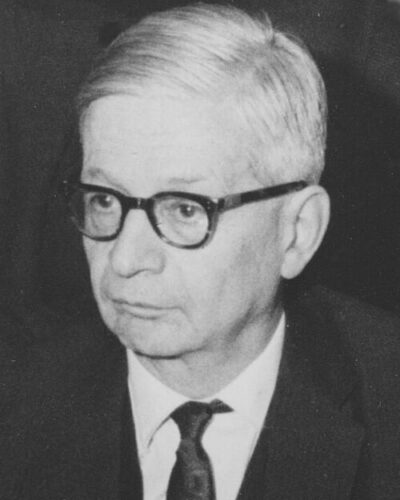
Rudolf Peierls
Rudolf Peierls was a German-born British physicist. Born June 5, 1907, in Berlin. Died September 19, 1995, in Oxford. Known for Frisch–Peierls memorandum, Peierls transition and spin-Peierls transition. Educated at LMU Munich and Frederick William University Berlin. Awards include Fellow of the Royal Society, Copley Medal and Royal Medal.
Facts
53 facts · 2 confirmed by two sources · 29 cited · 22 from one source
Where this comes from
Papalocal keeps its own record. It started from these sources; what each one said is kept here as it was copied, so a change on their side never changes this page by itself. Tap one to read its version.
What Wikidata says · copied November 16, 2026 · revision 2569129361
- Described as
- German-born British physicist
- Other names
- Rudolf Ernst Peierls, R.E. Peierls, Sir Rudolf Ernst Peierls, Sir Rudolph Ernst Peierls
- Born
- June 5, 1907 · 9 references
- Died
- September 19, 1995 · 8 references
- Born in
- Berlin · 2 references
- Died in
- Oxford · 1 reference
- Citizen of
- United Kingdom (1940–) · 1 reference; Germany
- Occupation
- theoretical physicist; university teacher · 1 reference; physicist · 1 reference; nuclear physicist
- Worked for
- University of Oxford (1963–1974) · 1 reference; University of Birmingham (1937–1963) · 1 reference; Leiden University (1976–) · 1 reference; Victoria University of Manchester (1932–1935) · 1 reference; ETH Zurich (1929–1932) · 1 reference; University of Cambridge (1935–1937) · 1 reference
- Education
- LMU Munich (1926–1928) · 2 references; Frederick William University Berlin (1925–1926) · 2 references; Leipzig University (1928–1929) · 2 references
- Member of
- Royal Society of London (1945–); Academy of Sciences of the USSR (1988–); French Academy of Sciences (1984–); American Academy of Arts and Sciences; Russian Academy of Sciences; German Academy of Sciences Leopoldina · 1 reference; American Physical Society · 1 reference; National Academy of Sciences (1970–); Accademia Nazionale dei Lincei (1991–) · 1 reference
- Known for
- Frisch–Peierls memorandum; Peierls transition; spin-Peierls transition; Peierls bracket; Peierls stress; Peierls substitution; Boltzmann–Peierls equation
- Awards
- Fellow of the Royal Society (1945) · 1 reference; Copley Medal (1986) · 1 reference; Royal Medal (1959) · 1 reference; Max Planck Medal (1963) · 1 reference; Lorentz Medal (1962); Commander of the Order of the British Empire (1946) · 1 reference; IOP Dirac Medal (1991) · 1 reference; Matteucci Medal (1982) · 1 reference; Enrico Fermi Award (1980) · 1 reference; Guthrie Medal and Prize (1968) · 1 reference; Fellow of the American Academy of Arts and Sciences; Knight Bachelor; Rutherford Medal and Prize (1952) · 1 reference; Medal of Freedom (1946) · 1 reference
- Field
- theoretical physics
- Children
- Ronald F. Peierls · 1 reference
- Father
- Heinrich Peierls · 1 reference
- Lived in
- United Kingdom · 1 reference
- Wikipedias with a page
- 40
Wikidata item Q61735 (wikidata.org/wiki/Q61735), public domain (CC0). Copied November 16, 2026.
What Wikipedia says · copied November 16, 2026 · revision 1379635450
Sir Rudolf Ernst Peierls, (; German: [ˈpaɪɐls]; 5 June 1907 – 19 September 1995) was a German-born British physicist who played a major role in Tube Alloys, Britain's nuclear weapon programme, as well as the subsequent Manhattan Project, the combined Allied nuclear bomb programme. His 1996 obituary in Physics Today described him as "a major player in the drama of the eruption of nuclear physics into world affairs".
Peierls studied physics at the Friedrich Wilhelm University of Berlin, at the Ludwig-Maximilians-Universität München under Arnold Sommerfeld, Leipzig University under Werner Heisenberg, and ETH Zurich under Wolfgang Pauli. After receiving his DPhil from Leipzig University in 1929, he became an assistant to Pauli at ETH Zurich. In 1932, he was awarded a Rockefeller Fellowship, which he used to study in Rome under Enrico Fermi, and then at the Cavendish Laboratory at the University of Cambridge under Ralph H. Fowler. Because of his Jewish background, he elected to not return home after Adolf Hitler's rise to power in 1933, but to remain in Britain, where he worked with Hans Bethe at the Victoria University of Manchester, then at the Mond Laboratory at Cambridge. In 1937, Mark Oliphant, the newly appointed Australian professor of physics at the University of Birmingham recruited him for a new chair there in applied mathematics.
In March 1940, Peierls co-authored the Frisch–Peierls memorandum with Otto Robert Frisch. This short paper was the first to set out that one could construct an atomic bomb from a small amount of fissile uranium-235. Until then it had been assumed that such a bomb would require many tons of uranium, and consequently was impractical to build and use. The paper was pivotal in igniting the interest of first the British and later the American authorities in nuclear weapons. He was also responsible for the recruitment of his compatriot Klaus Fuchs to work on Tube Alloys, as the British nuclear weapons project was called, which resulted in Peierls falling under suspicion when Fuchs was exposed as a spy for the Soviet Union in 1950.
After the war, Peierls returned to the University of Birmingham, where he worked until 1963, and then was the Wykeham Professor of Physics and a Fellow of New College at the University of Oxford until he retired in 1974. At Birmingham he worked on nuclear forces, scattering, quantum field theories, collective motion in nuclei, transport theory and statistical mechanics, and was a consultant to the Atomic Energy Research Establishment at Harwell. He received many awards, including a knighthood in 1968, and wrote several books including Quantum Theory of Solids, The Laws of Nature (1955), Surprises in Theoretical Physics (1979), More Surprises in Theoretical Physics (1991) and an autobiography, Bird of Passage (1985). Concerned with the nuclear weapons he had helped to unleash, he worked on the Bulletin of the Atomic Scientists, was President of the Atomic Scientists' Association in the UK, and was involved in the Pugwash movement.
- Born, in its opening lines
- June 5, 1907
- Died, in its opening lines
- September 19, 1995
From the Wikipedia article “Rudolf Peierls” (en.wikipedia.org/wiki/Rudolf_Peierls), by its contributors, under CC BY-SA 4.0 (creativecommons.org/licenses/by-sa/4.0/). Copied November 16, 2026; not changed.
Confirmed Two sources agree. Cited One source, and it names where it got it. One source One source, without a reference of its own. Sources disagree The sources disagree. We show the best-supported value and keep theirs below.
