
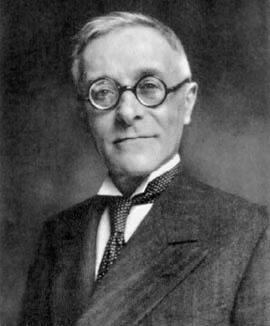
Tullio Levi-Civita
Tullio Levi-Civita was an Italian mathematician and physicist. Born March 29, 1873, in Padua. Died December 29, 1941, in Rome. Known for Levi-Civita symbol, Levi-Civita connection and Levi-Civita field. Educated at University of Padua. Awards include Foreign Member of the Royal Society, Sylvester Medal and Mathematical Prize of the Italian Academy of Sciences.
Facts
44 facts · 2 confirmed by two sources · 15 cited · 27 from one source
Where this comes from
Papalocal keeps its own record. It started from these sources; what each one said is kept here as it was copied, so a change on their side never changes this page by itself. Tap one to read its version.
What Wikidata says · copied November 16, 2026 · revision 2570022952
- Described as
- Italian mathematician and physicist (1873–1941)
- Born
- March 29, 1873 · 10 references
- Died
- December 29, 1941 · 11 references
- Born in
- Padua · 5 references
- Died in
- Rome · 4 references
- Buried in
- Campo Verano · 1 reference
- Citizen of
- Kingdom of Italy
- Occupation
- mathematician · 1 reference; physicist; university teacher · 1 reference
- Worked for
- Sapienza University of Rome (1918–1938) · 1 reference; University of Padua (1898–1918) · 2 references; University of Pavia (1895–1898) · 1 reference
- Education
- University of Padua (1890–1894) · 1 reference
- Member of
- Royal Society of London (1930–); Academy of Sciences of the USSR (1904–) · 1 reference; Saint Petersburg Academy of Sciences; Pontifical Academy of Sciences (1936–) · 1 reference; Accademia Nazionale dei Lincei (1905–) · 1 reference; French Academy of Sciences; American Academy of Arts and Sciences; Royal Prussian Academy of Sciences; German Academy of Sciences Leopoldina; Accademia Nazionale delle Scienze detta dei XL
- Known for
- Levi-Civita symbol; Levi-Civita connection; Levi-Civita field; Levi-Civita parallelogramoid; Levi-Civita tensor; The Absolute Differential Calculus (Calculus of Tensors) (1925); Levi-Civita regularization; Levi-Civita transformation
- Awards
- Foreign Member of the Royal Society (1930) · 1 reference; Sylvester Medal (1922) · 1 reference; Mathematical Prize of the Italian Academy of Sciences (1903) · 1 reference; doctor honoris causa from the University of Paris (1933) · 1 reference; honorary doctor of the University of Toulouse (1929) · 2 references
- Field
- differential geometry; theory of relativity; three-body problem; theoretical mechanics; hydrodynamics; tensor analysis
- Spouse
- Libera Trevisani Levi-Civita · 1 reference
- Father
- Giacomo Levi Civita · 1 reference
- Wikipedias with a page
- 43
Wikidata item Q353438 (wikidata.org/wiki/Q353438), public domain (CC0). Copied November 16, 2026.
What Wikipedia says · copied November 16, 2026 · revision 1372506165
Tullio Levi-Civita, (English: ; Italian: [ˈtulljo ˈlɛːvi ˈtʃiːvita]; 29 March 1873 – 29 December 1941) was an Italian mathematician, most famous for his work on absolute differential calculus (tensor calculus) and its applications to the theory of relativity, but who also made significant contributions in other areas. He was a pupil of Gregorio Ricci-Curbastro, the inventor of tensor calculus. His work included foundational papers in both pure and applied mathematics, celestial mechanics (notably on the three-body problem), analytic mechanics (the Levi-Civita separability conditions in the Hamilton–Jacobi equation) and hydrodynamics.
- Born, in its opening lines
- March 29, 1873
- Died, in its opening lines
- December 29, 1941
From the Wikipedia article “Tullio Levi-Civita” (en.wikipedia.org/wiki/Tullio_Levi-Civita), by its contributors, under CC BY-SA 4.0 (creativecommons.org/licenses/by-sa/4.0/). Copied November 16, 2026; not changed.
Confirmed Two sources agree. Cited One source, and it names where it got it. One source One source, without a reference of its own. Sources disagree The sources disagree. We show the best-supported value and keep theirs below.
