
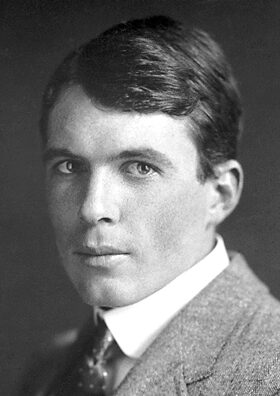
William Lawrence Bragg
William Lawrence Bragg was an Australian-born British physicist and X-ray crystallographer. Born March 31, 1890, in Adelaide. Died July 1, 1971, in Ipswich. Positions held include president (1927–1929) and Langworthy Professor (1919–1937). Known for X-ray diffraction. Educated at University of Adelaide and Trinity College. Awards include Fellow of the Royal Society, Military Cross and Officer of the Order of the British Empire.
Facts
58 facts · 2 confirmed by two sources · 19 cited · 37 from one source
Where this comes from
Papalocal keeps its own record. It started from these sources; what each one said is kept here as it was copied, so a change on their side never changes this page by itself. Tap one to read its version.
What Wikidata says · copied November 16, 2026 · revision 2563195961
- Described as
- Australian-born British physicist and X-ray crystallographer
- Born
- March 31, 1890 · 11 references
- Died
- July 1, 1971 · 11 references
- Born in
- Adelaide · 4 references
- Died in
- Ipswich · 1 reference
- Citizen of
- United Kingdom · 2 references; Australia
- Occupation
- mathematician; physicist · 2 references; university teacher; crystallographer; chemist; Nobel Prize winner · 1 reference
- Positions held
- president (1927–1929); Langworthy Professor (1919–1937)
- Worked for
- University of Manchester; University of Cambridge; Victoria University of Manchester · 1 reference
- Education
- University of Adelaide; Trinity College; University of Cambridge; Australian National University · 1 reference; University of Leeds · 1 reference; Queen's College, North Adelaide (1900–1901)
- Member of
- Royal Society of London; German Academy of Sciences at Berlin; Royal Swedish Academy of Sciences; Accademia Nazionale dei Lincei (1951–) · 1 reference; Royal Society of Edinburgh; American Academy of Arts and Sciences; Indian National Science Academy; Bavarian Academy of Sciences and Humanities; National Academy of Sciences (1945–); Manchester Literary and Philosophical Society
- Known for
- X-ray diffraction · 1 reference
- Awards
- Fellow of the Royal Society; Military Cross; Officer of the Order of the British Empire; Copley Medal (1966) · 1 reference; Roebling Medal (1948) · 1 reference; Royal Medal (1946); Nobel Prize in Physics (1915) · 2 references; Hughes Medal (1931); Matteucci Medal (1915); X-ray badge (1955); August Wilhelm von Hofmann Medal (1967) · 1 reference; Royal Society Bakerian Medal (1934) · 1 reference; Honorary Fellow of the Royal Society of Edinburgh; Guthrie Lecture (1952) · 1 reference; Knight Bachelor
- Field
- physics · 1 reference; X-ray crystallography · 1 reference; X-ray spectroscopy · 1 reference
- Spouse
- Alice Grace Jenny Hopkinson · 1 reference
- Children
- Stephen Bragg; Patience Mary Bragg · 2 references
- Father
- William Henry Bragg · 3 references
- Mother
- Gwendoline Todd · 1 reference
- Siblings
- Robert Charles Bragg · 1 reference
- Wikipedias with a page
- 91
Wikidata item Q131729 (wikidata.org/wiki/Q131729), public domain (CC0). Copied November 16, 2026.
What Wikipedia says · copied November 16, 2026 · revision 1381976168
Sir William Lawrence Bragg (31 March 1890 – 1 July 1971) was an Australian and British X-ray crystallographer who uniquely shared a Nobel Prize with his father William Henry Bragg – the 1915 Nobel Prize in Physics "for their services in the analysis of crystal structure by means of X-rays", an important step in the development of X-ray crystallography.
As of 2026, Bragg is the youngest ever Nobel laureate in physics, or in any science category, having received the award at the age of 25. Bragg was the director of the Cavendish Laboratory, Cambridge, when James D. Watson and Francis Crick reported the discovery of the structure of DNA in February 1953.
- Born, in its opening lines
- March 31, 1890
- Died, in its opening lines
- July 1, 1971
From the Wikipedia article “Lawrence Bragg” (en.wikipedia.org/wiki/Lawrence_Bragg), by its contributors, under CC BY-SA 4.0 (creativecommons.org/licenses/by-sa/4.0/). Copied November 16, 2026; not changed.
Confirmed Two sources agree. Cited One source, and it names where it got it. One source One source, without a reference of its own. Sources disagree The sources disagree. We show the best-supported value and keep theirs below.
