
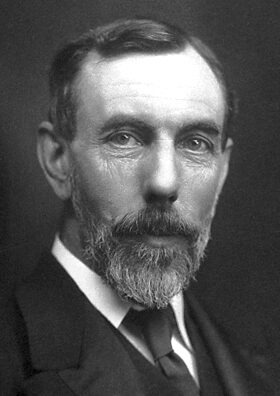
William Ramsay
William Ramsay was a Scottish chemist. Born October 2, 1852, in Glasgow. Died July 23, 1916, in High Wycombe. Educated at University of Tübingen (2 times) and University of Glasgow. Awards include Pour le Mérite for Sciences and Arts order, Fellow of the Royal Society and Knight Commander of the Order of the Bath.
Facts
44 facts · 2 confirmed by two sources · 11 cited · 31 from one source
Where this comes from
Papalocal keeps its own record. It started from these sources; what each one said is kept here as it was copied, so a change on their side never changes this page by itself. Tap one to read its version.
What Wikidata says · copied November 16, 2026 · revision 2568763498
- Described as
- Scottish chemist (1852–1916)
- Other names
- Sir William Ramsay
- Born
- October 2, 1852 · 11 references
- Died
- July 23, 1916 · 8 references
- Born in
- Glasgow · 5 references
- Died in
- High Wycombe · 3 references
- Cause of death
- cancer
- Citizen of
- United Kingdom of Great Britain and Ireland
- Occupation
- chemist · 1 reference; professor; historian · 1 reference; archaeologist · 1 reference
- Worked for
- University College London; University of Strathclyde; University of Bristol; University of Glasgow
- Education
- University of Tübingen (2 times) (1871–1878) · 1 reference; University of Glasgow (1868–1871) · 1 reference; The Glasgow Academy
- Member of
- Royal Society of London; Bavarian Academy of Sciences and Humanities; Saint Petersburg Academy of Sciences; Royal Swedish Academy of Sciences; Hungarian Academy of Sciences; Royal Society of Edinburgh; Russian Academy of Sciences; Royal Prussian Academy of Sciences; Accademia Nazionale delle Scienze detta dei XL; Royal Netherlands Academy of Arts and Sciences · 1 reference
- Awards
- Pour le Mérite for Sciences and Arts order; Fellow of the Royal Society; Knight Commander of the Order of the Bath; Leconte Prize (1895); Nobel Prize in Chemistry (1904) · 2 references; Elliott Cresson Medal (1913) · 1 reference; Matteucci Medal (1907); honorary doctor of the Jagiellonian University of Krakow (1900); August Wilhelm von Hofmann Medal (1903) · 1 reference; Davy Medal (1895) · 1 reference; Honorary Fellow of the Royal Society of Edinburgh; Pour le Mérite · 1 reference; Longstaff Prize (1897) · 1 reference; Barnard Medal for Meritorious Service to Science (1895) · 1 reference; honorary member of the Physics Association (Frankfurt am Main, Germany) (1904)
- Field
- chemistry
- Spouse
- Margaret Johnstone Marshall
- Wikipedias with a page
- 93
Wikidata item Q950726 (wikidata.org/wiki/Q950726), public domain (CC0). Copied November 16, 2026.
What Wikipedia says · copied November 16, 2026 · revision 1384569646
Sir William Ramsay (; 2 October 1852 – 23 July 1916) was a Scottish chemist who discovered the noble gases and received the Nobel Prize in Chemistry in 1904 "in recognition of his services in the discovery of the inert gaseous elements in air" along with his collaborator, John William Strutt, 3rd Baron Rayleigh, who received the Nobel Prize in Physics that same year for their discovery of argon. After the two men identified argon, Ramsay investigated other atmospheric gases. His work in isolating argon, helium, neon, krypton, and xenon led to the development of a new section of the periodic table.
- Born, in its opening lines
- October 2, 1852
- Died, in its opening lines
- July 23, 1916
From the Wikipedia article “William Ramsay” (en.wikipedia.org/wiki/William_Ramsay), by its contributors, under CC BY-SA 4.0 (creativecommons.org/licenses/by-sa/4.0/). Copied November 16, 2026; not changed.
Confirmed Two sources agree. Cited One source, and it names where it got it. One source One source, without a reference of its own. Sources disagree The sources disagree. We show the best-supported value and keep theirs below.
