
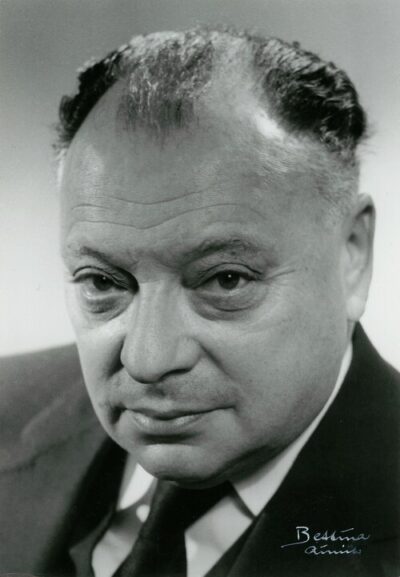
Wolfgang Pauli
Wolfgang Pauli was a physicist, Nobel prize winner. Born April 25, 1900, in Vienna. Died December 15, 1958, in Zurich. Known for Pauli exclusion principle, Pauli matrices and Pauli equation. Educated at LMU Munich and Bundesgymnasium Döbling. Awards include Lorentz Medal, Nobel Prize in Physics and Max Planck Medal.
Facts
57 facts · 2 confirmed by two sources · 22 cited · 33 from one source
Where this comes from
Papalocal keeps its own record. It started from these sources; what each one said is kept here as it was copied, so a change on their side never changes this page by itself. Tap one to read its version.
What Wikidata says · copied November 13, 2026 · revision 2565534151
- Described as
- physicist, Nobel prize winner (1900–1958)
- Other names
- Wolfgang Ernst Pauli
- Born
- April 25, 1900 · 12 references
- Died
- December 15, 1958 · 13 references
- Born in
- Vienna · 4 references
- Died in
- Zurich · 4 references
- Buried in
- Zollikon cemetery · 1 reference
- Cause of death
- pancreatic cancer
- Name at birth
- Wolfgang Ernst Pauli
- Citizen of
- United States (1946–); Switzerland (1949–); Austria (1900–)
- Occupation
- theoretical physicist; university teacher · 2 references; chemist · 1 reference; physicist · 3 references
- Worked for
- University of Hamburg (1923–1928); University of Göttingen (1921–1922) · 1 reference; ETH Zurich (2 times) (1928–1958) · 1 reference; University of Copenhagen Niels Bohr Institute (1922–1923) · 1 reference; Purdue University (1942) · 2 references; University of Michigan (1941) · 1 reference; Princeton University (1940–1946) · 1 reference
- Education
- LMU Munich (1918–1921) · 1 reference; Bundesgymnasium Döbling (–1918) · 1 reference
- Member of
- Royal Society of London (1953–); Bavarian Academy of Sciences and Humanities; Royal Swedish Academy of Sciences; Heidelberg Academy of Sciences and Humanities (1950–) · 1 reference; Royal Netherlands Academy of Arts and Sciences; American Academy of Arts and Sciences; American Association for the Advancement of Science · 1 reference; American Physical Society · 1 reference; Accademia Nazionale dei Lincei (1958–) · 1 reference
- Known for
- Pauli exclusion principle · 1 reference; Pauli matrices; Pauli equation; Pauli effect; Pauli–Villars regularization; Pauli group; Pauli–Lubanski pseudovector
- Awards
- Lorentz Medal (1931); Nobel Prize in Physics (1945) · 2 references; Max Planck Medal (1958); Matteucci Medal (1956); Franklin Medal (1952); honorary doctor of the University of Vienna · 1 reference; Foreign Member of the Royal Society (1953) · 1 reference; professor (1926); honorary doctor of the University of Hamburg (1958)
- Field
- quantum mechanics; particle physics
- Spouse
- Käthe Margarethe Deppner; Franziska Bertram (1934–)
- Father
- Wolfgang Joseph Pauli · 1 reference
- Mother
- Bertha Pauli
- Siblings
- Hertha Pauli · 1 reference
- Religion
- lapsed Catholic · 1 reference; Catholicism · 1 reference
- Wikipedias with a page
- 105
Wikidata item Q65989 (wikidata.org/wiki/Q65989), public domain (CC0). Copied November 13, 2026.
What Wikipedia says · copied November 13, 2026 · revision 1382554034
Wolfgang Ernst Pauli (25 April 1900 – 15 December 1958) was an Austrian theoretical physicist and a pioneer of quantum mechanics. In 1945, after having been nominated by Albert Einstein, Pauli received the Nobel Prize in Physics "for the discovery of the Exclusion Principle, also called the Pauli Principle". The discovery involved spin theory, which is the basis of a theory of the structure of matter.
To preserve the conservation of energy in beta decay, Pauli proposed the existence of a small neutral particle, dubbed the "neutrino" in 1930. Neutrinos were first detected in 1956.
- Born, in its opening lines
- April 25, 1900
- Died, in its opening lines
- December 15, 1958
From the Wikipedia article “Wolfgang Pauli” (en.wikipedia.org/wiki/Wolfgang_Pauli), by its contributors, under CC BY-SA 4.0 (creativecommons.org/licenses/by-sa/4.0/). Copied November 13, 2026; not changed.
Confirmed Two sources agree. Cited One source, and it names where it got it. One source One source, without a reference of its own. Sources disagree The sources disagree. We show the best-supported value and keep theirs below.
