
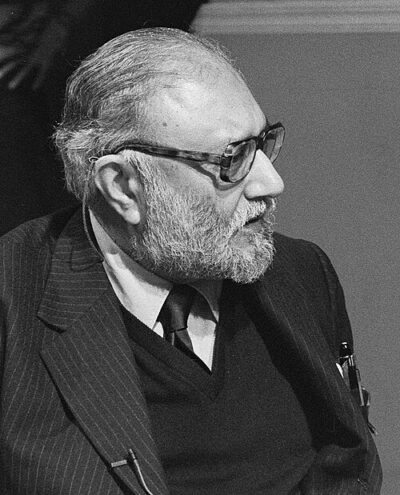
Abdus Salam
Abdus Salam was a theoretical physicist, and Nobel Prize in Physics recipient. Born January 29, 1926, in Jhang. Died November 21, 1996, in Oxford. Educated at Government College University and University of the Punjab. Awards include Atoms for Peace Award, Fellow of the Royal Society and Pride of Performance.
Facts
51 facts · 2 confirmed by two sources · 20 cited · 29 from one source
Where this comes from
Papalocal keeps its own record. It started from these sources; what each one said is kept here as it was copied, so a change on their side never changes this page by itself. Tap one to read its version.
What Wikidata says · copied November 16, 2026 · revision 2567439392
- Described as
- theoretical physicist, and Nobel Prize in Physics recipient
- Other names
- Mohammad Abdus Salam, Muhammad Abdus Salam
- Born
- January 29, 1926 · 11 references
- Died
- November 21, 1996 · 11 references
- Born in
- Jhang
- Died in
- Oxford · 2 references
- Cause of death
- progressive supranuclear palsy
- Citizen of
- British Raj (1926–1947); Pakistan (1947–1996)
- Occupation
- university teacher; theoretical physicist; physicist · 2 references
- Worked for
- Imperial College London; Ministry of Science and Technology; Government College University (1951–1954); St John's College (1954–1957); International Centre for Theoretical Physics; University of Chicago; University of Cambridge; Columbia University
- Education
- Government College University; University of the Punjab; St John's College · 1 reference; Sanatan Dharma College
- Member of
- Royal Society of London (1959–) · 1 reference; Pontifical Academy of Sciences (1981–) · 1 reference; Academy of Sciences of the USSR (1971–) · 1 reference; Royal Swedish Academy of Sciences; Hungarian Academy of Sciences; American Academy of Arts and Sciences (1971–) · 1 reference; Russian Academy of Sciences; Indian National Science Academy; Accademia Nazionale delle Scienze detta dei XL; The World Academy of Sciences (1983–) · 1 reference
- Awards
- Atoms for Peace Award (1968) · 1 reference; Fellow of the Royal Society (1959) · 1 reference; Pride of Performance; Copley Medal (1990) · 1 reference; Royal Medal (1978); Nobel Prize in Physics (1979) · 3 references; Lomonosov Gold Medal (1983) · 1 reference; Hughes Medal (1964) · 1 reference; Matteucci Medal (1978) · 1 reference; Honorary doctors of Ghent University (1988) · 1 reference; Catalonia International Prize (1990) · 1 reference; TWAS fellow (1983) · 1 reference; National Order of Scientific Merit; J. Robert Oppenheimer Memorial Prize (1971) · 1 reference; Nishan-e-Pakistan
- Field
- quantum field theory
- Spouse
- Louise Johnson · 1 reference
- Religion
- Ahmadiyya · 1 reference; Islam
- Wikipedias with a page
- 87
Wikidata item Q28189 (wikidata.org/wiki/Q28189), public domain (CC0). Copied November 16, 2026.
What Wikipedia says · copied November 16, 2026 · revision 1385552944
Mohammad Abdus Salam (; 29 January 1926 – 21 November 1996) was a Pakistani theoretical physicist and Nobel laureate. He shared the 1979 Nobel Prize in Physics with Steven Weinberg and Sheldon Glashow "for their contributions to the theory of the unified weak and electromagnetic interaction between elementary particles, including, inter alia, the prediction of the weak neutral current". He was the first Pakistani, and second person from any Muslim country (after Anwar Sadat of Egypt) to win a Nobel Prize.
Salam was scientific advisor to the Ministry of Science and Technology in Pakistan from 1960 to 1974, a position from which he played a major and influential role in the development of the country's science infrastructure. Salam contributed to numerous developments in theoretical and particle physics in Pakistan. He was the founding director of the Space and Upper Atmosphere Research Commission (SUPARCO). For this, he is viewed as the "scientific father" of this program. In 1974, Abdus Salam departed from his country in protest after the Parliament of Pakistan unanimously passed a parliamentary bill declaring members of the Ahmadiyya Muslim community, to which Salam belonged, non-Muslim.
Salam's notable achievements include the Pati–Salam model, a Grand Unified Theory he proposed along with Jogesh Pati in 1974, magnetic photon, vector meson, work on supersymmetry and most importantly, electroweak theory, for which he was awarded the Nobel Prize. Salam made a major contribution at Imperial College London. Salam made important contributions to the modern theory on neutrinos, as well as the work on modernising quantum mechanics. As a teacher and science promoter, Salam is remembered as a founder and scientific father of theoretical physics in Pakistan during his term as the chief scientific advisor to the president. Salam heavily contributed to the rise of Pakistani physics within the global physics community.
- Born, in its opening lines
- January 29, 1926
- Died, in its opening lines
- November 21, 1996
From the Wikipedia article “Abdus Salam” (en.wikipedia.org/wiki/Abdus_Salam), by its contributors, under CC BY-SA 4.0 (creativecommons.org/licenses/by-sa/4.0/). Copied November 16, 2026; not changed.
Confirmed Two sources agree. Cited One source, and it names where it got it. One source One source, without a reference of its own. Sources disagree The sources disagree. We show the best-supported value and keep theirs below.
