
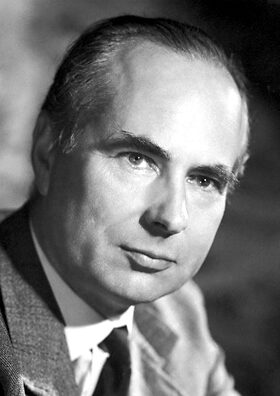
Andrew Huxley
Andrew Huxley was an English physiologist and biophysicist. Born November 22, 1917, in Hampstead. Died May 30, 2012, in Cambridge. Positions held include President of the Royal Society (1980–1985) and Master of Trinity College, Cambridge (1984–1990). Educated at Trinity College and Westminster School. Awards include Fellow of the Royal Society, Nobel Prize in Physiology or Medicine and honorary doctor of the Saarland University.
Facts
53 facts · 2 confirmed by two sources · 33 cited · 18 from one source
Where this comes from
Papalocal keeps its own record. It started from these sources; what each one said is kept here as it was copied, so a change on their side never changes this page by itself. Tap one to read its version.
What Wikidata says · copied November 16, 2026 · revision 2569149986
- Described as
- English physiologist and biophysicist (1917–2012)
- Other names
- Sir Andrew Huxley, A. F. Huxley, Andrew Fielding Huxley, Sir Andrew Fielding Huxley
- Born
- November 22, 1917 · 11 references
- Died
- May 30, 2012 · 13 references
- Born in
- Hampstead · 2 references
- Died in
- Cambridge · 1 reference
- Cause of death
- disease
- Citizen of
- United Kingdom · 3 references
- Occupation
- neuroscientist; physicist · 2 references; physician · 1 reference; physiologist · 3 references; biophysicist · 1 reference
- Positions held
- President of the Royal Society (1980–1985) · 1 reference; Master of Trinity College, Cambridge (1984–1990)
- Worked for
- University College London (1960–) · 1 reference
- Education
- Trinity College · 1 reference; Westminster School (1930–) · 1 reference; University College School · 1 reference; Imperial College School of Medicine
- Member of
- Royal Society of London (1955–); German Academy of Sciences Leopoldina (1964–) · 1 reference; National Academy of Sciences (1979–) · 1 reference; American Academy of Arts and Sciences; Indian National Science Academy; Royal Academy of Medicine of Belgium; Academia Europaea (1989–) · 1 reference; Japan Academy (1988–) · 1 reference; American Philosophical Society (1975–)
- Awards
- Fellow of the Royal Society (1955) · 1 reference; Nobel Prize in Physiology or Medicine (1963) · 2 references; honorary doctor of the Saarland University (1964) · 1 reference; Croonian Medal and Lecture (1967); Copley Medal (1973) · 1 reference; Annual Review Prize Lecture (1973) · 1 reference; Baly Medal (1975); honorary doctorate of the University of the Mediterranean - Aix Marseille II (1981) · 2 references; Knight Bachelor; Order of Merit · 1 reference; Honorary member of the British Biophysical Society; Swammerdam Medal (1997) · 1 reference
- Field
- physiology · 1 reference
- Spouse
- Jocelyn Richenda Gammell Pease (1947–) · 2 references
- Children
- Stewart Huxley · 2 references; Janet Huxley · 2 references; Camilla Rose Huxley · 3 references; Henrietta Huxley · 2 references; Clare Huxley · 2 references; Eleanor Huxley · 3 references
- Father
- Leonard Huxley · 2 references
- Mother
- Rosalind Bruce · 3 references
- Siblings
- Julian Huxley · 1 reference; Aldous Huxley · 1 reference; David Bruce Huxley · 1 reference
- Lived in
- Grantchester
- Wikipedias with a page
- 66
Wikidata item Q104607 (wikidata.org/wiki/Q104607), public domain (CC0). Copied November 16, 2026.
What Wikipedia says · copied November 16, 2026 · revision 1380613908
Sir Andrew Fielding Huxley (22 November 1917 – 30 May 2012) was an English physiologist and biophysicist. He was born into the prominent Huxley family. After leaving Westminster School in central London, he went to Trinity College, Cambridge, on a scholarship, after which he joined Alan Hodgkin to study nerve impulses. Their eventual discovery of the basis for propagation of nerve impulses (called an action potential) earned them the Nobel Prize in Physiology or Medicine in 1963. They made their discovery from the giant axon of the Atlantic squid. Soon after the outbreak of the Second World War, Huxley was recruited by the British Anti-Aircraft Command and later transferred to the Admiralty. After the war he resumed research at the University of Cambridge, where he developed interference microscopy that would be suitable for studying muscle fibres.
In 1952, he was joined by a German physiologist Rolf Niedergerke. Together they discovered in 1954 the mechanism of muscle contraction, popularly called the "sliding filament theory", which is the foundation of our modern understanding of muscle mechanics. In 1960 he became head of the Department of Physiology at University College London. He was elected a Fellow of the Royal Society in 1955, and President in 1980. The Royal Society awarded him the Copley Medal in 1973 for his collective contributions to the understanding of nerve impulses and muscle contraction. He was conferred a Knight Bachelor by the Queen in 1974, and was appointed to the Order of Merit in 1983. He was a fellow of Trinity College, Cambridge, until his death.
- Born, in its opening lines
- November 22, 1917
- Died, in its opening lines
- May 30, 2012
From the Wikipedia article “Andrew Huxley” (en.wikipedia.org/wiki/Andrew_Huxley), by its contributors, under CC BY-SA 4.0 (creativecommons.org/licenses/by-sa/4.0/). Copied November 16, 2026; not changed.
Confirmed Two sources agree. Cited One source, and it names where it got it. One source One source, without a reference of its own. Sources disagree The sources disagree. We show the best-supported value and keep theirs below.
