
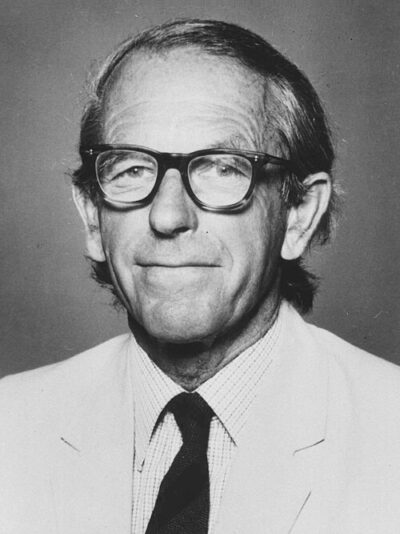
Frederick Sanger
Frederick Sanger was a British biochemist. Born August 13, 1918, in Rendcomb. Died November 19, 2013, in Cambridge. Educated at University of Cambridge and St John's College. Awards include Corday-Morgan Prize, Fellow of the Royal Society and Nobel Prize in Chemistry (2 times).
Facts
44 facts · 2 confirmed by two sources · 21 cited · 21 from one source
Where this comes from
Papalocal keeps its own record. It started from these sources; what each one said is kept here as it was copied, so a change on their side never changes this page by itself. Tap one to read its version.
What Wikidata says · copied November 16, 2026 · revision 2563200537
- Described as
- British biochemist (1918–2013)
- Born
- August 13, 1918 · 10 references
- Died
- November 19, 2013 · 10 references
- Born in
- Rendcomb · 1 reference
- Died in
- Cambridge · 2 references
- Citizen of
- United Kingdom; United Kingdom of Great Britain and Ireland (–1927)
- Occupation
- biochemist · 2 references; chemist · 1 reference; university teacher; conscientious objector
- Worked for
- University of Cambridge
- Education
- University of Cambridge; St John's College (1936–1939) · 1 reference; Bryanston School (1932–1936); Malvern College; The Downs, Malvern College Prep School
- Member of
- Royal Society of London (1954–) · 1 reference; National Academy of Sciences (1967–) · 2 references; Bavarian Academy of Sciences and Humanities; French Academy of Sciences (1981–) · 1 reference; American Academy of Arts and Sciences (1958–) · 1 reference; European Molecular Biology Organization (1981–) · 1 reference; Australian Academy of Science (1982–); Indian National Science Academy; King's College London (1954–) · 1 reference; World Academy of Art and Science (1962–) · 1 reference
- Awards
- Corday-Morgan Prize (1951) · 1 reference; Fellow of the Royal Society (1954–) · 1 reference; Nobel Prize in Chemistry (2 times) (1958, 1980) · 3 references; Commander of the Order of the British Empire (1963); Royal Medal (1969) · 1 reference; honorary doctorate from the University of Strasbourg (1970) · 1 reference; Croonian Medal and Lecture (1975); William Bate Hardy Prize (1976); Copley Medal (1977) · 1 reference; Albert Lasker Award for Basic Medical Research (1979) · 1 reference; Canada Gairdner International Award (1979); Louisa Gross Horwitz Prize (1979) · 1 reference; Companion of Honour (1981); Corresponding Member of the Australian Academy of Science (1982); Order of Merit (1986)
- Field
- biochemistry
- Spouse
- Margaret Joan Howe
- Religion
- agnostic atheism · 1 reference
- Wikipedias with a page
- 87
Wikidata item Q151564 (wikidata.org/wiki/Q151564), public domain (CC0). Copied November 16, 2026.
What Wikipedia says · copied November 16, 2026 · revision 1379442193
Frederick Sanger (; 13 August 1918 – 19 November 2013) was a British biochemist who received the Nobel Prize in Chemistry twice.
Sanger won the 1958 Chemistry Prize for determining the amino acid sequence of insulin and numerous other proteins, demonstrating in the process that each had a unique, definite structure; this was a foundational discovery for the central dogma of molecular biology.
At the newly constructed Laboratory of Molecular Biology in Cambridge, he developed and subsequently refined the first-ever DNA sequencing technique, which vastly expanded the number of feasible experiments in molecular biology and remains in widespread use today. The breakthrough earned him the 1980 Nobel Prize in Chemistry, which he shared with Walter Gilbert and Paul Berg.
He is one of only three people to have won multiple Nobel Prizes in the same category (the others being John Bardeen in physics and Karl Barry Sharpless in chemistry), and one of five persons with two Nobel Prizes.
- Born, in its opening lines
- August 13, 1918
- Died, in its opening lines
- November 19, 2013
From the Wikipedia article “Frederick Sanger” (en.wikipedia.org/wiki/Frederick_Sanger), by its contributors, under CC BY-SA 4.0 (creativecommons.org/licenses/by-sa/4.0/). Copied November 16, 2026; not changed.
Confirmed Two sources agree. Cited One source, and it names where it got it. One source One source, without a reference of its own. Sources disagree The sources disagree. We show the best-supported value and keep theirs below.
