
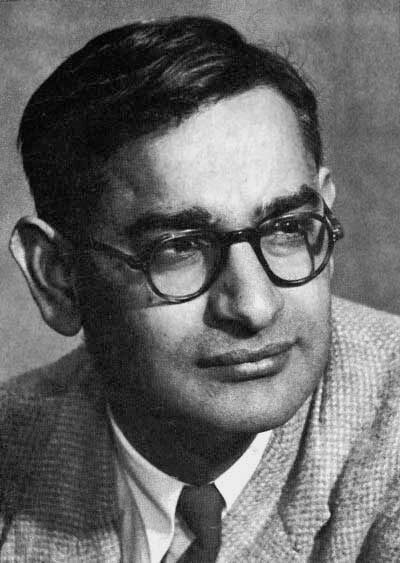
Har Gobind Khorana
Har Gobind Khorana was an Indian-American molecular biologist. Born January 9, 1922, in Raipur. Died November 9, 2011, in Concord. Educated at University of the Punjab and University of Liverpool. Awards include Albert Lasker Award for Basic Medical Research, Willard Gibbs Award and Nobel Prize in Physiology or Medicine.
Facts
49 facts · 2 confirmed by two sources · 16 cited · 31 from one source
Where this comes from
Papalocal keeps its own record. It started from these sources; what each one said is kept here as it was copied, so a change on their side never changes this page by itself. Tap one to read its version.
What Wikidata says · copied November 13, 2026 · revision 2565619904
- Described as
- Indian-American molecular biologist (1922-2011)
- Other names
- Har G. Khorana, H. Gobind Khorana, Gobind Khorana, Hargobind Khorana
- Born
- January 9, 1922 · 10 references
- Died
- November 9, 2011 · 10 references
- Born in
- Raipur · 1 reference
- Died in
- Concord · 3 references
- Cause of death
- disease
- Citizen of
- British Raj (–1947); United States (1966–) · 1 reference; Dominion of India (1947–1950); India (1950–1966)
- Occupation
- geneticist; biologist · 1 reference; university teacher; chemist · 1 reference
- Worked for
- Massachusetts Institute of Technology; University of British Columbia; University of Wisconsin–Madison; University of Cambridge; ETH Zurich
- Education
- University of the Punjab; University of Liverpool; University of Cambridge; Government College University · 1 reference
- Member of
- Royal Society of London; German Academy of Sciences Leopoldina · 1 reference; Pontifical Academy of Sciences · 1 reference; National Academy of Sciences; Academy of Sciences of the USSR; American Academy of Arts and Sciences; Russian Academy of Sciences; The World Academy of Sciences · 1 reference; American Philosophical Society (1973–)
- Awards
- Albert Lasker Award for Basic Medical Research (1968) · 1 reference; Willard Gibbs Award (1974) · 1 reference; Nobel Prize in Physiology or Medicine (1968) · 2 references; Louisa Gross Horwitz Prize (1968) · 1 reference; Canada Gairdner International Award (1980); ACS Award for Creative Work in Synthetic Organic Chemistry, (1969); National Medal of Science (1987); Dannie Heineman Prize (1967); Padma Vibhushan in Science & Engineering (1969); Remsen Award (1968) · 1 reference; Foreign Member of the Royal Society (1978) · 1 reference; honorary doctor of the University of Calcutta; honorary doctor of the University of Miami (1994) · 1 reference; Great Immigrants Award (2010) · 1 reference
- Field
- molecular biology
- Religion
- Hinduism; Sikhism
- Lived in
- presidencies and provinces in British India · 1 reference
- Wikipedias with a page
- 77
Wikidata item Q107462 (wikidata.org/wiki/Q107462), public domain (CC0). Copied November 13, 2026.
What Wikipedia says · copied November 13, 2026 · revision 1379532045
Har Gobind Khorana (9 January 1922 – 9 November 2011) was an Indian-American biochemist. While on the faculty of the University of Wisconsin–Madison, he shared the 1968 Nobel Prize for Physiology or Medicine with Marshall W. Nirenberg and Robert W. Holley for research that showed the order of nucleotides in nucleic acids, which carry the genetic code of the cell and control the cell's synthesis of proteins. Khorana and Nirenberg were also awarded the Louisa Gross Horwitz Prize from Columbia University in the same year.
Born in Raipur, Punjab (during the British Raj), Khorana served on the faculties of three universities in North America. He became a naturalized citizen of the United States in 1966, and received the National Medal of Science in 1987.
- Born, in its opening lines
- January 9, 1922
- Died, in its opening lines
- November 9, 2011
From the Wikipedia article “Har Gobind Khorana” (en.wikipedia.org/wiki/Har_Gobind_Khorana), by its contributors, under CC BY-SA 4.0 (creativecommons.org/licenses/by-sa/4.0/). Copied November 13, 2026; not changed.
Confirmed Two sources agree. Cited One source, and it names where it got it. One source One source, without a reference of its own. Sources disagree The sources disagree. We show the best-supported value and keep theirs below.
