
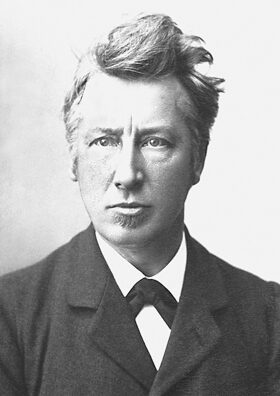
Jacobus Henricus van 't Hoff
Jacobus Henricus van 't Hoff was a Dutch physical and organic chemist. Born August 30, 1852, in Rotterdam. Died March 1, 1901, in Steglitz. Educated at Leiden University and Delft University of Technology. Awards include Pour le Mérite for Sciences and Arts order, Nobel Prize in Chemistry and Helmholtz Medal.
Facts
44 facts · 1 confirmed by two sources · 10 cited · 32 from one source · 1 where the sources disagree
What’s different
- Died: we show March 1, 1901 (Sources disagree). Wikipedia says March 1, 1911
Where this comes from
Papalocal keeps its own record. It started from these sources; what each one said is kept here as it was copied, so a change on their side never changes this page by itself. Tap one to read its version.
What Wikidata says · copied November 16, 2026 · revision 2568752679
- Described as
- Dutch physical and organic chemist (1852-1911)
- Other names
- Jacobus van't Hoff, J.H. van 't Hoff, Jacobus Henricus, Jacobus Henricus van't Hoff, Jacobus van 't Hoff, Jacobus H. van 't Hoff
- Born
- August 30, 1852 · 13 references
- Died
- March 1, 1901 · 11 references
- Born in
- Rotterdam · 4 references
- Died in
- Steglitz · 2 references
- Buried in
- Dahlem Cemetery · 2 references
- Cause of death
- tuberculosis
- Citizen of
- Kingdom of the Netherlands · 1 reference
- Occupation
- chemist · 1 reference; physicist; engineer · 1 reference; geologist · 1 reference; university teacher · 1 reference; stereochemist
- Worked for
- Utrecht University (1874–1878) · 1 reference; Frederick William University Berlin; Humboldt-Universität zu Berlin; University of Amsterdam (1877–1895) · 1 reference
- Education
- Leiden University; Delft University of Technology; University of Bonn; Utrecht University; University of Paris
- Member of
- Royal Society of London (1897–); Göttingen Academy of Sciences and Humanities in Lower Saxony; Saint Petersburg Academy of Sciences; French Academy of Sciences; Royal Swedish Academy of Sciences; Hungarian Academy of Sciences; Royal Netherlands Academy of Arts and Sciences; American Academy of Arts and Sciences; Royal Physiographic Society in Lund; Russian Academy of Sciences
- Awards
- Pour le Mérite for Sciences and Arts order; Nobel Prize in Chemistry (1901) · 3 references; Helmholtz Medal (1910); Davy Medal (1893) · 1 reference; Bavarian Maximilian Order for Science and Art (1901); Foreign Member of the Royal Society (1897) · 1 reference; Pour le Mérite · 1 reference; honorary member of the Physics Association (Frankfurt am Main, Germany) (1901); Honorary doctor of the Heidelberg University (1908) · 1 reference
- Field
- physical chemistry; organic chemistry
- Spouse
- Johanna Francina Mees
- Wikipedias with a page
- 99
Wikidata item Q102822 (wikidata.org/wiki/Q102822), public domain (CC0). Copied November 16, 2026.
What Wikipedia says · copied November 16, 2026 · revision 1384273170
Jacobus Henricus van 't Hoff Jr. (Dutch: [vɑn (ə)t ˈɦɔf]; 30 August 1852 – 1 March 1911) was a Dutch physical chemist. A highly influential theoretical chemist, in 1901 Van 't Hoff won the first Nobel Prize in Chemistry "[for his] discovery of the laws of chemical dynamics and osmotic pressure in solutions". His pioneering work helped found the modern theory of chemical affinity, chemical equilibrium, chemical kinetics, and chemical thermodynamics. In his 1874 pamphlet, Van 't Hoff formulated the theory of the tetrahedral carbon atom and laid the foundations of stereochemistry. In 1875, he predicted the correct structures of allenes and cumulenes as well as their axial chirality. He is also widely considered one of the three co-founders of physical chemistry as the discipline is known today. The Zeitschrift für physikalische Chemie (Journal of Physical Chemistry) was founded in 1887 by Van 't Hoff, Svante Arrhenius and Wilhelm Ostwald, at Leipzig University as the first dedicated scientific journal for the discipline.
- Born, in its opening lines
- August 30, 1852
- Died, in its opening lines
- March 1, 1911
From the Wikipedia article “Jacobus Henricus van 't Hoff” (en.wikipedia.org/wiki/Jacobus_Henricus_van_'t_Hoff), by its contributors, under CC BY-SA 4.0 (creativecommons.org/licenses/by-sa/4.0/). Copied November 16, 2026; not changed.
Confirmed Two sources agree. Cited One source, and it names where it got it. One source One source, without a reference of its own. Sources disagree The sources disagree. We show the best-supported value and keep theirs below.
