
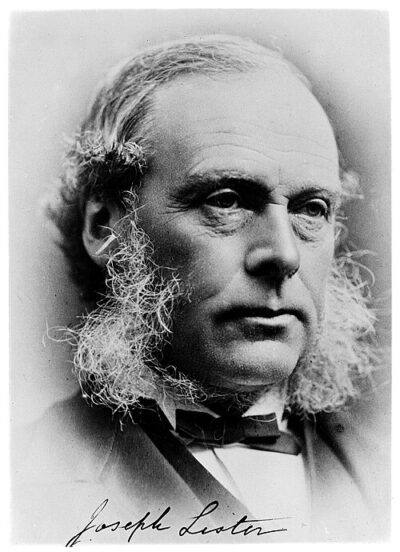
Joseph Lister
Joseph Lister was a British surgeon and antiseptic pioneer. Born April 5, 1827, in Upton House, Newham. Died February 10, 1912, in Walmer. Positions held include Member of the Privy Council of the United Kingdom (1902–), President of the Royal Society (1895–1900) and member of the House of Lords (1897–1912). Known for A Method of Antiseptic Treatment Applicable to Wounded Soldiers in the Present War. Educated at University College London and University of London. Awards include Fellow of the Royal Society, Copley Medal and Pour le Mérite for Sciences and Arts order.
Facts
50 facts · 2 confirmed by two sources · 15 cited · 33 from one source
Where this comes from
Papalocal keeps its own record. It started from these sources; what each one said is kept here as it was copied, so a change on their side never changes this page by itself. Tap one to read its version.
What Wikidata says · copied November 16, 2026 · revision 2570037024
- Described as
- British surgeon and antiseptic pioneer (1827–1912)
- Other names
- 1st Baron Lister, Lord Lister, Joseph, Lord Lister, Lord Joseph Lister, Joseph First Baron Lister
- Born
- April 5, 1827 · 10 references
- Died
- February 10, 1912 · 10 references
- Born in
- Upton House, Newham · 3 references
- Died in
- Walmer · 1 reference
- Buried in
- Hampstead Cemetery · 1 reference
- Citizen of
- United Kingdom of Great Britain and Ireland
- Occupation
- surgeon · 1 reference; university teacher; politician · 1 reference; botanical collector · 1 reference
- Positions held
- Member of the Privy Council of the United Kingdom (1902–) · 1 reference; President of the Royal Society (1895–1900) · 1 reference; member of the House of Lords (1897–1912) · 1 reference
- Worked for
- King's College London; University of Edinburgh; University of Glasgow
- Education
- University College London; University of London · 1 reference; Grove House School; UCL Medical School
- Member of
- Royal Society of London (1860–); Royal Swedish Academy of Sciences (1889–); Hungarian Academy of Sciences (1893–); Hellenic Philological Society of Constantinople (1881–); American Academy of Arts and Sciences (1893–); Royal Society of Arts and Sciences in Gothenburg (1882–); German Academy of Sciences Leopoldina (1882–); Académie Nationale de Médecine (1899–); Royal Academy of Medicine of Belgium (1879–); National Academy of Sciences (1898–)
- Known for
- A Method of Antiseptic Treatment Applicable to Wounded Soldiers in the Present War
- Awards
- Fellow of the Royal Society (1860); Copley Medal (1902) · 1 reference; Pour le Mérite for Sciences and Arts order (1885); Royal Medal (1880); Cothenius Medal (1877); Albert Medal (1894) · 1 reference; Croonian Medal and Lecture (1863); Honorary Doctorate from the National Autonomous University of Mexico (1910); Makdougall Brisbane Prize (1872); Grand Cross of the Order of the Dannebrog (1902); Cameron Prize of the University of Edinburgh (1890)
- Spouse
- Agnes Syme (1856–) · 2 references
- Father
- Joseph Jackson Lister · 2 references
- Mother
- Isabella Harris · 2 references
- Siblings
- Arthur Hugh Lister · 2 references; Mary Godlee; Isabella Sophia Lister · 1 reference; John Lister · 1 reference
- Religion
- Quakers
- Wikipedias with a page
- 79
Wikidata item Q155768 (wikidata.org/wiki/Q155768), public domain (CC0). Copied November 16, 2026.
What Wikipedia says · copied November 16, 2026 · revision 1385069561
Joseph Lister, 1st Baron Lister (5 April 1827 – 10 February 1912) was an English surgeon, medical scientist, experimental pathologist and pioneer of antiseptic surgery and preventive healthcare. Lister revolutionised the craft of surgery by the use of close anatomical observation, in the same manner that John Hunter revolutionised the science of surgery.
From a technical viewpoint, Lister was not an exceptional surgeon, but his research into bacteriology and infection in wounds revolutionised surgery throughout the world.
Lister's contributions were four-fold. Firstly, as a surgeon at the Glasgow Royal Infirmary, he introduced carbolic acid (modern-day phenol) as a steriliser for surgical instruments, patients' skins, sutures, surgeons' hands, and wards, promoting the principle of antiseptics. Secondly, he researched the role of inflammation and tissue perfusion in the healing of wounds. Thirdly, he advanced diagnostic science by analysing specimens using microscopes. Fourthly, he devised strategies to increase the chances of survival after surgery. His most important contribution, however, was recognising that putrefaction in wounds is caused by germs, in connection to Louis Pasteur's then-novel germ theory of fermentation.
Lister's work led to a reduction in post-operative infections and made surgery safer for patients, leading to him being distinguished as the "father of modern surgery".
- Born, in its opening lines
- April 5, 1827
- Died, in its opening lines
- February 10, 1912
From the Wikipedia article “Joseph Lister” (en.wikipedia.org/wiki/Joseph_Lister), by its contributors, under CC BY-SA 4.0 (creativecommons.org/licenses/by-sa/4.0/). Copied November 16, 2026; not changed.
Confirmed Two sources agree. Cited One source, and it names where it got it. One source One source, without a reference of its own. Sources disagree The sources disagree. We show the best-supported value and keep theirs below.
