
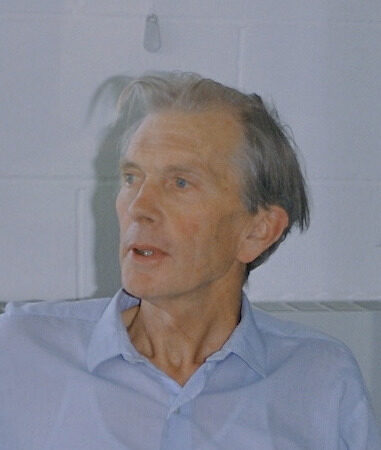
Martin Ryle
Martin Ryle was an English radio astronomer. Born September 27, 1918, in Brighton. Died October 14, 1984, in Cambridge. Positions held include Astronomer Royal (1972–1982). Educated at Christ Church and Trinity College. Awards include Nobel Prize in Physics, Fellow of the Royal Society and Royal Medal.
Facts
40 facts · 2 confirmed by two sources · 15 cited · 23 from one source
Where this comes from
Papalocal keeps its own record. It started from these sources; what each one said is kept here as it was copied, so a change on their side never changes this page by itself. Tap one to read its version.
What Wikidata says · copied November 16, 2026 · revision 2563195642
- Described as
- English radio astronomer (1918–1984)
- Other names
- Sir Martin Ryle
- Born
- September 27, 1918 · 7 references
- Died
- October 14, 1984 · 6 references
- Born in
- Brighton · 1 reference
- Died in
- Cambridge · 1 reference
- Citizen of
- United Kingdom
- Occupation
- astronomer · 1 reference; physicist · 1 reference; astrophysicist · 1 reference; researcher
- Positions held
- Astronomer Royal (1972–1982) · 1 reference
- Worked for
- University of Cambridge
- Education
- Christ Church; Trinity College; Bradfield College; University of Oxford · 1 reference
- Member of
- German Academy of Sciences Leopoldina (1974–) · 1 reference; Royal Society of London (1952–); Pontifical Academy of Sciences · 1 reference; American Academy of Arts and Sciences; Academy of Sciences of the USSR (1971–); National Academy of Sciences (1975–); Accademia Nazionale dei Lincei (1982–) · 1 reference; International Astronomical Union
- Awards
- Nobel Prize in Physics (1974) · 2 references; Fellow of the Royal Society; Royal Medal (1973); Albert A. Michelson Medal (1971) · 1 reference; A. S. Popov Gold Medal; Holweck Prize (1965) · 1 reference; Hughes Medal (1954); Henry Draper Medal (1965) · 1 reference; Faraday Medal (1971); Gold Medal of the Royal Astronomical Society (1964); Bruce Medal (1974) · 1 reference; IEEE Morris N. Liebmann Memorial Award (1971) · 1 reference; Royal Society Bakerian Medal (1958) · 1 reference; Guthrie Lecture (1964) · 1 reference; Knight Bachelor
- Field
- astronomy
- Father
- John Ryle · 1 reference
- Wikipedias with a page
- 77
Wikidata item Q190766 (wikidata.org/wiki/Q190766), public domain (CC0). Copied November 16, 2026.
What Wikipedia says · copied November 16, 2026 · revision 1371971627
Sir Martin Ryle (27 September 1918 – 14 October 1984) was an English radio astronomer who developed revolutionary radio telescope systems (see e.g. aperture synthesis) and used them for accurate location and imaging of weak radio sources. In 1946 Ryle and Derek Vonberg were the first people to publish interferometric astronomical measurements at radio wavelengths. With improved equipment, Ryle observed the most distant known galaxies in the universe at that time. He was the first Professor of Radio Astronomy in the University of Cambridge and founding director of the Mullard Radio Astronomy Observatory. He was the twelfth Astronomer Royal from 1972 to 1982. Ryle and Antony Hewish shared the Nobel Prize for Physics in 1974, the first Nobel prize awarded in recognition of astronomical research. In the 1970s, Ryle turned the greater part of his attention from astronomy to social and political issues which he considered to be more urgent. He was also an enthusiastic amateur radio operator (callsign G3CY).
- Born, in its opening lines
- September 27, 1918
- Died, in its opening lines
- October 14, 1984
From the Wikipedia article “Martin Ryle” (en.wikipedia.org/wiki/Martin_Ryle), by its contributors, under CC BY-SA 4.0 (creativecommons.org/licenses/by-sa/4.0/). Copied November 16, 2026; not changed.
Confirmed Two sources agree. Cited One source, and it names where it got it. One source One source, without a reference of its own. Sources disagree The sources disagree. We show the best-supported value and keep theirs below.
