
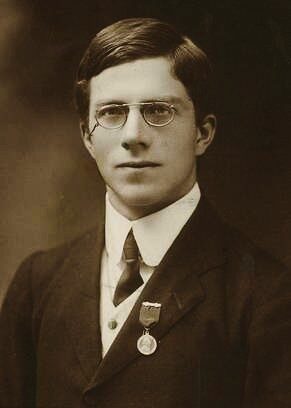
Ronald Fisher
Ronald Fisher was a British statistician, evolutionary biologist and geneticist. Born February 17, 1890, in East Finchley. Died July 29, 1962, in Adelaide. Positions held include president of the Royal Statistical Society (1952–1954). Educated at University of Cambridge and Harrow School. Awards include Fellow of the Royal Society, Copley Medal and Royal Medal.
Facts
47 facts · 2 confirmed by two sources · 25 cited · 19 from one source · 1 where the sources disagree
What’s different
- Cause of death: we show colorectal cancer (Sources disagree). Wikidata also lists embolism
Where this comes from
Papalocal keeps its own record. It started from these sources; what each one said is kept here as it was copied, so a change on their side never changes this page by itself. Tap one to read its version.
What Wikidata says · copied November 16, 2026 · revision 2566003153
- Described as
- British statistician, evolutionary biologist and geneticist (1890–1962)
- Other names
- Ronald A. Fisher, Ronald Aylmer Fisher, R. A. Fisher, Sir Ronald Fisher, Sir Ronald Aylmer Fisher
- Born
- February 17, 1890 · 9 references
- Died
- July 29, 1962 · 6 references
- Born in
- East Finchley · 1 reference
- Died in
- Adelaide · 2 references
- Buried in
- St Peter's Cathedral · 2 references
- Cause of death
- colorectal cancer · 1 reference; embolism · 1 reference
- Citizen of
- United Kingdom
- Occupation
- mathematician · 1 reference; geneticist · 1 reference; statistician · 2 references; astronomer · 1 reference; biostatistician
- Positions held
- president of the Royal Statistical Society (1952–1954) · 1 reference
- Worked for
- University College London (1933–1943) · 1 reference; Rothamsted Research (1919–1933) · 2 references; University of Adelaide (1959–1962) · 1 reference; University of Cambridge (1943–1959) · 1 reference; Rugby School (1915–1919) · 1 reference
- Education
- University of Cambridge (1909–1912) · 1 reference; Harrow School (1904–1909) · 2 references; Gonville and Caius College · 1 reference
- Member of
- Royal Society of London; German Academy of Sciences Leopoldina; Royal Swedish Academy of Sciences; Pontifical Academy of Sciences · 1 reference; American Academy of Arts and Sciences; American Philosophical Society (1941–) · 1 reference; National Academy of Sciences (1948–); Royal Statistical Society
- Awards
- Fellow of the Royal Society (1929) · 1 reference; Copley Medal (1955) · 1 reference; Royal Medal (1938); Darwin Medal (1948) · 1 reference; Darwin–Wallace Medal (1958) · 1 reference; Croonian Medal and Lecture (1953); Guy Medal in Gold (1946); honorary doctor of the University of Calcutta; Knight Bachelor (1952) · 1 reference
- Field
- statistics; genetics
- Spouse
- Ruth Eileen Guinness (1917–) · 2 references
- Children
- George Fisher Fisher · 1 reference; Joan Fisher Box · 1 reference
- Religion
- Church of England; Anglicanism
- Lived in
- United Kingdom · 1 reference; Australia (1959–) · 1 reference
- Wikipedias with a page
- 65
Wikidata item Q216723 (wikidata.org/wiki/Q216723), public domain (CC0). Copied November 16, 2026.
What Wikipedia says · copied November 16, 2026 · revision 1385042813
Sir Ronald Aylmer Fisher (17 February 1890 – 29 July 1962) was an English polymath who was active as a mathematician, statistician, biologist, geneticist, and academic. He has been described as "a genius who almost single-handedly created the foundations for modern statistical science" and "the single most important figure in 20th century statistics". In genetics, Fisher was the one to most comprehensively combine the ideas of Gregor Mendel and Charles Darwin, as his work used mathematics to combine Mendelian genetics and natural selection; this contributed to the revival of Darwinism in the early 20th-century revision of the theory of evolution known as the modern synthesis. For his contributions to biology, Richard Dawkins declared Fisher to be the greatest of Darwin's successors. He is also considered one of the founding fathers of neo-Darwinism. According to statistician Jeffrey T. Leek, Fisher is the most influential scientist of all time on the basis of the number of citations of his contributions.
From 1919, he worked at the Rothamsted Experimental Station for 14 years; there, he analyzed its immense body of data from crop experiments since the 1840s, and developed the analysis of variance (ANOVA). He established his reputation there in the following years as a biostatistician. Fisher also made fundamental contributions to multivariate statistics.
Fisher founded quantitative genetics, and, together with J. B. S. Haldane and Sewall Wright, is known as one of the three principal founders of population genetics. Fisher outlined Fisher's principle, the Fisherian runaway, the sexy son hypothesis theories of sexual selection, parental investment, and also pioneered linkage analysis and gene mapping. On the other hand, as the founder of modern statistics, Fisher made countless contributions, including creating the modern method of maximum likelihood and deriving the properties of maximum likelihood estimators, fiducial inference, the derivation of various sampling distributions, founding the principles of the design of experiments, and much more. Fisher's famous 1921 paper alone has been described as "arguably the most influential article" on mathematical statistics in the twentieth century, and equivalent to "Darwin on evolutionary biology, Gauss on number theory, Kolmogorov on probability, and Adam Smith on economics", and is credited with completely revolutionizing statistics. For his influence and numerous fundamental contributions, he has been described as "the most original evolutionary biologist of the twentieth century" and as "the greatest statistician of all time". His work is further credited with later initiating the Human Genome Project. Fisher also contributed to the understanding of human blood groups.
Fisher has also been praised as a pioneer of the Information Age. His work on a mathematical theory of information ran parallel to the work of Claude Shannon and Norbert Wiener, though based on statistical theory. A concept to have come out of his work is that of Fisher information. He also had ideas about social sciences, which have been described as a "foundation for evolutionary social sciences".
Fisher held strong views on race and eugenics, insisting on racial differences, although there is debate as to whether Fisher supported scientific racism (see § Views on race). He was the Galton Professor of Eugenics at University College London and editor of the Annals of Eugenics. Due to Fisher's association with eugenics, a number of institutions – including his alma mater Gonville and Caius College and his former employer University College London – have removed commemorations of their links to him.
- Born, in its opening lines
- February 17, 1890
- Died, in its opening lines
- July 29, 1962
From the Wikipedia article “Ronald Fisher” (en.wikipedia.org/wiki/Ronald_Fisher), by its contributors, under CC BY-SA 4.0 (creativecommons.org/licenses/by-sa/4.0/). Copied November 16, 2026; not changed.
Confirmed Two sources agree. Cited One source, and it names where it got it. One source One source, without a reference of its own. Sources disagree The sources disagree. We show the best-supported value and keep theirs below.
