
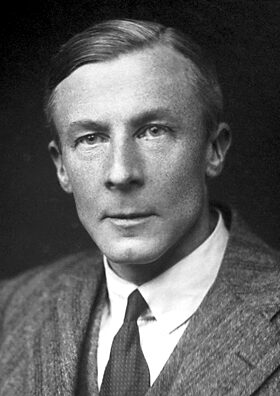
Edgar Douglas Adrian
Edgar Douglas Adrian was an English electrophysiologist. Born November 30, 1889, in Hampstead. Died August 4, 1977, in Cambridge. Positions held include member of the House of Lords (1955–1977), President of the Royal Society (1950–1955) and Chancellor of the University of Cambridge (1967–1976). Educated at Trinity College and Westminster School. Awards include Fellow of the Royal Society, Nobel Prize in Physiology or Medicine and Copley Medal.
Facts
54 facts · 2 confirmed by two sources · 19 cited · 33 from one source
Where this comes from
Papalocal keeps its own record. It started from these sources; what each one said is kept here as it was copied, so a change on their side never changes this page by itself. Tap one to read its version.
What Wikidata says · copied November 16, 2026 · revision 2567325816
- Described as
- English electrophysiologist (1889-1977)
- Other names
- Lord Edgar Adrian, Edgar Adrian, 1st Baron Adrian, Lord Edgar Douglas Adrian
- Born
- November 30, 1889 · 15 references
- Died
- August 4, 1977 · 16 references
- Born in
- Hampstead · 1 reference
- Died in
- Cambridge · 1 reference
- Buried in
- Trinity College Chapel
- Citizen of
- United Kingdom
- Occupation
- physician; politician · 1 reference; neuroscientist; university teacher; physiologist · 2 references; anatomist · 1 reference
- Positions held
- member of the House of Lords (1955–1977) · 1 reference; President of the Royal Society (1950–1955) · 1 reference; Chancellor of the University of Cambridge (1967–1976); Master of Trinity College, Cambridge (1951–1965); Vice-Chancellor of the University of Cambridge (1957–1959); President of the Royal Society of Medicine (1960–1962)
- Worked for
- University of Cambridge (1937–1951)
- Education
- Trinity College; Westminster School
- Member of
- Royal Society of London (1923–); German Academy of Sciences Leopoldina; Royal Swedish Academy of Sciences; American Academy of Arts and Sciences; Royal Netherlands Academy of Arts and Sciences; Académie Nationale de Médecine; National Academy of Sciences (1941–); Royal Academy of Science, Letters and Fine Arts of Belgium; American Philosophical Society (1938–); Accademia Nazionale dei Lincei (1947–) · 1 reference
- Awards
- Fellow of the Royal Society; Nobel Prize in Physiology or Medicine (1932) · 2 references; Copley Medal (1946) · 1 reference; Royal Medal (1934); Karl Spencer Lashley Award (1961) · 1 reference; Albert Medal (1953); Croonian Medal and Lecture (1931); Honorary Fellow of the Royal Society of Edinburgh; Fellow of the American Academy of Arts and Sciences; Baly Medal (1929); Order of Merit (1942); doctor honoris causa from the University of Lyon (1946) · 1 reference; doctor honoris causa from the University of Paris (1957) · 1 reference; Honorary Fellow of the British Psychological Society
- Field
- electrophysiology
- Spouse
- Hester Adrian, Baroness Adrian (1923–) · 2 references
- Children
- Richard Adrian, 2nd Baron Adrian · 2 references; Anne Adrian · 2 references; Jennet Adrian · 2 references
- Father
- Alfred Douglas Adrian · 2 references
- Mother
- Flora Lavinia Barton · 2 references
- Siblings
- Harold Douglas Adrian · 1 reference; John Adrian · 1 reference
- Wikipedias with a page
- 63
Wikidata item Q231292 (wikidata.org/wiki/Q231292), public domain (CC0). Copied November 16, 2026.
What Wikipedia says · copied November 16, 2026 · revision 1380613548
Edgar Douglas Adrian, 1st Baron Adrian (30 November 1889 – 4 August 1977) was an English electrophysiologist and recipient of the 1932 Nobel Prize for Physiology, won jointly with Sir Charles Sherrington for work on the function of neurons. He provided experimental evidence for the all-or-none law of nerves.
- Born, in its opening lines
- November 30, 1889
- Died, in its opening lines
- August 4, 1977
From the Wikipedia article “Edgar Adrian” (en.wikipedia.org/wiki/Edgar_Adrian), by its contributors, under CC BY-SA 4.0 (creativecommons.org/licenses/by-sa/4.0/). Copied November 16, 2026; not changed.
Confirmed Two sources agree. Cited One source, and it names where it got it. One source One source, without a reference of its own. Sources disagree The sources disagree. We show the best-supported value and keep theirs below.
