
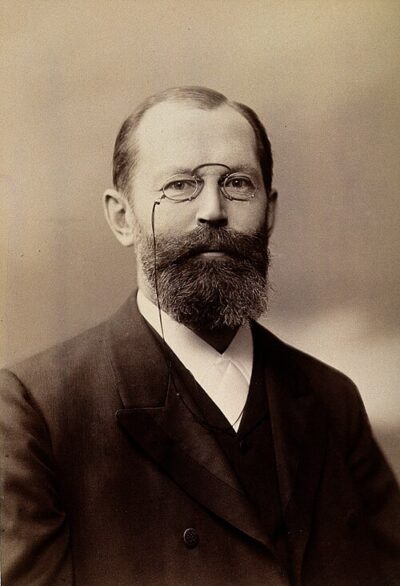
Emil Fischer
Emil Fischer was a German chemist. Born October 9, 1852, in Euskirchen. Died July 15, 1919, in Berlin. Educated at University of Bonn and University of Strasbourg. Awards include Faraday Lectureship Prize, Pour le Mérite for Sciences and Arts order and Nobel Prize in Chemistry.
Facts
43 facts · 2 confirmed by two sources · 14 cited · 27 from one source
Where this comes from
Papalocal keeps its own record. It started from these sources; what each one said is kept here as it was copied, so a change on their side never changes this page by itself. Tap one to read its version.
What Wikidata says · copied November 16, 2026 · revision 2565843520
- Described as
- German chemist (1852–1919)
- Other names
- Hermann Emil Louis Fischer, Hermann Emil Fischer
- Born
- October 9, 1852 · 9 references
- Died
- July 15, 1919 · 6 references
- Born in
- Euskirchen · 2 references
- Died in
- Berlin · 3 references
- Buried in
- Friedhof Wannsee, Lindenstraße
- Citizen of
- German Empire; Germany
- Occupation
- biochemist; chemist · 1 reference; university teacher; organic chemist
- Worked for
- LMU Munich; University of Würzburg; Humboldt-Universität zu Berlin; University of Erlangen–Nuremberg; University of Strasbourg
- Education
- University of Bonn; University of Strasbourg
- Member of
- Royal Society of London (1899–) · 1 reference; Göttingen Academy of Sciences and Humanities in Lower Saxony (1907–) · 1 reference; Royal Swedish Academy of Sciences; Royal Physiographic Society in Lund; American Academy of Arts and Sciences (1908–) · 1 reference; Accademia Nazionale dei Lincei (1899–) · 1 reference; Russian Academy of Sciences (1913–) · 1 reference; Royal Prussian Academy of Sciences; Accademia Nazionale delle Scienze detta dei XL; Académie Nationale de Médecine
- Awards
- Faraday Lectureship Prize (1907) · 1 reference; Pour le Mérite for Sciences and Arts order; Nobel Prize in Chemistry (1902) · 2 references; Elliott Cresson Medal (1913) · 1 reference; Helmholtz Medal (1909); Cothenius Medal (1898); Bavarian Maximilian Order for Science and Art (1898); Davy Medal (1890) · 1 reference; Foreign Member of the Royal Society (1899) · 1 reference; Baly Medal (1909); honorary member of the Physics Association (Frankfurt am Main, Germany) (1901)
- Field
- chemistry
- Spouse
- Agnes Gerlach
- Children
- Hermann Fischer · 1 reference
- Father
- Laurenz Fischer · 1 reference
- Wikipedias with a page
- 90
Wikidata item Q70554 (wikidata.org/wiki/Q70554), public domain (CC0). Copied November 16, 2026.
What Wikipedia says · copied November 16, 2026 · revision 1378186598
Hermann Emil Louis Fischer (German: [ˈeːmiːl ˈfɪʃɐ] ; 9 October 1852 – 15 July 1919) was a German chemist and 1902 recipient of the Nobel Prize in Chemistry. He discovered the Fischer esterification. He also developed the Fischer projection, a symbolic way of drawing asymmetric carbon atoms. He also hypothesized the lock and key mechanism of enzyme action. He never used his first given name, and was known throughout his life simply as Emil Fischer.
- Born, in its opening lines
- October 9, 1852
- Died, in its opening lines
- July 15, 1919
From the Wikipedia article “Emil Fischer” (en.wikipedia.org/wiki/Emil_Fischer), by its contributors, under CC BY-SA 4.0 (creativecommons.org/licenses/by-sa/4.0/). Copied November 16, 2026; not changed.
Confirmed Two sources agree. Cited One source, and it names where it got it. One source One source, without a reference of its own. Sources disagree The sources disagree. We show the best-supported value and keep theirs below.
